Department of Obstetrics and Gynecology, Peking University Third Hospital, Beijing, China.
National Clinical Research Centre for Obstetrics and Gynecology, Beijing, China.
Front Endocrinol (Lausanne). 2022 Oct 14;13:967102. doi: 10.3389/fendo.2022.967102. eCollection 2022.
Despite the important clinical significance, limited data on the joint contribution of prepregnancy body mass index (BMI) and gestational weight gain (GWG) to preeclampsia, the second leading cause of maternal mortality worldwide. This study aimed to estimate the risk of preeclampsia by GWG among women with varied prepregnancy BMI.
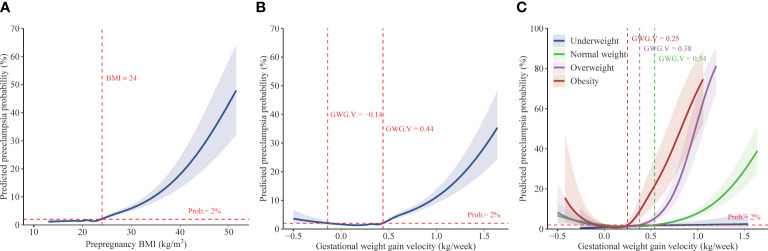
We conducted a retrospective cohort study using data of 117 738 singleton pregnant women aged 18-49 years from 150 maternity hospitals in China between 2015 and 2018. GWG was calculated as the measured weight at the time of preeclampsia assessment minus prepregnancy weight; GWG velocity was calculated as the GWG divided by the gestational age at weighing. The non-linear associations of GWG with preeclampsia were examined by restricted cubic spline regression analysis according to prepregnancy BMI. The association of the GWG categories with preeclampsia was further examined by performing robust Poisson regression stratified by the prepregnancy BMI categories.
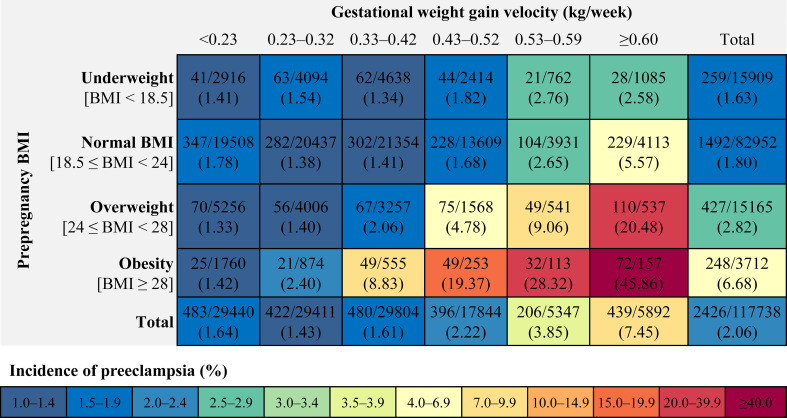
Among participants, 2426 (2.06%) were diagnosed with preeclampsia. Compared to women with normal BMI, those who were overweight and obese had 1.92- fold (95%CI, 1.73-2.14) and 5.06- fold (95%CI, 4.43-5.78) increased risks for preeclampsia, respectively. The association of GWG velocity with preeclampsia was presented as a J-shaped curve with the varied inflexion point (where the rate of preeclampsia was 2%), which was 0.54, 0.38, and 0.25 kg/week in women with normal BMI, overweight, and obesity, respectively; a steep risk rise was observed along with GWG velocity beyond the inflexion points. The overall adjusted relative risk for preeclampsia was calculated among women with the different GWG categories of GWG.
The findings highlight that high prepregnancy BMI and exceed GWG contributed to increased risk of preeclampsia with a superimposed effect and underscore the need to optimize the recommendations for GWG for women with different prepregnancy BMI.
尽管孕前体重指数(BMI)和妊娠体重增加(GWG)与子痫前期密切相关,后者是全球导致孕产妇死亡的第二大原因,但目前关于这两者联合作用的数据有限。本研究旨在评估不同孕前 BMI 孕妇的 GWG 与子痫前期发生风险的关系。
我们在中国 150 家妇产科医院开展了一项回顾性队列研究,纳入了 2015 年至 2018 年期间年龄在 18-49 岁的 117738 例单胎孕妇。GWG 定义为子痫前期评估时的体重减去孕前体重;GWG 速度定义为 GWG 除以称重时的孕周。根据孕前 BMI 采用限制性立方样条回归分析评估 GWG 与子痫前期的非线性关系。根据孕前 BMI 类别,采用稳健泊松回归分层分析 GWG 类别与子痫前期的关系。
在参与者中,2426 例(2.06%)被诊断为子痫前期。与正常 BMI 孕妇相比,超重和肥胖孕妇发生子痫前期的风险分别增加了 1.92 倍(95%CI,1.73-2.14)和 5.06 倍(95%CI,4.43-5.78)。GWG 速度与子痫前期的关系呈 J 型曲线,拐点处(子痫前期发生率为 2%)分别为正常 BMI、超重和肥胖孕妇的 0.54、0.38 和 0.25 kg/周;拐点后 GWG 速度的增加与子痫前期风险的急剧上升相关。对不同 GWG 类别孕妇的 GWG 进行整体调整后,计算子痫前期的相对风险。
本研究结果强调,孕前 BMI 高和 GWG 增加均与子痫前期风险增加相关,且存在叠加效应,提示需要针对不同孕前 BMI 孕妇优化 GWG 建议。