Moliterno Paula, Donangelo Carmen Marino, Borgarello Luciana, Oviedo Leticia, Nogara Romina, Olascoaga Alicia, Boggia José
Escuela de Nutrición Universidad de la República Montevideo Uruguay Escuela de Nutrición, Universidad de la República, Montevideo, Uruguay.
Laboratorio de Patología Clínica Hospital de Clínicas Universidad de la República Montevideo Uruguay Laboratorio de Patología Clínica, Hospital de Clínicas, Universidad de la República, Montevideo, Uruguay.
Rev Panam Salud Publica. 2022 Oct 25;46:e180. doi: 10.26633/RPSP.2022.180. eCollection 2022.
To evaluate the association between knowledge, attitudes, and behavior (KAB) towards sodium use and sodium intake measured by 24-hour urinary collection in an adult cohort from Uruguay (Genotype Phenotype and Environment of Hypertension Study, GEFA-HT-UY).
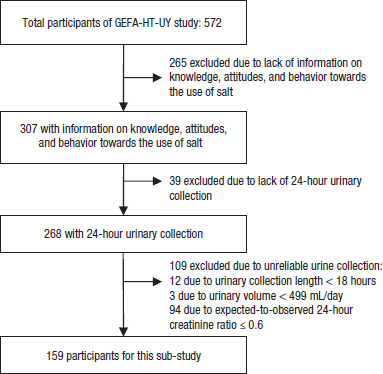
In a cross-sectional study (n = 159), a single 24-hour urinary sample, participants' physical, biochemical and blood pressure measurements and questionnaire data were collected. The association between KAB and 24-hour urinary sodium excretion was assessed using general linear models.
Mean age of participants was 49.8±15.5 years, 67.9% were women, and mean 24-hour urinary sodium excretion was 3.6±1.7 g/day. Although 90.6% of participants exceeded the maximum recommended intake as indicated by urinary sodium excretion, more than half misperceived their actual intake, reporting consuming "the right amount." Almost three-quarters of the participants reported being concerned about the amount of sodium in their diet, but only 52.8% reported taking action to control it. Lack of procedural knowledge was observed. There was no association between KAB and sodium use and intake assessed by 24-hour urinary sodium excretion.
The lack of association between KAB towards the use of sodium and intake measured by 24-hour urinary excretion reflects the need to support people with opportunities and motivations to reduce sodium consumption. Structural actions to promote an adequate food environment, such as the effective implementation of the front-of-package nutrition labeling in Uruguay, are positive steps.
在乌拉圭的一个成人队列(高血压研究的基因型、表型和环境,GEFA-HT-UY)中,评估关于钠摄入的知识、态度和行为(KAB)与通过24小时尿样收集测量的钠摄入量之间的关联。
在一项横断面研究(n = 159)中,收集了单次24小时尿样、参与者的身体、生化和血压测量数据以及问卷数据。使用一般线性模型评估KAB与24小时尿钠排泄之间的关联。
参与者的平均年龄为49.8±15.5岁,67.9%为女性,24小时尿钠排泄的平均值为3.6±1.7克/天。尽管90.6%的参与者尿钠排泄量超过了推荐的最大摄入量,但超过一半的人错误感知了自己的实际摄入量,报告称摄入“适量”。近四分之三的参与者表示担心饮食中的钠含量,但只有52.8%的人报告采取了控制措施。观察到缺乏程序知识。KAB与通过24小时尿钠排泄评估的钠使用和摄入量之间没有关联。
关于钠使用的KAB与通过24小时尿排泄测量的摄入量之间缺乏关联,这反映出需要为人们提供减少钠消耗的机会和动机。促进适宜食物环境的结构性行动,如在乌拉圭有效实施包装正面营养标签,是积极的举措。