Centre of Studies & Research, Ministry of Health, Muscat, Oman.
The Research Council, Seeb, Oman.
BMJ Open. 2020 Oct 23;10(10):e037012. doi: 10.1136/bmjopen-2020-037012.
To estimate population sodium and potassium intakes and explore knowledge, attitudes and behaviour (KAB) towards the use of salt in adults in the Sultanate of Oman.
National cross-sectional population-based survey.
Proportional random samples, representative of Omani adults (18 years or older), were obtained from all governorates of the Sultanate of Oman.
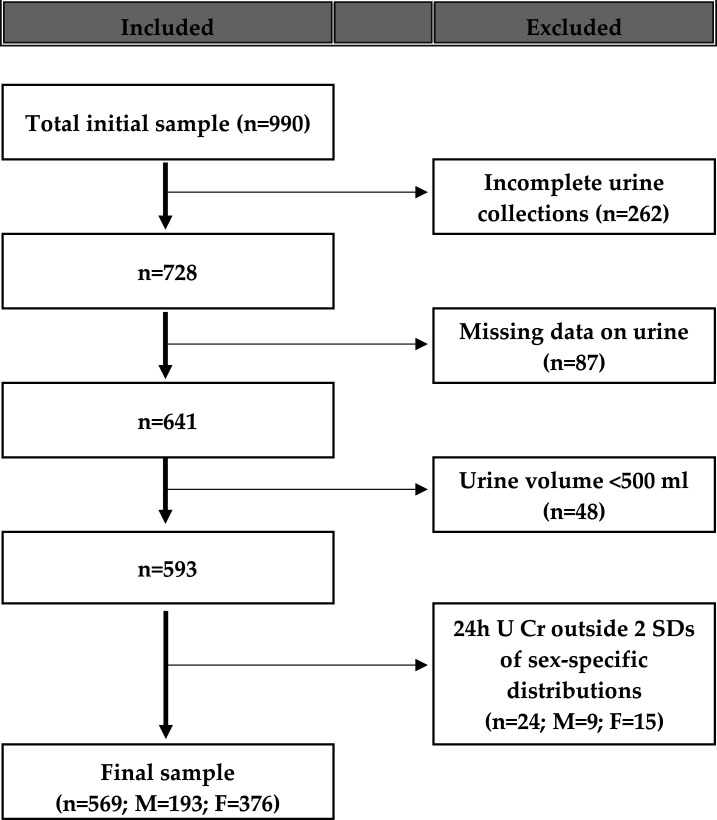
Five hundred and sixty-nine (193 men, 376 women; 18 years or older) were included in the analysis (response rate 57%). Mean age was 39.4 years (SD 13.1). Participants attended a screening including demographic, anthropometric and physical measurements.
We assessed dietary sodium, potassium and creatinine by 24-hour urinary sodium (UNa), potassium (UK) and creatinine (UCr) excretions. We collected KAB by a questionnaire on an electronic tablet.
Mean UNa was 144.3 (78.8) mmol/day, equivalent to 9.0 g of salt/day and potassium excretion 52.6 (32.6) mmol/day, equivalent to 2.36 g/day, after adjusting for non-urinary losses. Men ate significantly more sodium and potassium than women. Only 22% of the sample had a salt intake below the WHO recommended target of 5 g/day and less than 10% met WHO targets for potassium excretion (>90 mmol/day). While 89.1% of those interviewed knew that consuming too much salt could cause serious health problems and only 6.9% felt they were using too much added salt, one in two participants used always or often salt, salty seasonings or salty sauces in cooking or when preparing food at home.
In the Sultanate of Oman, salt consumption is higher and potassium consumption lower than recommended by WHO, both in men and in women. The present data provide, for the first time, evidence to support a national programme of population salt reduction to prevent the increasing burden of cardiovascular disease in the area.
评估阿曼成年人的钠和钾摄入量,并探讨他们对盐使用的知识、态度和行为(KAB)。
全国性的横断面人群为基础的调查。
从阿曼的所有省份获得具有代表性的阿曼成年人(18 岁或以上)的比例随机样本。
569 人(男性 193 人,女性 376 人;18 岁或以上)纳入分析(应答率 57%)。平均年龄为 39.4 岁(SD 13.1)。参与者参加了包括人口统计学、人体测量和身体测量的筛选。
我们通过 24 小时尿钠(UNa)、钾(UK)和肌酐(UCr)排泄来评估膳食钠、钾和肌酐。我们通过电子平板电脑上的问卷收集 KAB。
调整非尿丢失后,平均 UNa 为 144.3(78.8)mmol/天,相当于 9.0g 盐/天,钾排泄 52.6(32.6)mmol/天,相当于 2.36g/天。男性摄入的钠和钾明显多于女性。只有 22%的样本盐摄入量低于世界卫生组织推荐的 5g/天的目标,不到 10%的样本符合世界卫生组织的钾排泄目标(>90mmol/天)。虽然 89.1%的受访者知道摄入过多的盐会导致严重的健康问题,只有 6.9%的人觉得他们使用的添加盐太多,但一半的参与者在烹饪或在家准备食物时总是或经常使用盐、咸调味料或咸酱汁。
在阿曼,男女的盐摄入量都高于世界卫生组织推荐的量,钾摄入量也低于推荐量。本研究首次提供了证据支持全国范围内的减盐计划,以预防该地区心血管疾病负担的增加。