Institute for Public Health, National Institutes of Health, Ministry of Health Malaysia, Selangor, Shah Alam, Malaysia.
Centre for Environmental and Preventive, Medicine Wolfson Institute of Preventive Medicine, Queen Mary University of London, London, UK.
J Health Popul Nutr. 2021 May 31;40(Suppl 1):5. doi: 10.1186/s41043-021-00231-4.
Excessive intake of sodium is a major public health concern. Information on knowledge, perception, and practice (KPP) related to sodium intake in Malaysia is important for the development of an effective salt reduction strategy. This study aimed to investigate the KPP related to sodium intake among Malaysian adults and to determine associations between KPP and dietary sodium intake.
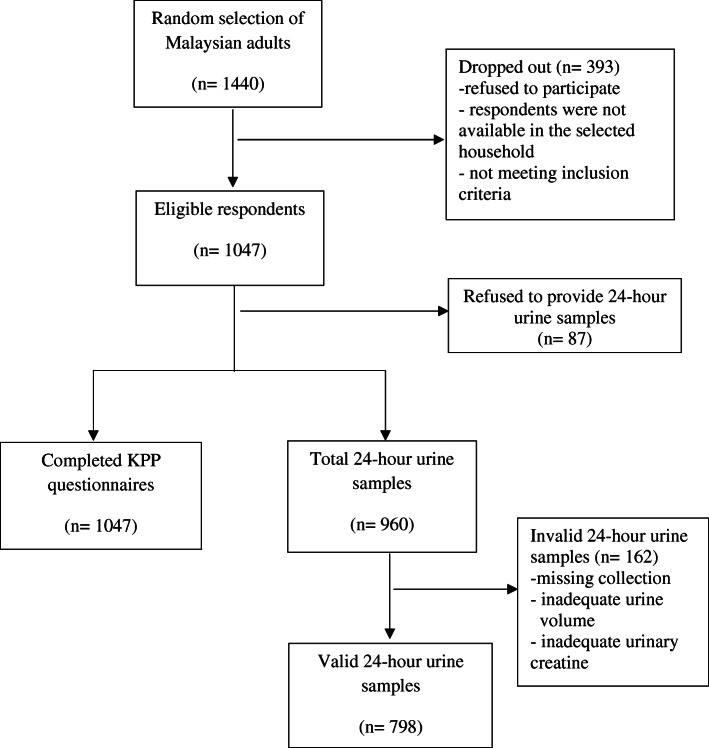
Data were obtained from Malaysian Community Salt Survey (MyCoSS) which is a nationally representative survey with proportionate stratified cluster sampling design. A pre-tested face-to-face questionnaire was used to collect information on socio-demographic background, and questions from the World Health Organization/Pan American Health Organization were adapted to assess the KPP related to sodium intake. Dietary sodium intake was determined using single 24-h urinary sodium excretion. Respondents were categorized into two categories: normal dietary sodium intake (< 2000 mg) and excessive dietary sodium intake (≥ 2000 mg). Out of 1440 respondents that were selected to participate, 1047 respondents completed the questionnaire and 798 of them provided valid urine samples. Factors associated with excessive dietary sodium intake were analyzed using complex sample logistic regression analysis.
Majority of the respondents knew that excessive sodium intake could cause health problems (86.2%) and more than half of them (61.8%) perceived that they consume just the right amount of sodium. Overall, complex sample logistic regression analysis revealed that excessive dietary sodium intake was not significantly associated with KPP related to sodium intake among respondents (P > 0.05).
The absence of significant associations between KPP and excessive dietary sodium intake suggests that salt reduction strategies should focus on sodium reduction education includes measuring actual dietary sodium intake and educating the public about the source of sodium. In addition, the relationship between the authority and food industry in food reformulation needs to be strengthened for effective dietary sodium reduction in Malaysia.
摄入过多的钠是一个主要的公共卫生问题。了解马来西亚人关于钠摄入量的知识、看法和做法(KPP)对于制定有效的减盐策略非常重要。本研究旨在调查马来西亚成年人与钠摄入量相关的 KPP,并确定 KPP 与膳食钠摄入量之间的关系。
数据来自马来西亚社区盐调查(MyCoSS),这是一项具有比例分层聚类抽样设计的全国代表性调查。使用经过预测试的面对面问卷收集社会人口统计学背景信息,并采用世界卫生组织/泛美卫生组织的问题来评估与钠摄入量相关的 KPP。膳食钠摄入量通过单次 24 小时尿钠排泄量来确定。受访者分为两类:正常膳食钠摄入量(<2000mg)和过量膳食钠摄入量(≥2000mg)。在被选中参与的 1440 名受访者中,有 1047 名完成了问卷,其中 798 名提供了有效的尿液样本。使用复杂样本逻辑回归分析来分析与过量膳食钠摄入相关的因素。
大多数受访者知道过量摄入钠会导致健康问题(86.2%),超过一半的人(61.8%)认为他们摄入的钠量正好。总体而言,复杂样本逻辑回归分析显示,受访者的 KPP 与过量膳食钠摄入之间没有显著关联(P>0.05)。
KPP 与过量膳食钠摄入之间不存在显著关联表明,减盐策略应侧重于钠减少教育,包括测量实际的膳食钠摄入量,并向公众宣传钠的来源。此外,需要加强政府和食品行业在食品配方改革方面的关系,以在马来西亚实现有效的膳食钠减少。