The George Institute for Global Health, Sydney Medical School, The University of Sydney, PO BOX M201, Missenden Road, Camperdown, Sydney, NSW, Australia.
Int J Behav Nutr Phys Act. 2014 Apr 4;11(1):47. doi: 10.1186/1479-5868-11-47.
Salt reduction efforts usually have a strong focus on consumer education. Understanding the association between salt consumption levels and knowledge, attitudes and behaviours towards salt should provide insight into the likely effectiveness of education-based programs.
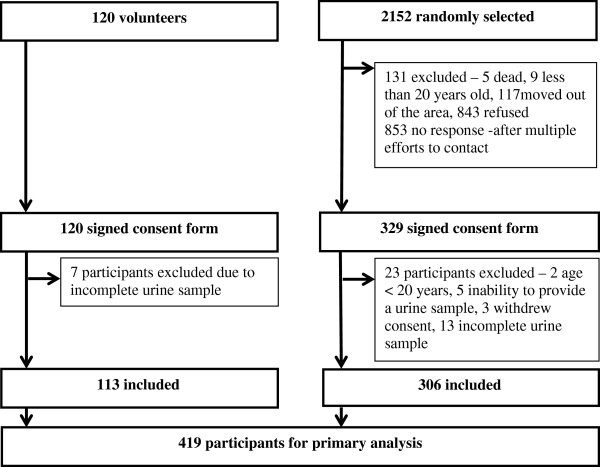
A single 24-hour urine sample and a questionnaire describing knowledge, attitudes and behaviours was obtained from 306 randomly selected participants and 113 volunteers from a regional town in Australia.
Mean age of all participants was 55 years (range 20-88), 55% were women and mean 24-hour urinary salt excretion was 8.8(3.6) g/d. There was no difference in salt excretion between the randomly selected and volunteer sample. Virtually all participants (95%) identified that a diet high in salt can cause serious health problems with the majority of participants (81%) linking a high salt diet to raised blood pressure. There was no difference in salt excretion between those who did 8.7(2.1) g/d and did not 7.5(3.3) g/d identify that a diet high in salt causes high blood pressure (p=0.1). Nor was there a difference between individuals who believed they consumed "too much" 8.9(3.3) g/d "just the right amount" 8.4(2.6) g/d or "too little salt" 9.1(3.7) g/d (p=0.2). Likewise, individuals who indicated that lowering their salt intake was important 8.5(2.9) g/d vs. not important 8.8(2.4) g/d did not have different consumption levels (p=0.4).
The absence of a clear association between knowledge, attitudes and behaviours towards salt and actual salt consumption suggests that interventions focused on knowledge, attitudes and behaviours alone may be of limited efficacy.
减盐工作通常非常注重消费者教育。了解盐摄入量与对盐的知识、态度和行为之间的关系,应该可以深入了解基于教育的计划的有效性。
从澳大利亚一个地区城镇中随机抽取的 306 名参与者和 113 名志愿者中,每人采集一次 24 小时尿液样本和一份描述知识、态度和行为的问卷。
所有参与者的平均年龄为 55 岁(范围 20-88 岁),55%为女性,平均 24 小时尿盐排泄量为 8.8(3.6)g/d。随机抽取的样本和志愿者样本的盐排泄量没有差异。几乎所有参与者(95%)都认为高盐饮食会导致严重的健康问题,大多数参与者(81%)将高盐饮食与高血压联系起来。盐排泄量在那些认为高盐饮食会导致高血压的人和那些不认为高盐饮食会导致高血压的人之间没有差异(p=0.1)。那些认为自己摄入“过多”盐(8.9(3.3)g/d)、“适量”盐(8.4(2.6)g/d)或“过少盐”(9.1(3.7)g/d)的人之间也没有差异(p=0.2)。同样,那些认为降低盐摄入量很重要的人和那些认为不重要的人之间的盐摄入量也没有差异(p=0.4)。
对盐的知识、态度和行为与实际盐摄入量之间缺乏明确的关联表明,仅关注知识、态度和行为的干预措施可能效果有限。