Hu Yingying, Tong Zijia, Huang Xuewei, Qin Juan-Juan, Lin Lijin, Lei Fang, Wang Wenxin, Liu Weifang, Sun Tao, Cai Jingjing, She Zhi-Gang, Li Hongliang
Department of Cardiology, Renmin Hospital of Wuhan University, Wuhan, China.
Institute of Model Animal, Wuhan University, Wuhan, China.
Front Cardiovasc Med. 2022 Oct 18;9:941917. doi: 10.3389/fcvm.2022.941917. eCollection 2022.
Rheumatic heart disease (RHD) remains the leading cause of preventable death and disability in children and young adults, killing an estimated 320,000 individuals worldwide yearly.
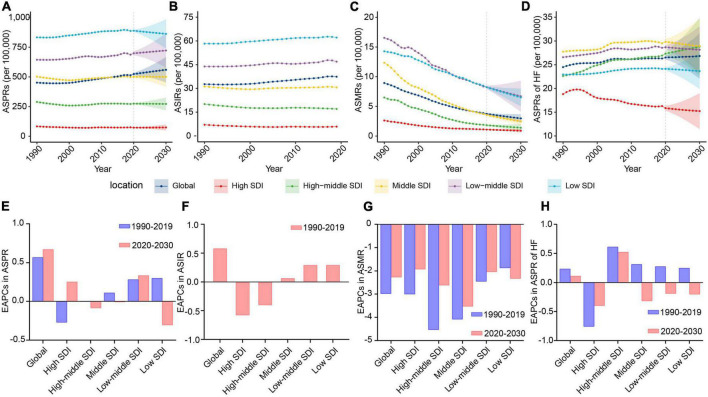
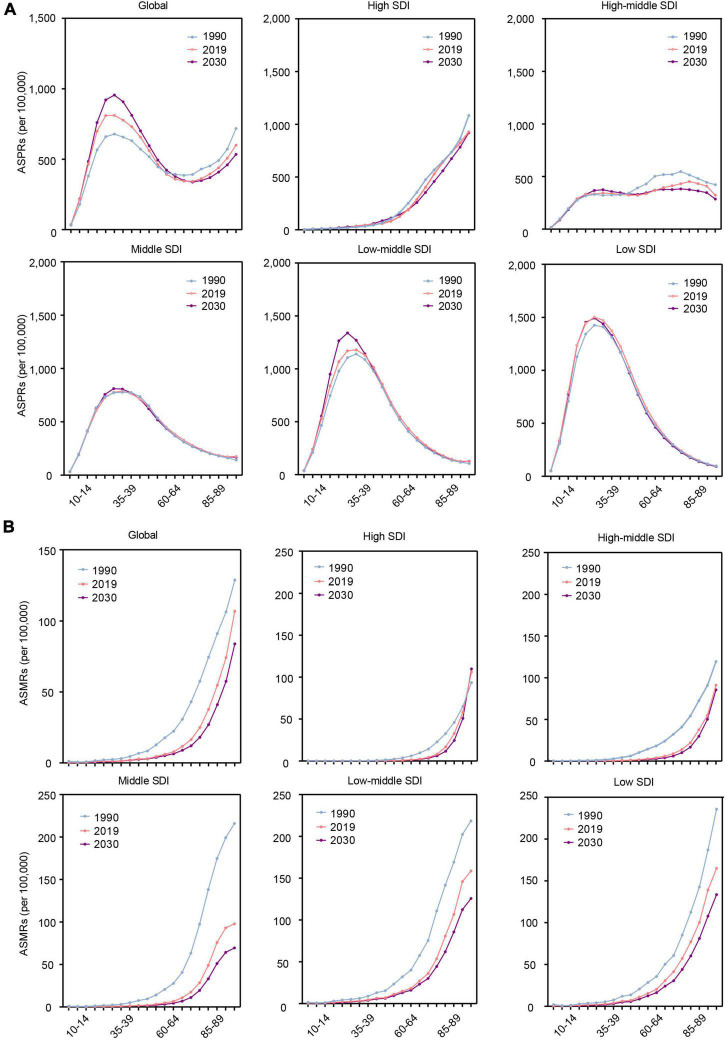
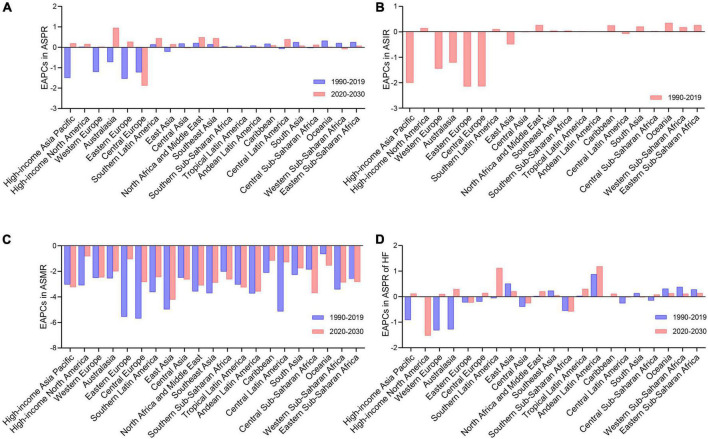
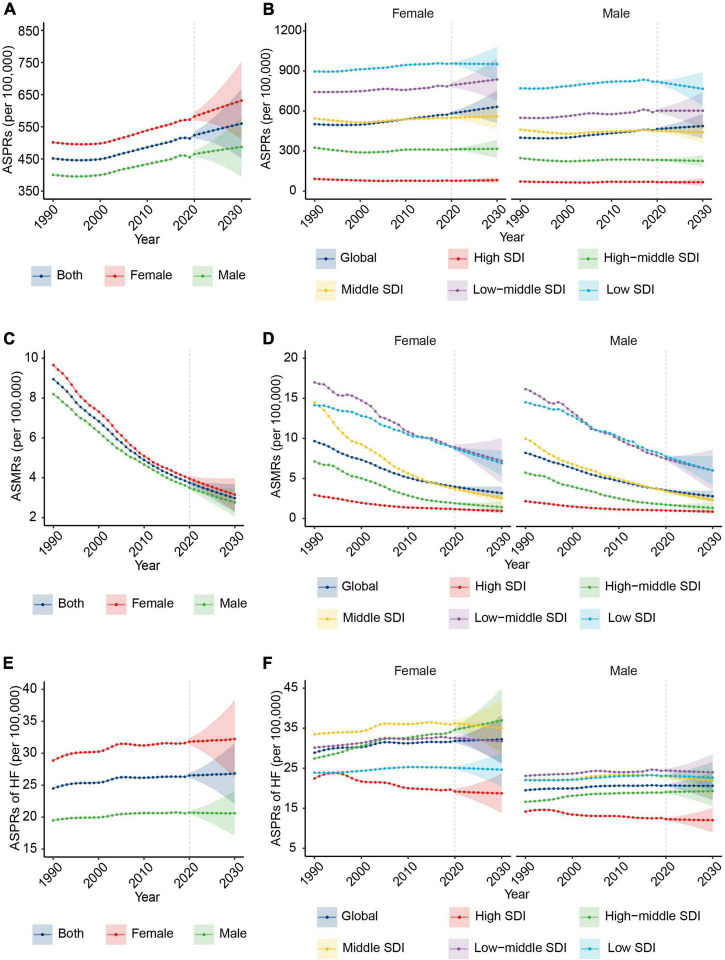
We utilized the Bayesian age-period cohort (BAPC) model to project the change in disease burden from 2020 to 2030 using the data from the Global Burden of Disease (GBD) Study 2019. Then we described the projected epidemiological characteristics of RHD by region, sex, and age.
The global age-standardized prevalence rate (ASPR) and age-standardized incidence rate (ASIR) of RHD increased from 1990 to 2019, and ASPR will increase to 559.88 per 100,000 population by 2030. The global age-standardized mortality rate (ASMR) of RHD will continue declining, while the projected death cases will increase. Furthermore, ASPR and cases of RHD-associated HF will continue rising, and there will be 2,922,840 heart failure (HF) cases in 2030 globally. Female subjects will still be the dominant population compared to male subjects, and the ASPR of RHD and the ASPR of RHD-associated HF in female subjects will continue to increase from 2020 to 2030. Young people will have the highest ASPR of RHD among all age groups globally, while the elderly will bear a greater death and HF burden.
In the following decade, the RHD burden will remain severe. There are large variations in the trend of RHD burden by region, sex, and age. Targeted and effective strategies are needed for the management of RHD, particularly in female subjects and young people in developing regions.
风湿性心脏病(RHD)仍是儿童和青年中可预防死亡和残疾的主要原因,全球每年估计有32万人死亡。
我们利用贝叶斯年龄-时期队列(BAPC)模型,使用2019年全球疾病负担(GBD)研究的数据预测2020年至2030年疾病负担的变化。然后,我们按地区、性别和年龄描述了RHD的预测流行病学特征。
1990年至2019年,RHD的全球年龄标准化患病率(ASPR)和年龄标准化发病率(ASIR)有所上升,到2030年,ASPR将增至每10万人559.88例。RHD的全球年龄标准化死亡率(ASMR)将继续下降,而预测死亡病例数将增加。此外,RHD相关心力衰竭(HF)的ASPR和病例数将继续上升,2030年全球将有2922,840例心力衰竭病例。与男性相比,女性仍将是主要人群,2020年至2030年,女性RHD的ASPR和RHD相关HF的ASPR将继续上升。在全球所有年龄组中,年轻人的RHD的ASPR最高,而老年人将承担更大的死亡和HF负担。
在接下来的十年中,RHD负担仍将很严重。RHD负担的趋势在地区、性别和年龄方面存在很大差异。需要有针对性的有效策略来管理RHD,特别是在发展中地区的女性和年轻人中。