Arık Sercan Ö, Shor Joel, Sinha Rajarishi, Yoon Jinsung, Ledsam Joseph R, Le Long T, Dusenberry Michael W, Yoder Nathanael C, Popendorf Kris, Epshteyn Arkady, Euphrosine Johan, Kanal Elli, Jones Isaac, Li Chun-Liang, Luan Beth, Mckenna Joe, Menon Vikas, Singh Shashank, Sun Mimi, Ravi Ashwin Sura, Zhang Leyou, Sava Dario, Cunningham Kane, Kayama Hiroki, Tsai Thomas, Yoneoka Daisuke, Nomura Shuhei, Miyata Hiroaki, Pfister Tomas
Google Cloud AI, 1170 Bordeaux Dr, Sunnyvale, CA, USA.
Google, Japan, Shibuya, 3-Chrome-21-3, Tokyo, Japan.
NPJ Digit Med. 2021 Oct 8;4(1):146. doi: 10.1038/s41746-021-00511-7.
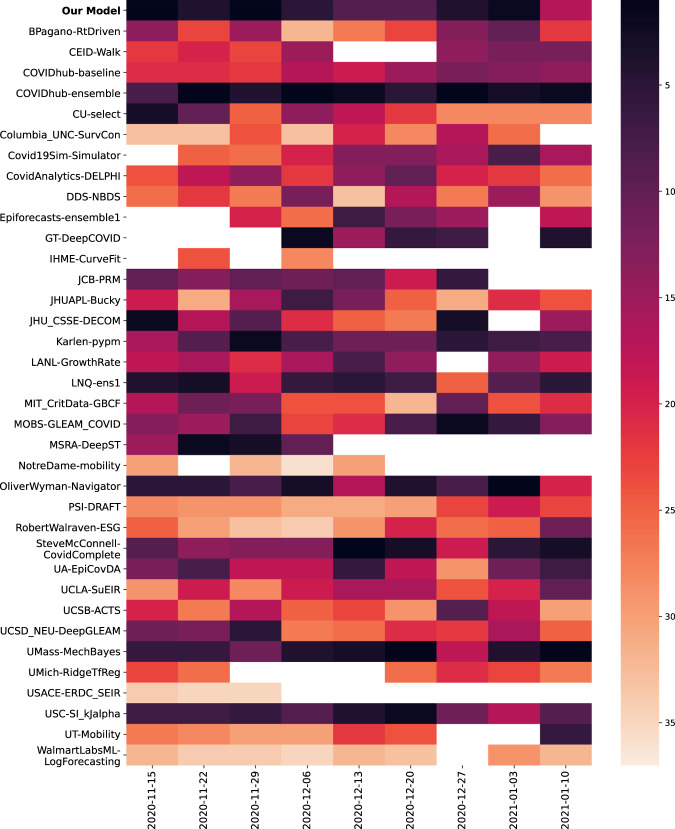
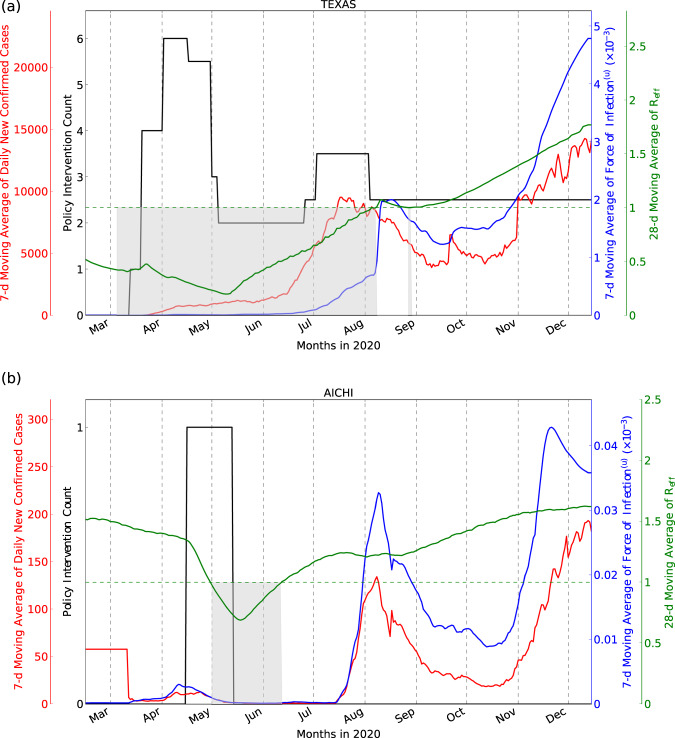
The COVID-19 pandemic has highlighted the global need for reliable models of disease spread. We propose an AI-augmented forecast modeling framework that provides daily predictions of the expected number of confirmed COVID-19 deaths, cases, and hospitalizations during the following 4 weeks. We present an international, prospective evaluation of our models' performance across all states and counties in the USA and prefectures in Japan. Nationally, incident mean absolute percentage error (MAPE) for predicting COVID-19 associated deaths during prospective deployment remained consistently <8% (US) and <29% (Japan), while cumulative MAPE remained <2% (US) and <10% (Japan). We show that our models perform well even during periods of considerable change in population behavior, and are robust to demographic differences across different geographic locations. We further demonstrate that our framework provides meaningful explanatory insights with the models accurately adapting to local and national policy interventions. Our framework enables counterfactual simulations, which indicate continuing Non-Pharmaceutical Interventions alongside vaccinations is essential for faster recovery from the pandemic, delaying the application of interventions has a detrimental effect, and allow exploration of the consequences of different vaccination strategies. The COVID-19 pandemic remains a global emergency. In the face of substantial challenges ahead, the approach presented here has the potential to inform critical decisions.
新冠疫情凸显了全球对可靠疾病传播模型的需求。我们提出了一个人工智能增强的预测建模框架,该框架能对未来4周内新冠确诊死亡人数、病例数和住院人数的预期数量进行每日预测。我们对我们的模型在美国所有州和郡以及日本各县的表现进行了一项国际性的前瞻性评估。在全国范围内,前瞻性部署期间预测新冠相关死亡的事件平均绝对百分比误差(MAPE)在美国始终保持<8%,在日本保持<29%,而累积MAPE在美国保持<2%,在日本保持<10%。我们表明,即使在人口行为发生相当大变化的时期,我们的模型也表现良好,并且对不同地理位置的人口差异具有鲁棒性。我们进一步证明,我们的框架提供了有意义的解释性见解,模型能够准确适应地方和国家的政策干预。我们的框架能够进行反事实模拟,这表明在接种疫苗的同时继续实施非药物干预对于从疫情中更快恢复至关重要,推迟干预的实施会产生不利影响,并允许探索不同疫苗接种策略的后果。新冠疫情仍然是一场全球紧急情况。面对未来的重大挑战,这里提出的方法有可能为关键决策提供信息。