Center for Non-Linear Studies, Los Alamos National Laboratory, Los Alamos, NM, 87545, USA.
Earth and Environmental Sciences Division, Los Alamos National Laboratory, Los Alamos, NM, 87545, USA.
Sci Rep. 2022 Nov 4;12(1):18734. doi: 10.1038/s41598-022-22832-7.
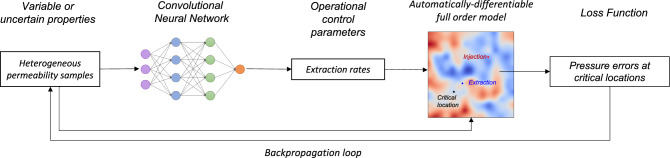
Avoiding over-pressurization in subsurface reservoirs is critical for applications like CO[Formula: see text] sequestration and wastewater injection. Managing the pressures by controlling injection/extraction are challenging because of complex heterogeneity in the subsurface. The heterogeneity typically requires high-fidelity physics-based models to make predictions on CO[Formula: see text] fate. Furthermore, characterizing the heterogeneity accurately is fraught with parametric uncertainty. Accounting for both, heterogeneity and uncertainty, makes this a computationally-intensive problem challenging for current reservoir simulators. To tackle this, we use differentiable programming with a full-physics model and machine learning to determine the fluid extraction rates that prevent over-pressurization at critical reservoir locations. We use DPFEHM framework, which has trustworthy physics based on the standard two-point flux finite volume discretization and is also automatically differentiable like machine learning models. Our physics-informed machine learning framework uses convolutional neural networks to learn an appropriate extraction rate based on the permeability field. We also perform a hyperparameter search to improve the model's accuracy. Training and testing scenarios are executed to evaluate the feasibility of using physics-informed machine learning to manage reservoir pressures. We constructed and tested a sufficiently accurate simulator that is 400 000 times faster than the underlying physics-based simulator, allowing for near real-time analysis and robust uncertainty quantification.
避免地下储层过压是 CO2封存和污水注入等应用的关键。由于地下储层的复杂非均质性,通过控制注入/开采来管理压力具有挑战性。这种非均质性通常需要基于物理的高保真模型来预测 CO2的命运。此外,准确地表征非均质性充满了参数不确定性。考虑到非均质性和不确定性,这使得当前的储层模拟器面临计算密集型问题。为了解决这个问题,我们使用基于全物理模型和机器学习的可微分编程来确定防止关键储层位置过压的流体开采率。我们使用 DPFEHM 框架,该框架基于标准的两点通量有限体积离散化具有可靠的物理基础,并且与机器学习模型一样是自动可微分的。我们的物理启发式机器学习框架使用卷积神经网络根据渗透率场学习适当的开采率。我们还进行了超参数搜索以提高模型的准确性。执行训练和测试场景以评估使用物理启发式机器学习管理储层压力的可行性。我们构建并测试了一个足够准确的模拟器,它比基础的基于物理的模拟器快 40 万倍,允许进行近乎实时的分析和稳健的不确定性量化。