Psychological Institute of Russian Academy of Education, Moscow, Russia.
Ural Federal University Named After the First President of Russia B. N. Yeltsin, Yekaterinburg, Russia.
Sci Rep. 2022 Nov 4;12(1):18659. doi: 10.1038/s41598-022-22079-2.
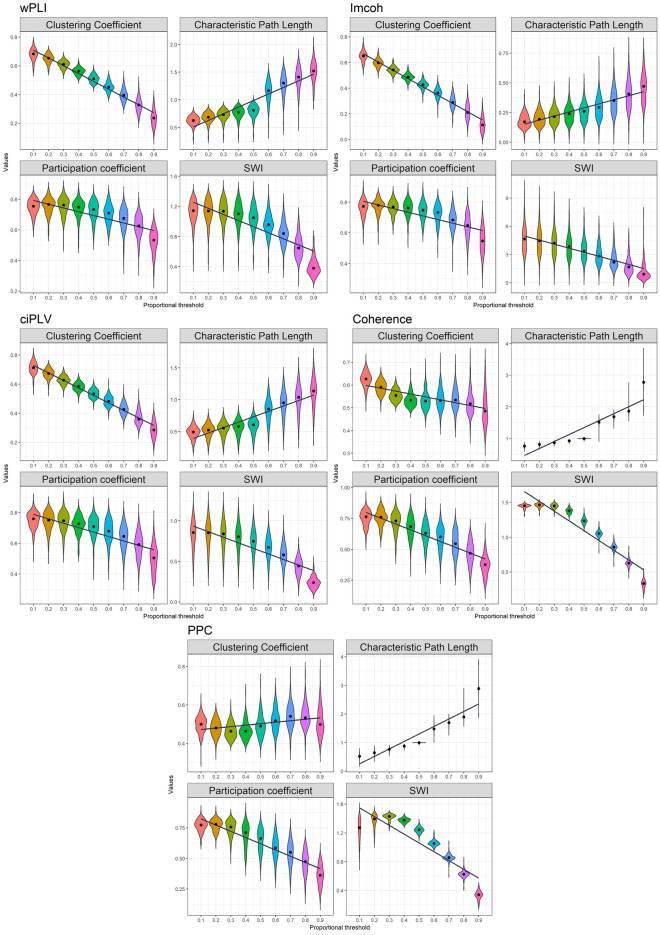
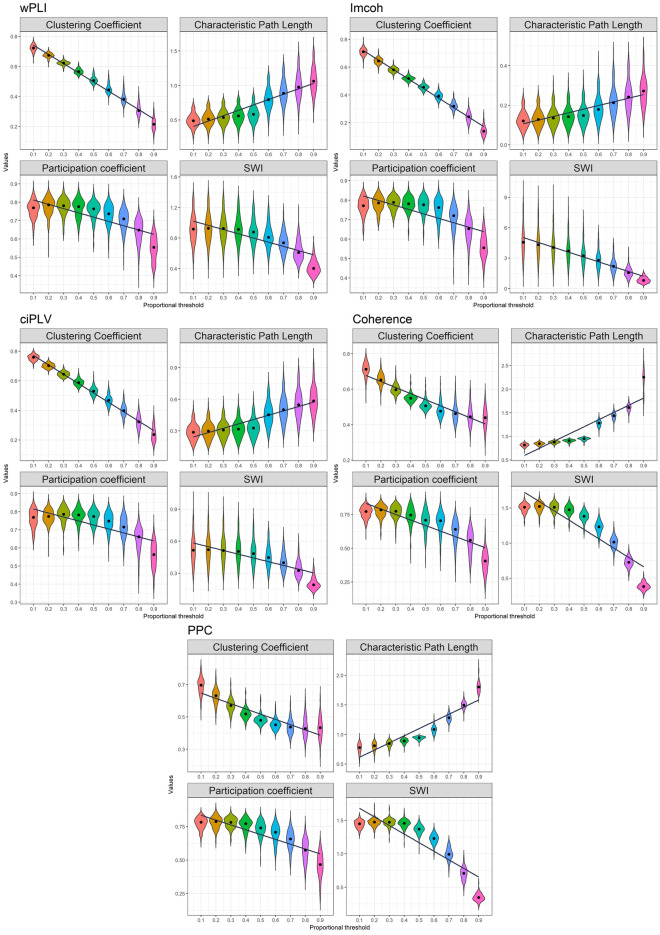
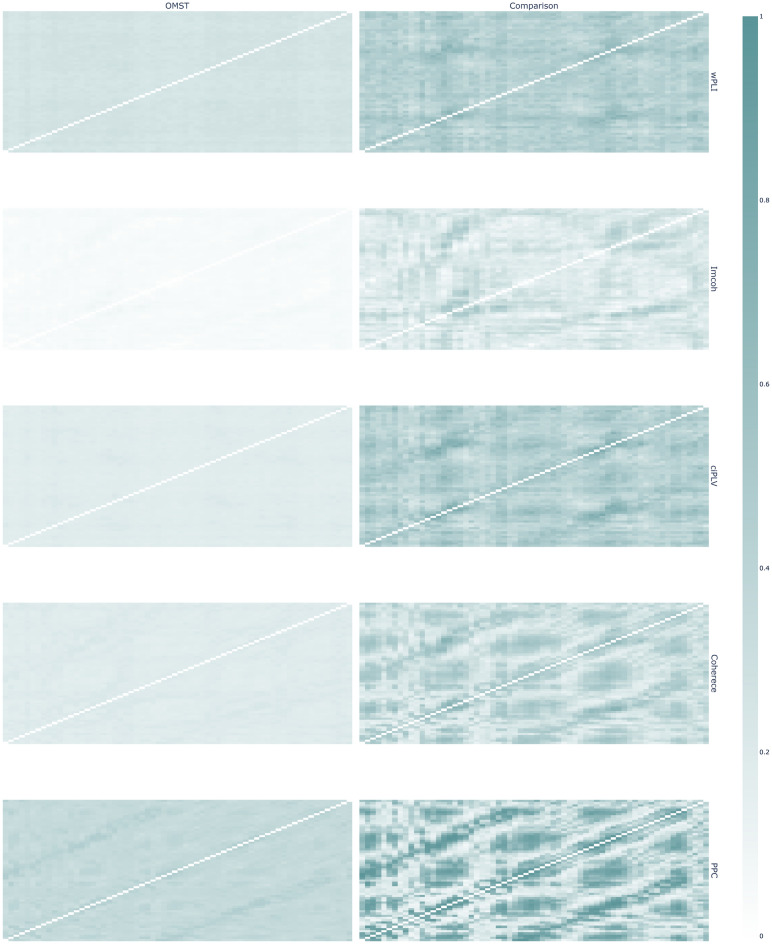
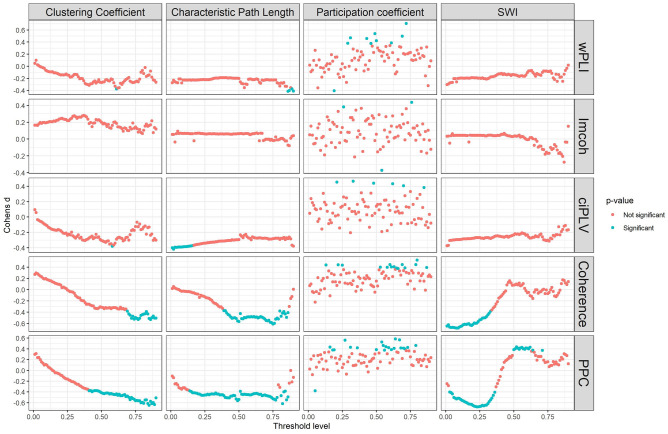
Graph thresholding is a frequently used practice of eliminating the weak connections in brain functional connectivity graphs. The main aim of the procedure is to delete the spurious connections in the data. However, the choice of the threshold is arbitrary, and the effect of the threshold choice is not fully understood. Here we present the description of the changes in the global measures of a functional connectivity graph depending on the different proportional thresholds based on the 146 resting-state EEG recordings. The dynamics is presented in five different synchronization measures (wPLI, ImCoh, Coherence, ciPLV, PPC) in sensors and source spaces. The analysis shows significant changes in the graph's global connectivity measures as a function of the chosen threshold which may influence the outcome of the study. The choice of the threshold could lead to different study conclusions; thus it is necessary to improve the reasoning behind the choice of the different analytic options and consider the adoption of different analytic approaches. We also proposed some ways of improving the procedure of thresholding in functional connectivity research.
图阈值处理是一种常用于消除脑功能连接图中弱连接的方法。该过程的主要目的是删除数据中的虚假连接。然而,阈值的选择是任意的,并且阈值选择的效果尚未完全理解。在这里,我们根据 146 个静息态 EEG 记录,描述了基于不同比例阈值的功能连接图全局测度的变化。动态变化在传感器和源空间中的五个不同的同步测度(wPLI、ImCoh、相干性、ciPLV、PPC)中呈现。分析表明,作为所选阈值的函数,图的全局连接测度会发生显著变化,这可能会影响研究的结果。阈值的选择可能会导致不同的研究结论;因此,有必要改进不同分析选项选择背后的推理,并考虑采用不同的分析方法。我们还提出了一些改进功能连接研究中阈值处理过程的方法。