State Key Laboratory of Molecular Vaccinology and Molecular Diagnostics, School of Public Health, Xiamen University, 4221-117 South Xiang'an Road, Xiang'an District, Xiamen, Fujian Province, People's Republic of China.
Jilin Provincial Centre for Disease Control and Prevention, ChangchunJilin, China, 3145 Jing Yang Road, Green Park District, Changchun, Jilin Province, People's Republic of China.
BMC Public Health. 2022 Nov 4;22(1):2019. doi: 10.1186/s12889-022-14407-y.
There is still a relatively serious disease burden of infectious diseases and the warning time for different infectious diseases before implementation of interventions is important. The logistic differential equation models can be used for predicting early warning of infectious diseases. The aim of this study is to compare the disease fitting effects of the logistic differential equation (LDE) model and the generalized logistic differential equation (GLDE) model for the first time using data on multiple infectious diseases in Jilin Province and to calculate the early warning signals for different types of infectious diseases using these two models in Jilin Province to solve the disease early warning schedule for Jilin Province throughout the year.
Collecting the incidence of 22 infectious diseases in Jilin Province, China. The LDE and GLDE models were used to calculate the recommended warning week (RWW), the epidemic acceleration week (EAW) and warning removed week (WRW) for acute infectious diseases with seasonality, respectively.
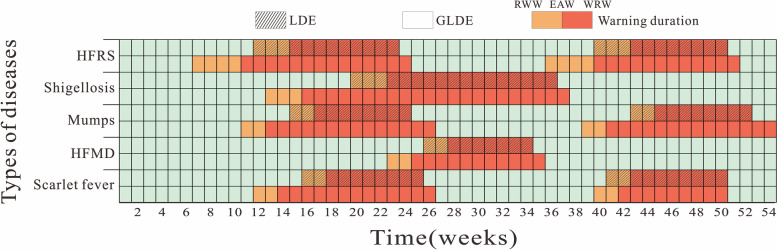
Five diseases were selected for analysis based on screening principles: hemorrhagic fever with renal syndrome (HFRS), shigellosis, mumps, Hand, foot and mouth disease (HFMD), and scarlet fever. The GLDE model fitted the above diseases better (0.80 ≤ R ≤ 0.94, P < 0. 005) than the LDE model. The estimated warning durations (per year) of the LDE model for the above diseases were: weeks 12-23 and 40-50; weeks 20-36; weeks 15-24 and 43-52; weeks 26-34; and weeks 16-25 and 41-50. While the durations of early warning (per year) estimated by the GLDE model were: weeks 7-24 and 36-51; weeks 13-37; weeks 11-26 and 39-54; weeks 23-35; and weeks 12-26 and 40-50.
Compared to the LDE model, the GLDE model provides a better fit to the actual disease incidence data. The RWW appeared to be earlier when estimated with the GLDE model than the LDE model. In addition, the WRW estimated with the GLDE model were more lagged and had a longer warning time.
传染病的疾病负担仍然相对严重,干预前不同传染病的预警时间很重要。逻辑差分方程模型可用于预测传染病的早期预警。本研究的目的是首次使用吉林省多种传染病数据比较逻辑差分方程(LDE)模型和广义逻辑差分方程(GLDE)模型的疾病拟合效果,并计算吉林省不同类型传染病的早期预警信号,解决吉林省全年的疾病预警时间表。
收集中国吉林省 22 种传染病的发病率。使用 LDE 和 GLDE 模型分别计算具有季节性的急性传染病的推荐预警周(RWW)、流行加速周(EAW)和预警消除周(WRW)。
基于筛选原则,选择了 5 种疾病进行分析:肾综合征出血热(HFRS)、痢疾、流行性腮腺炎、手足口病(HFMD)和猩红热。GLDE 模型比 LDE 模型更好地拟合了上述疾病(0.80≤R≤0.94,P<0.005)。LDE 模型对上述疾病的估计预警时间(每年)分别为:第 12-23 周和第 40-50 周;第 20-36 周;第 15-24 周和第 43-52 周;第 26-34 周;第 16-25 周和第 41-50 周。而 GLDE 模型估计的早期预警时间(每年)分别为:第 7-24 周和第 36-51 周;第 13-37 周;第 11-26 周和第 39-54 周;第 23-35 周;第 12-26 周和第 40-50 周。
与 LDE 模型相比,GLDE 模型对实际疾病发病率数据的拟合效果更好。使用 GLDE 模型估计的 RWW 似乎比 LDE 模型更早。此外,使用 GLDE 模型估计的 WRW 滞后时间更长,预警时间更长。