Department of Anesthesiology, the Third Affiliated Hospital of Guangxi Medical University, Nanning, Guangxi, China.
Department of Anesthesiology, Hechi Third People's Hospital, Hechi, Guangxi, China.
J Clin Pharm Ther. 2022 Dec;47(12):2230-2236. doi: 10.1111/jcpt.13797. Epub 2022 Nov 5.
Propofol is the most commonly used sedative in gastrointestinal endoscopic procedures, but is associated with cardiorespiratory suppression, particularly in elderly patients. Remimazolam is a new short-acting GABA(A) receptor agonist with minimal impact on cardiorespiratory suppression, and may be a viable alternative in elderly patients undergoing endoscopic procedures.
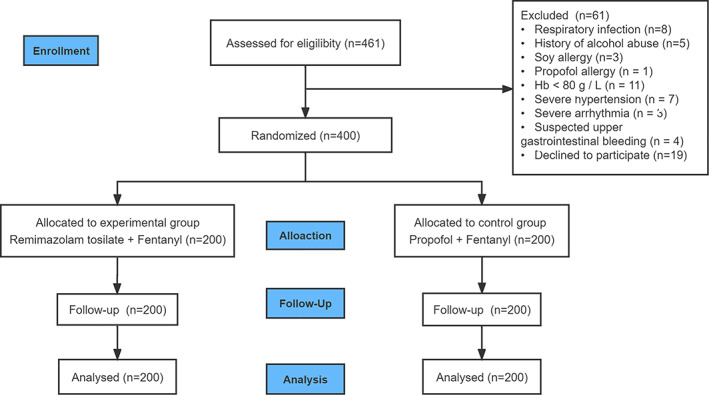
This multicenter, randomized controlled trial was conducted between September 2020 and September 2021. Elderly patients (65-85 years of age) scheduled to undergo upper gastrointestinal endoscopy were randomized in 1:1 ratio to receive remimazolam tosilate (300 mg/h) or propofol (3 g/h) in addition to 50-μg fentanyl, until the Modified Observer's Assessment of Alertness/Sedation Scale (MOAA/S) reached ≤1. MOAA/S was maintained at 0 or 1 throughout the procedure using 2.5 mg remimazolam or 0.5 mg/kg propofol boluses in the two groups, respectively. The primary outcome was the rate of hypotension (defined as systolic blood pressure at ≤90 mmHg or > 30% decline vs. the baseline). Bradycardia was defined as heart rate ≤50 per minute; respiratory depression was defined as respiratory rate <8 per minute and/or SpO < 90%.
A total of 400 patients (161 men and 239 women; 70.4 ± 4.6 years of age) were enrolled (200 patients per group). Average body mass index was 22.2 ± 2.4 kg/m . The rate of hypotension was 36.5% in the remimazolam group and 69.6% in the propofol group (p < 0.001). The remimazolam group also had a lower rate of bradycardia (1.5% vs. 8.5%, p < 0.001), respiratory depression (4.5% vs. 10.0%, p < 0.05) and pain at the injection site (0% vs. 12.0%, p < 0.001).
Remimazolam was associated with a lower rate of hypotension in elderly patients undergoing upper gastrointestinal endoscopy under deep sedation/anaesthesia than propofol.
异丙酚是胃肠内镜检查中最常用的镇静剂,但与心肺抑制有关,尤其是在老年患者中。雷米唑仑是一种新的短作用 GABA(A) 受体激动剂,对心肺抑制的影响最小,在接受内镜检查的老年患者中可能是一种可行的替代药物。
这是一项多中心、随机对照试验,于 2020 年 9 月至 2021 年 9 月进行。将计划接受上消化道内镜检查的老年患者(65-85 岁)以 1:1 的比例随机分为雷米唑仑甲苯磺酸盐(300mg/h)或异丙酚(3g/h)加 50-μg 芬太尼组,直至改良观察者评估警觉/镇静评分(MOAA/S)达到≤1。两组分别使用 2.5mg 雷米唑仑或 0.5mg/kg 异丙酚推注,使 MOAA/S 在整个过程中保持在 0 或 1。主要结局是低血压(定义为收缩压≤90mmHg 或较基线下降>30%)的发生率。心动过缓定义为心率≤50 次/分钟;呼吸抑制定义为呼吸频率<8 次/分钟和/或 SpO < 90%。
共纳入 400 例患者(161 例男性和 239 例女性;70.4±4.6 岁)(每组 200 例)。平均体重指数为 22.2±2.4kg/m 。雷米唑仑组低血压发生率为 36.5%,异丙酚组为 69.6%(p<0.001)。雷米唑仑组心动过缓(1.5% vs. 8.5%,p<0.001)、呼吸抑制(4.5% vs. 10.0%,p<0.05)和注射部位疼痛(0% vs. 12.0%,p<0.001)的发生率也较低。
与异丙酚相比,老年患者在上消化道内镜检查中接受深度镇静/麻醉时,雷米唑仑低血压发生率较低。