Chan Li Yi Tammy, Chua Chong Shan, Chou Siaw Meng, Seah Ren Yi Benjamin, Huang Yilun, Luo Yue, Dacy Lincoln, Bin Abd Razak Hamid Rahmatullah
Yong Loo Lin School of Medicine, National University of Singapore, Singapore, Singapore.
School of Mechanical and Aerospace Engineering, Nanyang Technological University, Singapore, Singapore.
Mhealth. 2022 Oct 30;8:30. doi: 10.21037/mhealth-22-7. eCollection 2022.
Our study aims to validate a commercially available inertial measurement unit (IMU) system against a standard laboratory-based optical motion capture (OMC) system for shoulder measurements in a clinical context.
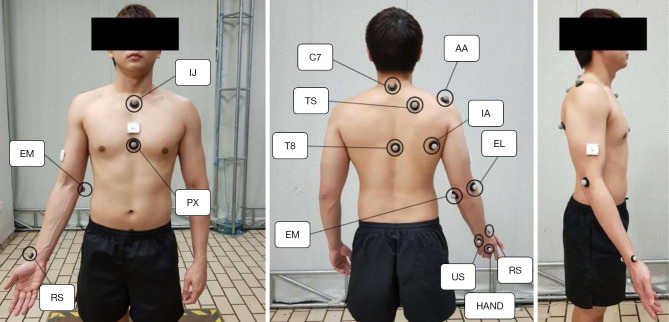
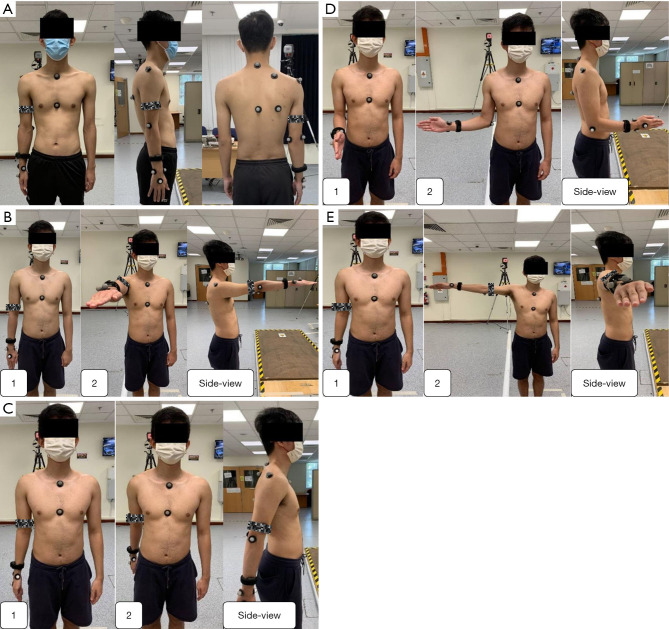
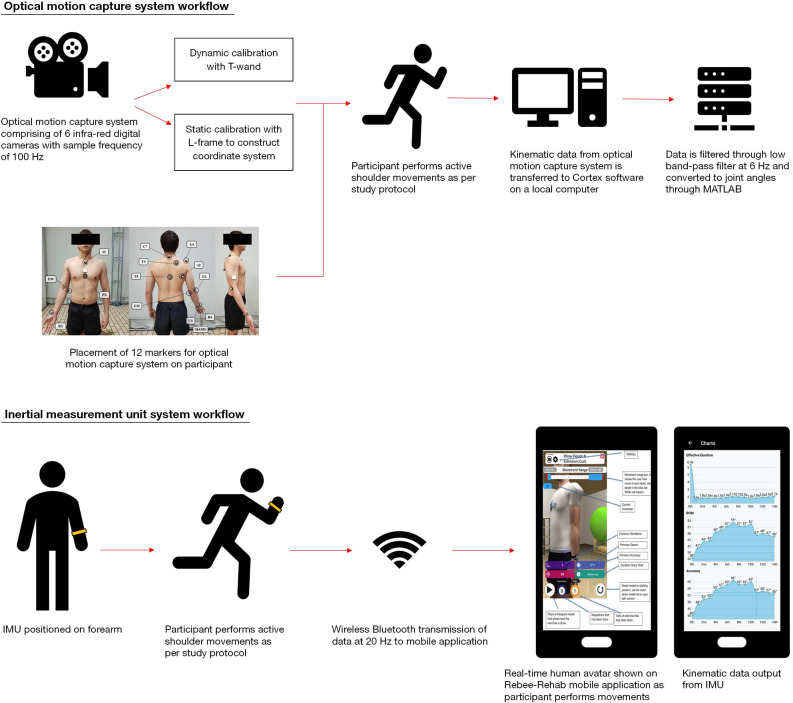
The validation analyses were conducted on 19 healthy male volunteers. Twelve reflective markers were placed on each participant's trunk, scapula and across the arm and one IMU was attached via a self-adhesive strap on the forearm. A single tester simultaneously collected shoulder kinematic data for four shoulder movements: flexion, extension, external rotation, and abduction. Agreement between OMC system and IMU measurements was assessed with Bland-Altman analyses. Secondary analysis included mean biases, root mean square error (RMSE) analysis and Welch's -test.
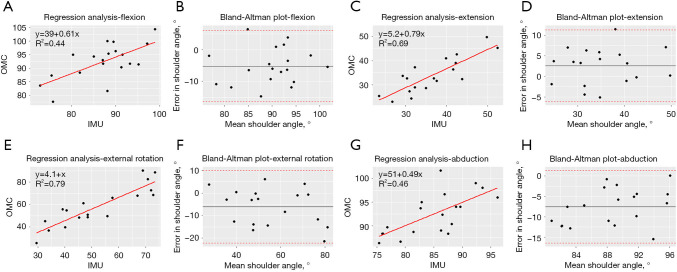
Bland-Altman limits of agreement (LoA) exceeded the acceptable range of mean difference for 95% of the population (-22.27°, 11.31°). The mean bias showed high levels of agreement within 8° for all four movements. More than 60% of participants demonstrated mean bias less than 10° between methods. Statistically significant differences were found between measurements for abduction (P<0.001) and flexion (P=0.027) but not for extension and external rotation (P≥0.05).
Our study shows preliminary evidence for acceptable accuracy of a commercially available IMU against an OMC system for assessment of shoulder movements by a single tester. The IMU also exhibits similar whole degree of error compared to a standard goniometer with potential for application in remote rehabilitation.
我们的研究旨在针对临床环境中肩部测量,将一种商用惯性测量单元(IMU)系统与基于标准实验室的光学动作捕捉(OMC)系统进行验证对比。
对19名健康男性志愿者进行了验证分析。在每位参与者的躯干、肩胛骨和手臂上放置了12个反光标记,并通过自粘带将一个IMU固定在前臂上。一名测试人员同时收集了四种肩部运动的肩部运动学数据:前屈、后伸、外旋和外展。通过Bland-Altman分析评估OMC系统与IMU测量之间的一致性。二次分析包括平均偏差、均方根误差(RMSE)分析和韦尔奇t检验。
Bland-Altman一致性界限(LoA)超出了95%人群平均差异的可接受范围(-22.27°,11.31°)。所有四种运动在8°范围内平均偏差显示出高度一致性。超过60%的参与者在两种方法之间的平均偏差小于10°。在外展(P<0.001)和前屈(P=0.027)测量中发现了统计学上的显著差异,但在后伸和外旋测量中未发现(P≥0.05)。
我们的研究显示了初步证据,表明一种商用IMU相对于OMC系统在由单一测试人员评估肩部运动时具有可接受的准确性。与标准测角仪相比,IMU还表现出相似的整体误差程度,具有在远程康复中应用的潜力。