Susai Surraj, Chandrupatla Mrudula, Motwani Rohini
Department of Anatomy, All India Institute of Medical Sciences, Hyderabad, Telangana, India.
Anat Cell Biol. 2023 Mar 31;56(1):1-8. doi: 10.5115/acb.22.166. Epub 2022 Nov 9.
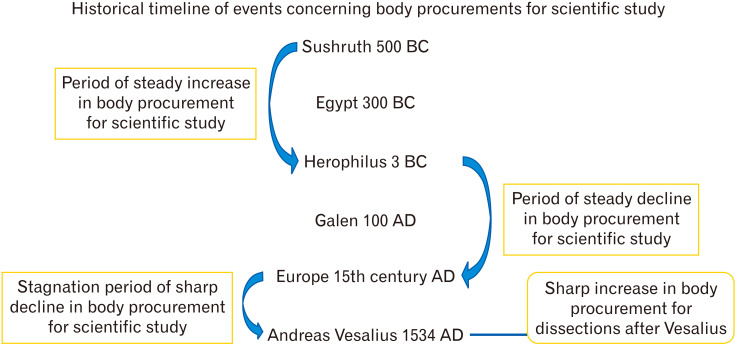
From the era of pre-historic times, the ancient Indians and the Greeks highlighted the importance of body and organ donations thereby emphasizing the need for anatomical sciences in medicine through the use of effective dissections for the same. However, after the Renaissance, there was a surge in dissections throughout the world, particularly in Europe, as a result of which various laws were enacted by governments concerning the procurement of bodies for the purpose of scientific dissections, which were later promulgated throughout the world through various anatomical acts. The situation in India was quite similar to that of Britain until its independence in 1947, after which different Indian states formulated their own anatomy acts that had their own merits and pitfalls. Hence, this literature review serves to highlight the various acts throughout history and would serve as a guide to emphasize the future perspectives of formulating a centralized unified anatomy act for the Indian nation that could possibly be the need of the hour.
从史前时代起,古印度人和希腊人就强调了身体和器官捐赠的重要性,从而通过有效的解剖来强调医学中解剖学的必要性。然而,文艺复兴之后,世界各地,尤其是欧洲,解剖活动激增,因此各国政府颁布了各种关于为科学解剖目的获取尸体的法律,这些法律后来通过各种解剖法案在全世界颁布。在1947年独立之前,印度的情况与英国颇为相似,此后印度不同邦制定了各自的解剖法案,这些法案各有优缺点。因此,这篇文献综述旨在突出历史上的各种法案,并作为强调为印度制定一部可能是当务之急的统一解剖法案的未来展望的指南。