Feduniw Stepan, Golik Dawid, Kajdy Anna, Pruc Michał, Modzelewski Jan, Sys Dorota, Kwiatkowski Sebastian, Makomaska-Szaroszyk Elżbieta, Rabijewski Michał
Department of Reproductive Health, Centre of Postgraduate Medical Education, Żelazna 90 St., 01-004 Warsaw, Poland.
Faculty of Medicine, Lazarski University, Świeradowska 43 St., 02-662 Warsaw, Poland.
Healthcare (Basel). 2022 Oct 29;10(11):2164. doi: 10.3390/healthcare10112164.
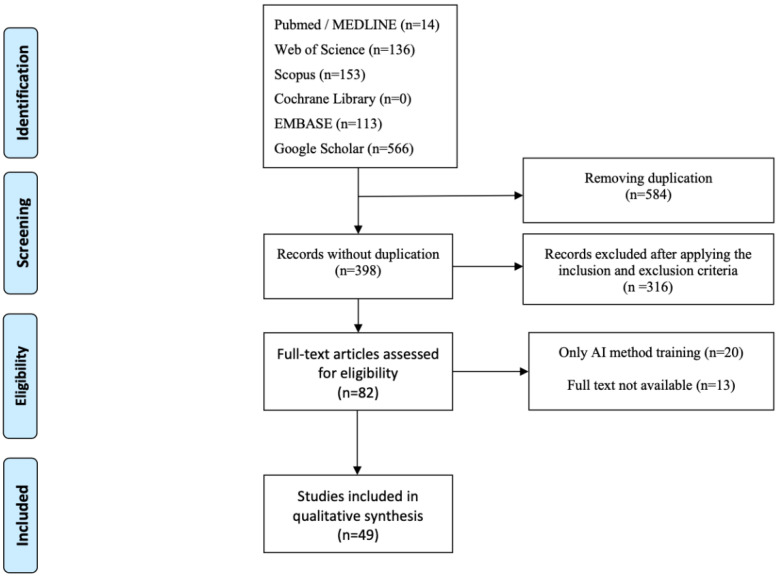
(1) Background: AI-based solutions could become crucial for the prediction of pregnancy disorders and complications. This study investigated the evidence for applying artificial intelligence methods in obstetric pregnancy risk assessment and adverse pregnancy outcome prediction. (2) Methods: Authors screened the following databases: Pubmed/MEDLINE, Web of Science, Cochrane Library, EMBASE, and Google Scholar. This study included all the evaluative studies comparing artificial intelligence methods in predicting adverse pregnancy outcomes. The PROSPERO ID number is CRD42020178944, and the study protocol was published before this publication. (3) Results: AI application was found in nine groups: general pregnancy risk assessment, prenatal diagnosis, pregnancy hypertension disorders, fetal growth, stillbirth, gestational diabetes, preterm deliveries, delivery route, and others. According to this systematic review, the best artificial intelligence application for assessing medical conditions is ANN methods. The average accuracy of ANN methods was established to be around 80-90%. (4) Conclusions: The application of AI methods as a digital software can help medical practitioners in their everyday practice during pregnancy risk assessment. Based on published studies, models that used ANN methods could be applied in APO prediction. Nevertheless, further studies could identify new methods with an even better prediction potential.
(1) 背景:基于人工智能的解决方案对于预测妊娠疾病和并发症可能至关重要。本研究调查了在产科妊娠风险评估和不良妊娠结局预测中应用人工智能方法的证据。(2) 方法:作者筛选了以下数据库:PubMed/MEDLINE、科学网、考克兰图书馆、EMBASE和谷歌学术。本研究纳入了所有比较人工智能方法预测不良妊娠结局的评估性研究。PROSPERO注册号为CRD42020178944,研究方案在本出版物之前已发表。(3) 结果:在九个组中发现了人工智能的应用:一般妊娠风险评估、产前诊断、妊娠高血压疾病、胎儿生长、死产、妊娠期糖尿病、早产、分娩方式及其他。根据本系统评价,评估医疗状况的最佳人工智能应用是人工神经网络方法。人工神经网络方法的平均准确率约为80%-90%。(4) 结论:作为数字软件应用人工智能方法可在妊娠风险评估的日常实践中帮助医疗从业者。基于已发表的研究,使用人工神经网络方法的模型可应用于不良妊娠结局预测。然而,进一步的研究可能会发现具有更好预测潜力的新方法。