Segura-Ortí Eva, Martínez-Olmos Francisco J, Ródenas-Pascual Álvaro, Guillem-Giménez Edgar, Vercher-Narbona Verónica, Piñón-Ruiz Martha Jocelyne, Garcia-Testal Alicia
Department of Physiotherapy, Universidad Cardenal Herrera-CEU, CEU Universities, 46001 Valencia, Spain.
Department of Nephrology, Hospital de Manises, 46001 Valencia, Spain.
Healthcare (Basel). 2022 Nov 4;10(11):2217. doi: 10.3390/healthcare10112217.
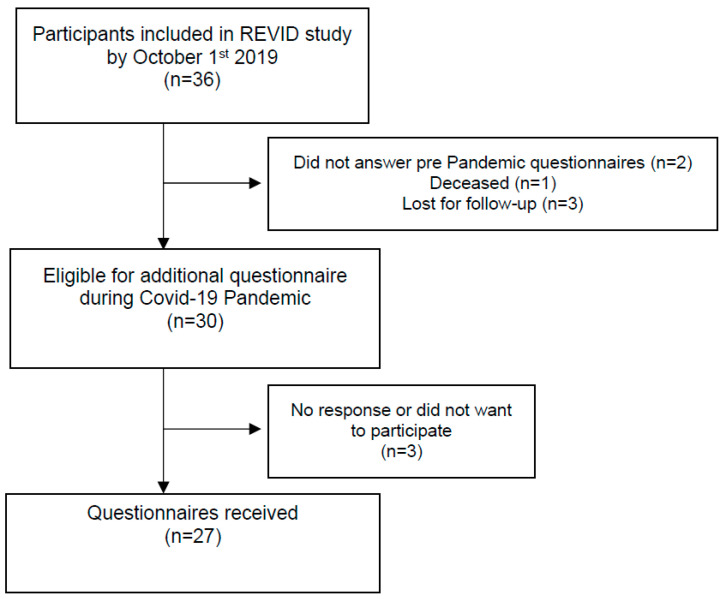
Chronic dialysis patients have an increased risk of severe COVID-19 infection-related complications. The aim of this study was to quantify the impact of the COVID-19 pandemic on health-related quality of life (HRQoL) and physical activity levels of patients undertaking hemodialysis (HD). This was an observational study that compared data from two periods of time, before the COVID-19 pandemic vs pandemic. We used the Medical Outcomes Survey Short Form (SF-36) to measure the HRQoL and the Human Activity Profile (HAP) questionnaire was used to measure the physical activity. Data were analyzed with a mixed ordinal linear regression. A total of 27 eligible participants were interviewed during COVID-19 pandemic (median age 78 years). The linear regression model showed that the pandemic, after controlling for the covariates age, comorbidity, albumin, and hemoglobin, had a significant impact on the HRQoL. Physical function (-15.7) and social functioning subscales (-28.0) worsened ( = 0.001), and the physical component scale also showed a significant decrease (-3.6; = 0.05). Time had a significant impact on the Human Activity Profile, with an average activity score diminished with the pandemic (-13.9; = 0.003). The COVID-19 pandemic had a very negative impact on HRQoL and physical activity level of subjects undertaking hemodialysis. Interventions to improve HRQoL and activity levels of patients undertaking HD are recommended.
慢性透析患者发生严重的2019冠状病毒病(COVID-19)感染相关并发症的风险增加。本研究的目的是量化COVID-19大流行对接受血液透析(HD)患者的健康相关生活质量(HRQoL)和身体活动水平的影响。这是一项观察性研究,比较了COVID-19大流行之前和大流行期间两个时间段的数据。我们使用医学结局调查简表(SF-36)来测量HRQoL,并使用人类活动概况(HAP)问卷来测量身体活动。数据采用混合有序线性回归进行分析。在COVID-19大流行期间,共采访了27名符合条件的参与者(中位年龄78岁)。线性回归模型显示,在控制了年龄、合并症、白蛋白和血红蛋白等协变量后,大流行对HRQoL有显著影响。身体功能(-15.7)和社会功能分量表(-28.0)恶化(P = 0.001),身体成分量表也显示出显著下降(-3.6;P = 0.05)。时间对人类活动概况有显著影响,随着大流行,平均活动得分降低(-13.9;P = 0.003)。COVID-19大流行对接受血液透析的受试者的HRQoL和身体活动水平有非常负面的影响。建议采取干预措施来改善接受HD治疗患者 的HRQoL和活动水平。