Saleem Ammara, Akhtar Muhammad Furqan, Sharif Ali, Akhtar Bushra, Siddique Rida, Ashraf Ghulam Md, Alghamdi Badrah S, Alharthy Saif A
Department of Pharmacology, Faculty of Pharmaceutical Sciences, Government College University Faisalabad, Faisalabad 38000, Pakistan.
Riphah Institute of Pharmaceutical Sciences, Riphah International University, Lahore Campus, Lahore 38000, Pakistan.
Molecules. 2022 Oct 26;27(21):7286. doi: 10.3390/molecules27217286.
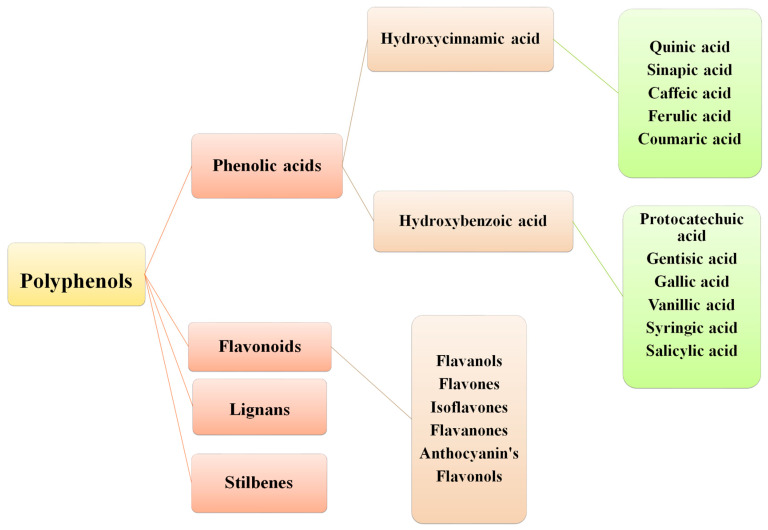
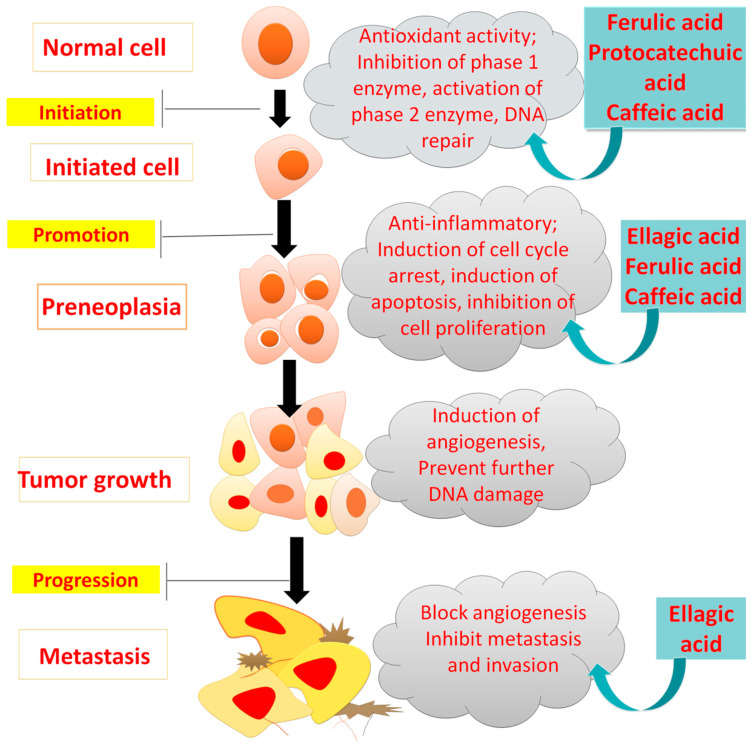
Phenolic acids (PAs) are one of the utmost prevalent classes of plant-derived bioactive chemicals. They have a specific taste and odor, and are found in numerous medicinal and food plants, such as L., (L.), and L. Their biosynthesis, physical and chemical characteristics and structure-activity relationship are well understood. These phytochemicals and their derivatives exert several bioactivities including but not limited to anticancer, cardioprotective, anti-inflammatory, immune-regulatory and anti-obesity properties. They are strong antioxidants because of hydroxyl groups which play pivotal role in their anticancer, anti-inflammatory and cardioprotective potential. They may play significant role in improving human health owing to anticarcinogenic, anti-arthritis, antihypertensive, anti-stroke, and anti-atherosclerosis activities, as several PAs have demonstrated biological activities against these disease during in vitro and in vivo studies. These PAs exhibited anticancer action by promoting apoptosis, targeting angiogenesis, and reducing abnormal cell growth, while anti-inflammatory activity was attributed to reducing proinflammatory cytokines. Pas exhibited anti-atherosclerotic activity via inhibition of platelets. Moreover, they also reduced cardiovascular complications such as myocardial infarction and stroke by activating Paraoxonase 1. The present review focuses on the plant sources, structure activity relationship, anticancer, anti-inflammatory and cardioprotective actions of PAs that is attributed to modulation of oxidative stress and signal transduction pathways, along with highlighting their mechanism of actions in disease conditions. Further, preclinical and clinical studies must be carried out to evaluate the mechanism of action and drug targets of PAs to understand their therapeutic actions and disease therapy in humans, respectively.
酚酸(PAs)是植物源生物活性化合物中最普遍的类别之一。它们具有独特的味道和气味,存在于许多药用和食用植物中,如[植物名称1]、[植物名称2]和[植物名称3]。人们对它们的生物合成、物理化学特性以及构效关系有充分的了解。这些植物化学物质及其衍生物具有多种生物活性,包括但不限于抗癌、心脏保护、抗炎、免疫调节和抗肥胖特性。由于羟基在其抗癌、抗炎和心脏保护潜力中起关键作用,它们是强大的抗氧化剂。由于几种酚酸在体外和体内研究中已显示出针对这些疾病的生物活性,它们在改善人类健康方面可能发挥重要作用,这些生物活性包括抗癌、抗关节炎、抗高血压、抗中风和抗动脉粥样硬化作用。这些酚酸通过促进细胞凋亡、靶向血管生成和减少异常细胞生长来发挥抗癌作用,而抗炎活性则归因于减少促炎细胞因子。酚酸通过抑制血小板表现出抗动脉粥样硬化活性。此外,它们还通过激活对氧磷酶1减少心血管并发症,如心肌梗死和中风。本综述重点关注酚酸的植物来源、构效关系、抗癌、抗炎和心脏保护作用,这些作用归因于对氧化应激和信号转导途径的调节,同时突出它们在疾病状态下的作用机制。此外,必须进行临床前和临床研究,以分别评估酚酸的作用机制和药物靶点,从而了解它们在人类中的治疗作用和疾病治疗效果。