Blandi Lorenzo, Sabbatucci Michela, Dallagiacoma Giulia, Alberti Federica, Bertuccio Paola, Odone Anna
School of Public Health, Department of Public Health, Experimental and Forensic Medicine University of Pavia, 27100 Pavia, Italy.
Italian National Institute of Health, Department Infectious Diseases, 00161 Rome, Italy.
Vaccines (Basel). 2022 Oct 28;10(11):1822. doi: 10.3390/vaccines10111822.
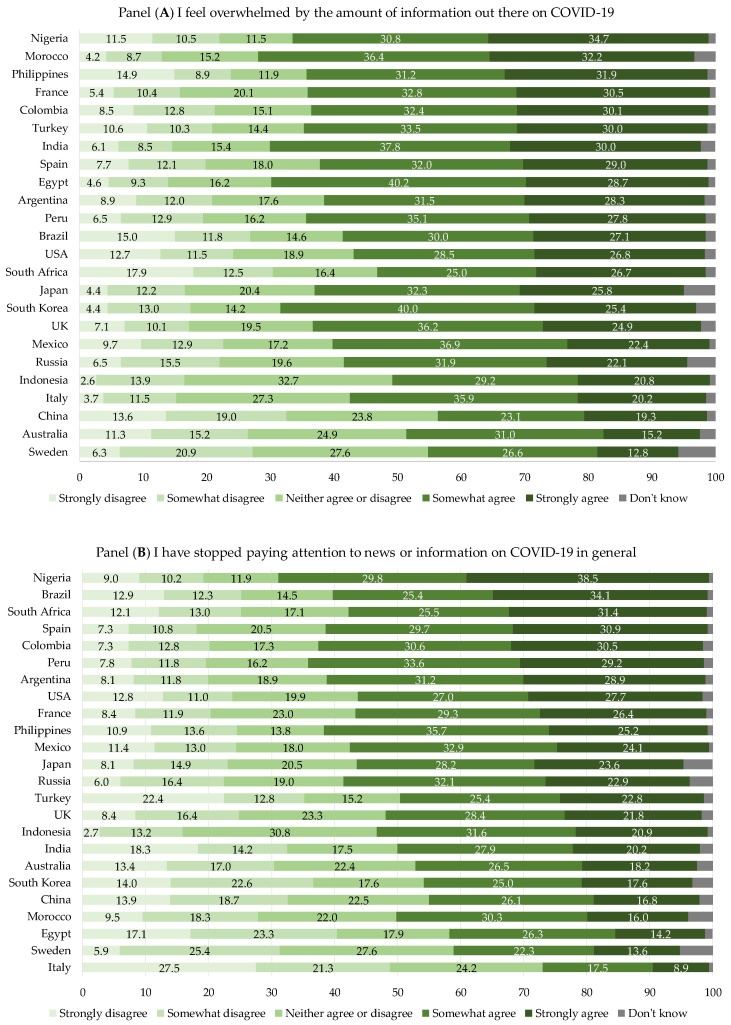
An infodemic represents a concern for public health, influencing the general population's perceptions of key health issues. Misinformation is rapidly spread by social media, particularly among young generations. We used data from the WHO "Social Media and COVID-19" study, which was conducted in 24 countries worldwide on over 23,000 subjects aged 18-40 years, to explore Generation Z and Millennials' models for health-information-seeking behaviors on social media. We summarized data on the most used sources of information, content of interest, and content sharing, as well as the sentiment toward the infodemic, through descriptive statistics and Chi-square test to verify the differences between groups. Among the survey respondents, 9475 (40.3%) were from high-income countries (HIC), 8000 (34.1%) from upper-middle-income countries (UMIC), and 6007 (25.6%) from lower-middle-income countries (LMIC). Social media were the most used sources of information to retrieve news on COVID-19 disease (about 79% in HIC, 87% in UMIC, and 90% in LIC) and the COVID-19 vaccine (about 78% in HIC and about 88% in UMIC and LIC). More than a half of the young respondents declared that they pay attention to scientific contents (about 51% in HIC, 59% in UMIC, and 55% in LMIC). Finally, most young participants reported feeling overwhelmed by the infodemic. However, this sentiment did not stop them from seeking information about COVID-19. Our findings highlight the importance of shaping public health interventions and campaigns on social media platforms and leveraging scientific contents. Public health authorities should work also on strategies to improve the digital literacy of the population as a driving force to empower them and achieve better health outcomes.
信息疫情是对公众健康的一个担忧,影响着普通民众对关键健康问题的认知。错误信息通过社交媒体迅速传播,尤其是在年轻一代中。我们使用了世界卫生组织“社交媒体与新冠疫情”研究的数据,该研究在全球24个国家对超过23000名18至40岁的受试者进行,以探索Z世代和千禧一代在社交媒体上获取健康信息行为的模式。我们通过描述性统计和卡方检验总结了关于最常用信息来源、感兴趣的内容和内容分享的数据,以及对信息疫情的看法,以验证组间差异。在调查受访者中,9475人(40.3%)来自高收入国家(HIC),8000人(34.1%)来自中高收入国家(UMIC),6007人(25.6%)来自中低收入国家(LMIC)。社交媒体是获取新冠疾病新闻(在HIC中约79%,在UMIC中约87%,在LIC中约90%)和新冠疫苗信息(在HIC中约78%,在UMIC和LIC中约88%)最常用的信息来源。超过一半的年轻受访者表示他们关注科学内容(在HIC中约51%,在UMIC中约59%,在LMIC中约55%)。最后,大多数年轻参与者表示被信息疫情压得喘不过气来。然而,这种情绪并没有阻止他们寻求关于新冠疫情的信息。我们的研究结果强调了在社交媒体平台上制定公共卫生干预措施和宣传活动以及利用科学内容的重要性。公共卫生当局还应致力于制定战略,提高民众的数字素养,以此作为增强他们能力并实现更好健康结果的驱动力。