Luo Lei, Qiao Dakuan, Wang Lishuang, Qiu Ling, Liu Yuying, Fu Xinhong
School of Management, Sichuan Agricultural University, China.
Sichuan Rural Development Research Center, Chengdu, China.
J Clean Prod. 2022 Dec 20;380:135068. doi: 10.1016/j.jclepro.2022.135068. Epub 2022 Nov 6.
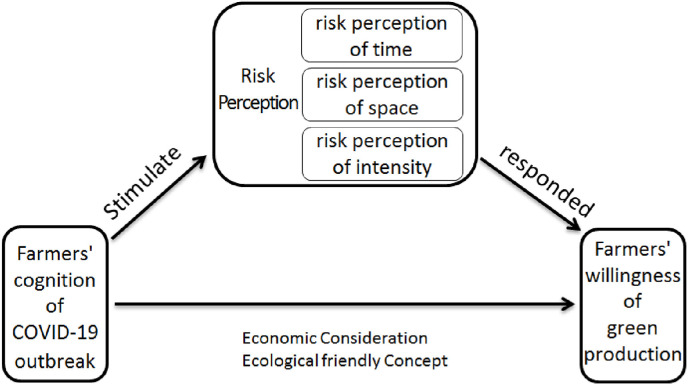
Existing literature reports that COVID-19 outbreak may affect people's risk perceptions, with disturbances ranging from mild negative emotional reactions to overall mental health. At the same time, the pneumonia pandemic reveals all the vulnerabilities and weaknesses of our ecosystem and makes people reflect on traditional ecologically harmful production practices. Therefore, the aim of this paper is to review the existing scientific literature on these variables, through a survey and empirical analysis, in order to present and comment on the effects and mechanisms of influence between them. The results showed that: (1) Increasing farmers'cognition of COVID-19 outbreak could significantly enhance the green production willingness. Specifically, the probability of "Very willing"to participate in green production increased by 29.9% for each unit of increase in cognition. (2) Farmers'cognition of COVID-19 outbreak can significantly enhance the level of risk perception and thus enhance their green production willingness, that is, risk perception is an important transmission medium of this effect. (3)The analysis of inter-generational difference showed that the impact of cognition of COVID-19 outbreak on green production willingness was significant for both the new generation and the old generation. On the basis of this, some policy suggestions are put forward, such as strengthening the propaganda and education of natural ecological environment protection, establishing the propaganda mechanism of green agricultural products market in the later period of epidemic situation, raising farmers'risk perception level through multi-channels and so on.
现有文献报道,新冠疫情爆发可能会影响人们的风险认知,干扰范围从轻微的负面情绪反应到整体心理健康。与此同时,肺炎大流行揭示了我们生态系统的所有脆弱性和弱点,促使人们反思传统的生态有害生产方式。因此,本文旨在通过调查和实证分析,回顾关于这些变量的现有科学文献,以便呈现并评论它们之间的影响效果和机制。结果表明:(1)提高农民对新冠疫情爆发的认知能显著增强绿色生产意愿。具体而言,认知每提高一个单位,“非常愿意”参与绿色生产的概率增加29.9%。(2)农民对新冠疫情爆发的认知能显著提高风险认知水平,进而增强其绿色生产意愿,即风险认知是这种影响的重要传导媒介。(3)代际差异分析表明,新冠疫情爆发认知对绿色生产意愿的影响在新一代和老一代中均显著。在此基础上,提出了一些政策建议,如加强自然生态环境保护宣传教育、在疫情后期建立绿色农产品市场宣传机制、通过多渠道提高农民风险认知水平等。