Abiri Behnaz, Ahmadi Amirhossein Ramezani, Hejazi Mahdi, Amini Shirin
Obesity Research Center, Research Institute for Endocrine Sciences, Shahid Beheshti University of Medical Sciences, Tehran 19839-63113, Iran.
Isfahan Endocrine and Metabolism Research Center, Isfahan University of Medical Sciences, Isfahan 81746-73461, Iran.
Clin Nutr Res. 2022 Oct 24;11(4):331-346. doi: 10.7762/cnr.2022.11.4.331. eCollection 2022 Oct.
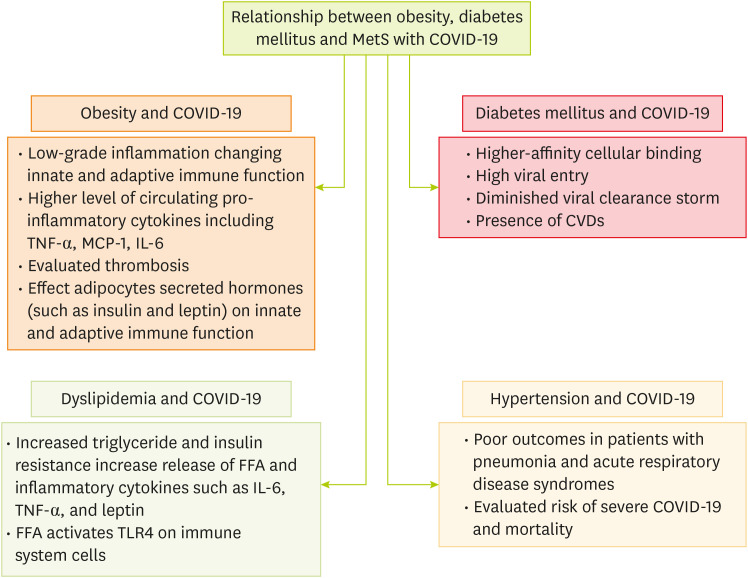
Coronavirus disease 2019 (COVID-19), a novel coronavirus named severe acute respiratory syndrome coronavirus 2 (SARS-CoV-2) is now at pandemic levels leading to considerable morbidity and mortality throughout the globe. Patients with obesity, diabetes, and metabolic syndrome (MetS) are mainly susceptible and more probably to get severe side effects when affected by this virus. The pathophysiologic mechanisms for these notions have not been completely known. The pro-inflammatory milieu observed in patients with metabolic disruption could lead to COVID-19-mediated host immune dysregulation, such as immune dysfunction, severe inflammation, microvascular dysfunction, and thrombosis. The present review expresses the current knowledge regarding the influence of obesity, diabetes mellitus, and MetS on COVID-19 infection and severity, and their pathophysiological mechanisms.
2019冠状病毒病(COVID-19),一种名为严重急性呼吸综合征冠状病毒2(SARS-CoV-2)的新型冠状病毒,目前正处于大流行水平,在全球范围内导致相当高的发病率和死亡率。肥胖、糖尿病和代谢综合征(MetS)患者主要易感,感染这种病毒时更有可能出现严重的副作用。这些观点的病理生理机制尚未完全明确。在代谢紊乱患者中观察到的促炎环境可能导致COVID-19介导的宿主免疫失调,如免疫功能障碍、严重炎症、微血管功能障碍和血栓形成。本综述阐述了关于肥胖、糖尿病和代谢综合征对COVID-19感染及其严重程度的影响以及它们的病理生理机制的现有知识。