Mancin Laura, Amatori Stefano, Caprio Massimiliano, Sattin Eleonora, Bertoldi Loris, Cenci Lorenzo, Sisti Davide, Bianco Antonino, Paoli Antonio
Department of Biomedical Sciences, University of Padua, Padua, Italy.
Human Inspired Technology Research Center, University of Padua, Padua, Italy.
Front Nutr. 2022 Oct 25;9:979651. doi: 10.3389/fnut.2022.979651. eCollection 2022.
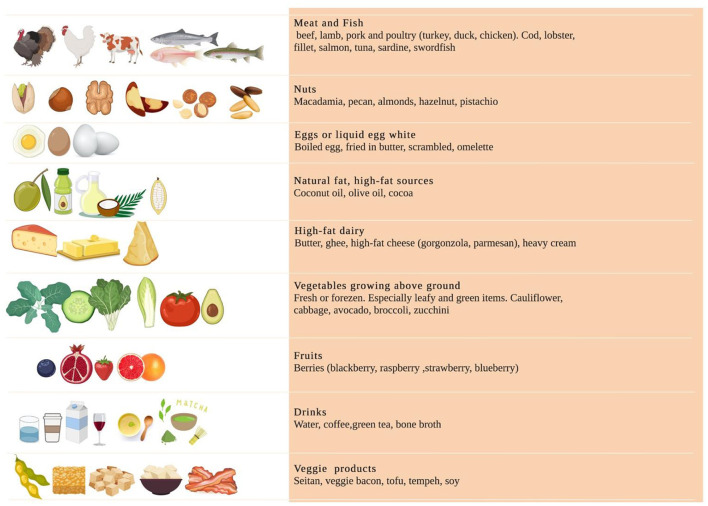
Recent research suggest that gut microbiome may play a fundamental role in athlete's health and performance. Interestingly, nutrition can affect athletic performance by influencing the gut microbiome composition. Among different dietary patterns, ketogenic diet represents an efficient nutritional approach to get adequate body composition in athletes, however, some concerns have been raised about its potential detrimental effect on gut microbiome. To the best of our knowledge, only one study investigated the effect of ketogenic diet on the gut microbiome in athletes (elite race walkers), whilst no studies are available in a model of mixed endurance/power sport such as soccer. This study aimed to investigate the influence of a ketogenic Mediterranean diet with phytoextracts (KEMEPHY) diet on gut microbiome composition in a cohort of semi-professional soccer players.
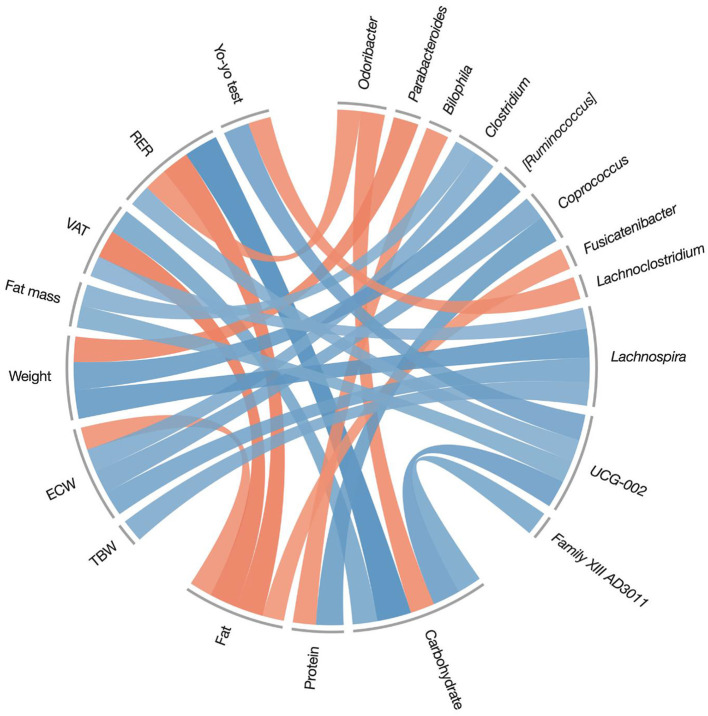
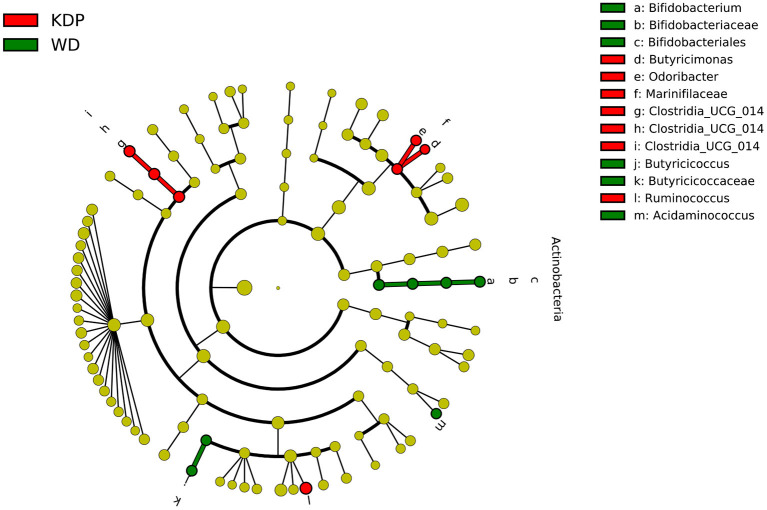
16 male soccer players were randomly assigned to KEMEPHY diet (KDP = 8) or western diet (WD = 8). Body composition, performance measurements and gut microbiome composition were measured before and after 30 days of intervention by 16S rRNA amplicon sequencing. Alpha-diversity measures and PERMANOVA was used to investigate pre-post differences in the relative abundance of all taxonomic levels (from phylum to genus) and Spearman's correlations was used to investigate associations between microbial composition and macronutrient intake. Linear discriminant analysis was also performed at the different taxonomic levels on the post-intervention data.
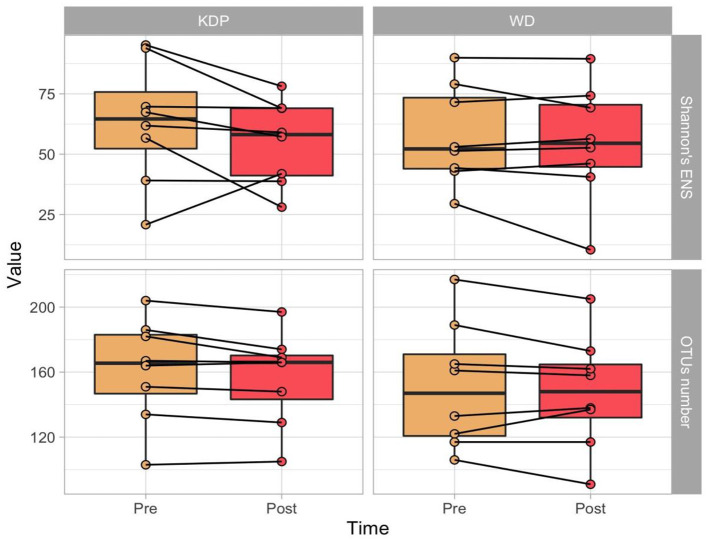
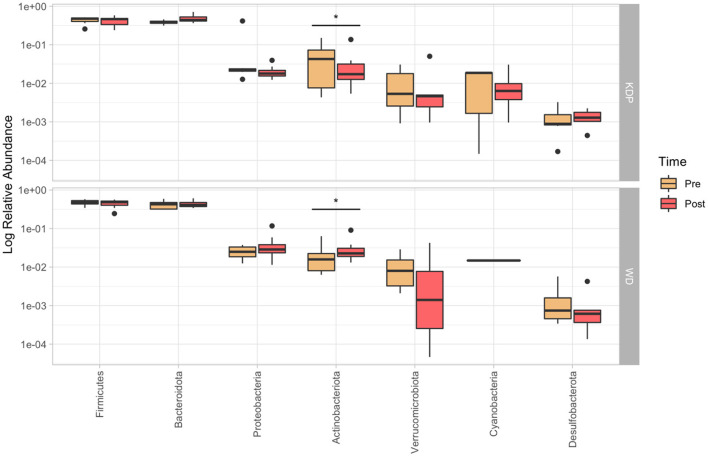
No differences were found between pre and post- dietary intervention for microbial community diversity: no significant effects of time ( = 0.056, ES = 0.486 and = 0.129, ES = 0.388, respectively for OTUs number and Shannon's ENS), group ( = 0.317, ES = 0.180 and = 0.809, ES = 0.047) or time × group ( = 0.999, ES = 0.01 and = 0.230, ES = 0.315). paired Wilcoxon test showed a significant time × group effect for ( = 0.021, ES = 0.578), which increased in the WD group (median pre: 1.7%; median post: 2.3%) and decreased in the KEMEPHY group (median pre: 4.3%; median post: 1.7%). At genus level, the linear discriminant analysis in the post intervention differentiated the two groups for genus (pertaining to the phylum), and genera, all more abundant in the WD group, and for (order, family, and genus), genera (pertaining to the Marinifilaceae family), and genus, all more abundant in the KEMEPHY group.
Our results demonstrate that 30 days of KEMEPHY intervention, in contrast with previous research on ketogenic diet and gut microbiome, do not modify the overall composition of gut microbiome in a cohort of athletes. KEMEPHY dietary pattern may represent an alternative and safety tool for maintaining and/or regulating the composition of gut microbiome in athletes practicing regular exercise. Due to the fact that not all ketogenic diets are equal, we hypothesized that each version of ketogenic diet, with different kind of nutrients or macronutrients partitioning, may differently affect the human gut microbiome.
近期研究表明,肠道微生物群可能在运动员的健康和表现中发挥重要作用。有趣的是,营养可以通过影响肠道微生物群的组成来影响运动表现。在不同的饮食模式中,生酮饮食是一种在运动员中获得适当身体成分的有效营养方法,然而,人们对其对肠道微生物群的潜在有害影响提出了一些担忧。据我们所知,只有一项研究调查了生酮饮食对运动员(精英竞走运动员)肠道微生物群的影响,而在足球等耐力/力量混合运动模型中尚无相关研究。本研究旨在调查生酮地中海植物提取物饮食(KEMEPHY)对一组半职业足球运动员肠道微生物群组成的影响。
16名男性足球运动员被随机分配到KEMEPHY饮食组(KDP = 8)或西方饮食组(WD = 8)。在干预30天前后,通过16S rRNA扩增子测序测量身体成分、运动表现指标和肠道微生物群组成。使用α多样性测量和PERMANOVA来研究所有分类水平(从门到属)相对丰度的前后差异,并使用Spearman相关性来研究微生物组成与常量营养素摄入之间的关联。还对干预后的数据在不同分类水平上进行了线性判别分析。
饮食干预前后微生物群落多样性无差异:时间(OTU数量的P = 0.056,效应量ES = 0.486;香农熵的P = 0.129,效应量ES = 0.388)、组间(P = 0.317,效应量ES = 0.180;P = 0.809,效应量ES = 0.047)或时间×组间(P = 0.999,效应量ES = 0.01;P = 0.230,效应量ES = 0.315)均无显著影响。配对Wilcoxon检验显示,对于γ-谷氨酰转移酶(GGT)有显著的时间×组间效应(P = 0.021,效应量ES = 0.578),其在WD组中增加(干预前中位数:1.7%;干预后中位数:2.3%),而在KEMEPHY组中减少(干预前中位数:4.3%;干预后中位数:1.7%)。在属水平上,干预后的线性判别分析区分了两组,WD组中丰度更高的有Ruminococcus属(属于厚壁菌门)、Blautia属和Dorea属,以及KEMEPHY组中丰度更高的Christensenellaceae菌科(目、科和属)、Marinifilaceae菌科的一些属和Bacteroides属。
我们的结果表明,与先前关于生酮饮食和肠道微生物群的研究相比,30天的KEMEPHY干预并未改变一组运动员肠道微生物群的整体组成。KEMEPHY饮食模式可能是一种用于维持和/或调节经常锻炼的运动员肠道微生物群组成的替代且安全的方法。由于并非所有生酮饮食都是相同的,我们假设每种不同营养素或常量营养素分配的生酮饮食版本可能对人类肠道微生物群有不同的影响。