Cho Ky Young
Department of Pediatrics, Hallym University Kangnam Sacred Heart Hospital, Seoul, Korea.
Clin Exp Pediatr. 2023 Apr;66(4):148-154. doi: 10.3345/cep.2021.01837. Epub 2022 Nov 16.
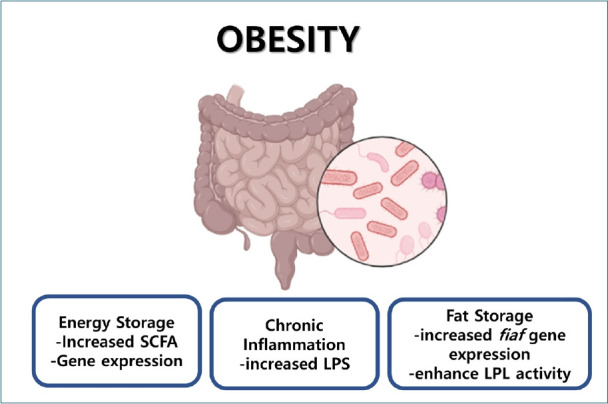
Pediatric obesity is among the most serious global health problems whose prevalence has increased over the past decade. Pediatric obesity increases concomitant health problems, including type 2 diabetes mellitus, hypertension, dyslipidemia, fatty liver disease, and psychological problems, which often progress into adulthood. The gut microbiota is a new factor in the development of obesity, which is affected by renowned risk factors such as diet, lifestyle, and socioeconomic status. This review aimed to describe the association between the gut microbiota and childhood obesity. According to advances in gene sequencing technologies, many findings of experimental animal and human studies of adults and children demonstrated that compositional and functional changes in the gut microbiota (dysbiosis) are associated with the development of obesity. Many studies have reported that an increased Firmicutes/Bacteroidetes (F/B) ratio is a biomarker of obesity susceptibility; however, with the rapid accumulation of data, meta-analyses of human gut microbiota and obesity showed no clear association between F/B ratio and obesity status. The contribution of the microbiota to obesity has been considered using multifactorial approaches, such as supplying additional calories to the host, modulating blood lipopolysaccharide levels, favoring fat storage, and affecting satiety. Probiotics are proposed to manipulate the gut microbiota population to improve obesity; however, their clinical application remains limited because trials have shown different results. Further studies are required to better understand the mechanisms underlying the observed association between the gut microbiota and pediatric obesity.
儿童肥胖是最严重的全球健康问题之一,其患病率在过去十年中有所上升。儿童肥胖会引发一系列伴随的健康问题,包括2型糖尿病、高血压、血脂异常、脂肪肝疾病以及心理问题,这些问题常常会持续到成年期。肠道微生物群是肥胖发生发展中的一个新因素,它会受到饮食、生活方式和社会经济地位等著名风险因素的影响。本综述旨在描述肠道微生物群与儿童肥胖之间的关联。根据基因测序技术的进展,许多针对实验动物以及成人和儿童的人体研究结果表明,肠道微生物群的组成和功能变化(生态失调)与肥胖的发生发展有关。许多研究报告称,厚壁菌门/拟杆菌门(F/B)比例升高是肥胖易感性的一个生物标志物;然而,随着数据的迅速积累,对人体肠道微生物群与肥胖的荟萃分析表明,F/B比例与肥胖状况之间没有明确的关联。人们已采用多因素方法来考量微生物群对肥胖的影响,例如为宿主提供额外热量、调节血液中脂多糖水平、促进脂肪储存以及影响饱腹感。有人提出使用益生菌来调节肠道微生物群数量以改善肥胖状况;然而,由于试验结果各异,其临床应用仍然有限。需要进一步开展研究,以更好地理解肠道微生物群与儿童肥胖之间所观察到的关联背后的机制。