Li Xiao-Fang, Wan Cheng-Quan, Mao Yi-Min
Department of Respiratory Medicine, The First Affiliated Hospital, College of Clinical Medicine of Henan University of Science and Technology, Luoyang, Henan, China.
Department of Neonatology, Luoyang Maternal and Child Health Hospital,, Luoyang, Henan, China.
Front Med (Lausanne). 2022 Nov 4;9:979959. doi: 10.3389/fmed.2022.979959. eCollection 2022.
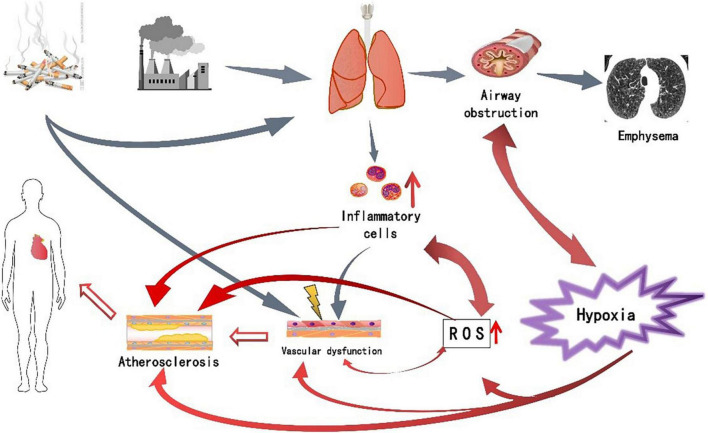
Chronic obstructive pulmonary disease (COPD) is a disease characterized by persistent airflow limitation, and is associated with abnormal inflammatory responses in the lungs to cigarette smoke and toxic and harmful gases. Due to the existence of common risk factors, COPD is prone to multiple complications, among which cardiovascular disease (CVD) is the most common. It is currently established that cardiovascular comorbidities increase the risk of exacerbations and mortality from COPD. COPD is also an independent risk factor for CVD, and its specific mechanism is still unclear, which may be related to chronic systemic inflammation, oxidative stress, and vascular dysfunction. There is evidence that chronic inflammation of the airways can lead to destruction of the lung parenchyma and decreased lung function. Inflammatory cells in the airways also generate reactive oxygen species in the lungs, and reactive oxygen species further promote lung inflammation through signal transduction and other pathways. Inflammatory mediators circulate from the lungs to the whole body, causing intravascular dysfunction, promoting the formation and rupture of atherosclerotic plaques, and ultimately leading to the occurrence and development of CVD. This article reviews the pathophysiological mechanisms of COPD complicated by CVD and the effects of common cardiovascular drugs on COPD.
慢性阻塞性肺疾病(COPD)是一种以持续性气流受限为特征的疾病,与肺部对香烟烟雾及有毒有害气体的异常炎症反应相关。由于存在共同的危险因素,COPD易于并发多种疾病,其中心血管疾病(CVD)最为常见。目前已明确,心血管合并症会增加COPD急性加重和死亡的风险。COPD也是CVD的独立危险因素,其具体机制尚不清楚,可能与慢性全身炎症、氧化应激及血管功能障碍有关。有证据表明,气道慢性炎症可导致肺实质破坏和肺功能下降。气道中的炎症细胞还会在肺部产生活性氧,活性氧通过信号转导等途径进一步促进肺部炎症。炎症介质从肺部循环至全身,导致血管内功能障碍,促进动脉粥样硬化斑块的形成和破裂,最终导致CVD的发生和发展。本文综述了COPD合并CVD的病理生理机制以及常用心血管药物对COPD的影响。