
基于深度学习的裂隙灯图像感染性角膜炎分类
Deep learning-based classification of infectious keratitis on slit-lamp images.
作者信息
Zhang Zijun, Wang Haoyu, Wang Shigeng, Wei Zhenyu, Zhang Yang, Wang Zhiqun, Chen Kexin, Ou Zhonghong, Liang Qingfeng
机构信息
Beijing Institute of Ophthalmology, Beijing Tongren Eye Center and Beijing Key Laboratory of Ophthalmology and Visual Sciences, Beijing Tongren Hospital, Capital Medical University, Beijing, China.
Beijing University of Posts and Telecommunications, Beijing, China.
出版信息
Ther Adv Chronic Dis. 2022 Nov 14;13:20406223221136071. doi: 10.1177/20406223221136071. eCollection 2022.
BACKGROUND
Infectious keratitis (IK) is an ocular emergency caused by a variety of microorganisms, including bacteria, fungi, viruses, and parasites. Culture-based methods were the gold standard for diagnosing IK, but difficult biopsy, delaying report, and low positive rate limited their clinical application.
OBJECTIVES
This study aims to construct a deep-learning-based auxiliary diagnostic model for early IK diagnosis.
DESIGN
A retrospective study.
METHODS
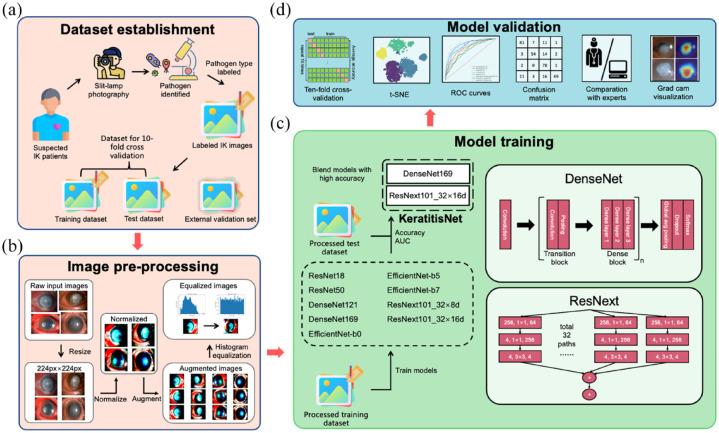
IK patients with pathological diagnosis were enrolled and their slit-lamp photos were collected. Image augmentation, normalization, and histogram equalization were applied, and five image classification networks were implemented and compared. Model blending technique was used to combine the advantages of single model. The performance of combined model was validated by 10-fold cross-validation, receiver operating characteristic curves (ROC), confusion matrix, Gradient-wright class activation mapping (Grad-CAM) visualization, and t-distributed Stochastic Neighbor Embedding (t-SNE). Three experienced cornea specialists were invited and competed with the combined model on making clinical decisions.
RESULTS
Overall, 4830 slit-lamp images were collected from patients diagnosed with IK between June 2010 and May 2021, including 1490 (30.8%) bacterial keratitis (BK), 1670 (34.6%) fungal keratitis (FK), 600 (12.4%) herpes simplex keratitis (HSK), and 1070 (22.2%) keratitis (AK). KeratitisNet, the combination of ResNext101_32x16d and DenseNet169, reached the highest accuracy 77.08%. The accuracy of KeratitisNet for diagnosing BK, FK, AK, and HSK was 70.27%, 77.71%, 83.81%, and 79.31%, and AUC was 0.86, 0.91, 0.96, and 0.98, respectively. KeratitisNet was mainly confused in distinguishing BK and FK. There were 20% of BK cases mispredicted into FK and 16% of FK cases mispredicted into BK. In diagnosing each type of IK, the accuracy of model was significantly higher than that of human ophthalmologists ( < 0.001).
CONCLUSION
KeratitisNet demonstrates a good performance on clinical IK diagnosis and classification. Deep learning could provide an auxiliary diagnostic method to help clinicians suspect IK using different corneal manifestations.
背景
感染性角膜炎(IK)是由多种微生物引起的眼部急症,包括细菌、真菌、病毒和寄生虫。基于培养的方法曾是诊断IK的金标准,但活检困难、报告延迟以及阳性率低限制了其临床应用。
目的
本研究旨在构建一种基于深度学习的辅助诊断模型用于早期IK诊断。
设计
一项回顾性研究。
方法
纳入经病理诊断的IK患者并收集其裂隙灯照片。应用图像增强、归一化和直方图均衡化,实施并比较了五个图像分类网络。采用模型融合技术结合单一模型的优势。通过10折交叉验证、受试者工作特征曲线(ROC)、混淆矩阵、梯度加权类激活映射(Grad-CAM)可视化以及t分布随机邻域嵌入(t-SNE)验证组合模型的性能。邀请三位经验丰富的角膜专科医生与组合模型进行临床决策竞赛。
结果
总体而言,2010年6月至2021年5月期间从诊断为IK的患者中收集了4830张裂隙灯图像,包括1490例(30.8%)细菌性角膜炎(BK)、1670例(34.6%)真菌性角膜炎(FK)、600例(12.4%)单纯疱疹性角膜炎(HSK)和1070例(22.2%)非特异性角膜炎(AK)。KeratitisNet,即ResNext101_32x16d和DenseNet169的组合,达到了最高准确率77.08%。KeratitisNet诊断BK、FK、AK和HSK的准确率分别为70.27%、77.71%、83.81%和79.31%,AUC分别为0.86、0.91、0.96和0.98。KeratitisNet在区分BK和FK时主要出现混淆。有20%的BK病例被误判为FK,16%的FK病例被误判为BK。在诊断每种类型的IK时,模型的准确率显著高于眼科医生(P < 0.001)。
结论
KeratitisNet在临床IK诊断和分类方面表现良好。深度学习可为临床医生利用不同角膜表现怀疑IK提供一种辅助诊断方法。



 Zotero 插件