Umuhoza Therese, Oyugi Julius, Mancuso James D, Bulimo Wallace D
Institute of Tropical and Infectious Diseases, University of Nairobi.
Department of Preventive Medicine and Biostatistics, Uniformed Services University of the Health Sciences, Bethesda, MD, USA.
East Afr Health Res J. 2022;6(1):52-63. doi: 10.24248/eahrj.v6i1.679.
Human Respiratory Syncytial Virus (HRSV), Human Parainfluenza Virus (HPIV), and Human Adenovirus (HAdV) epidemics differ in geographical location, time, and virus type. Regions prone to infections can be identified using geographic information systems (GIS) and available methods for detecting spatial and time clusters. We sought to find statistically significant spatial and time clusters of HRSV, HPIV, and HAdV cases in different parts of Kenya.
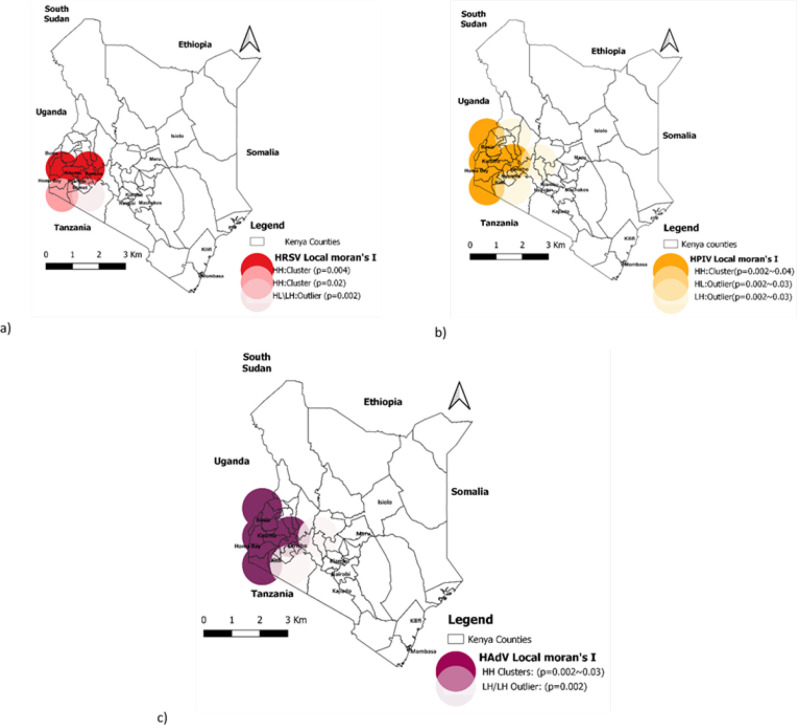
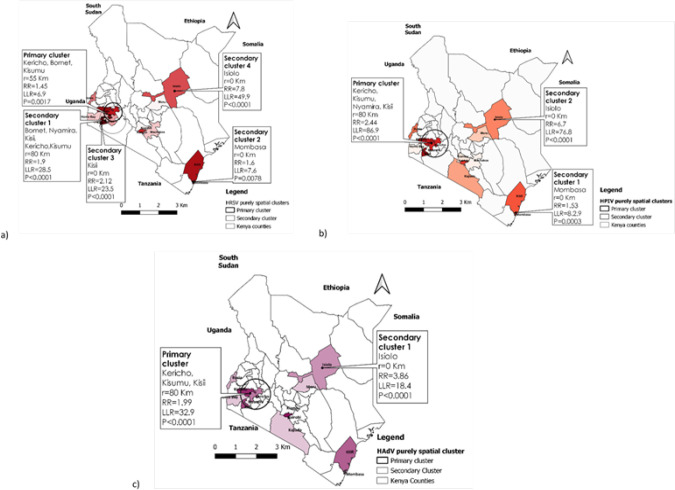
To analyse retrospective data, we used a geographical information system (GIS) and the spatial scan statistic. The information was gathered from surveillance sites and aggregated at the county level in order to identify purely spatial and Spatio-temporal clusters. To detect the presence of spatial autocorrelation, the local Moran's I test was used. To detect the spatial clusters of HRSV, HPIV, and HAdV cases, we performed the purely spatial scan statistic. Furthermore, space-time clusters were identified using space-time scan statistics. Both spatial and space-time analyses were based on the discrete Poisson model with a pre-specified statistical significance levelof p<0.05.
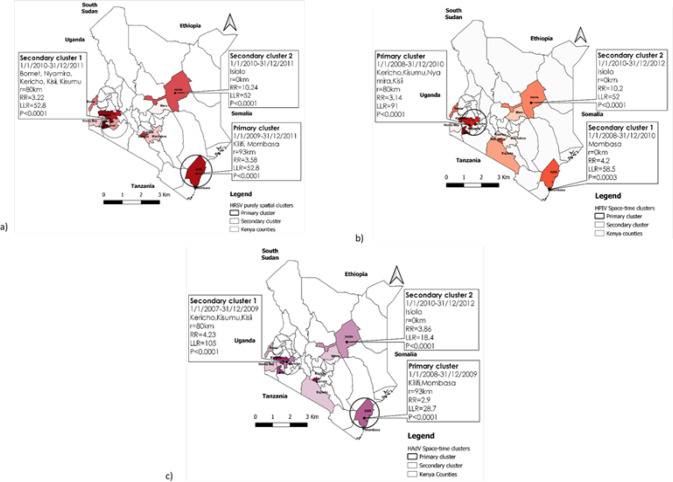
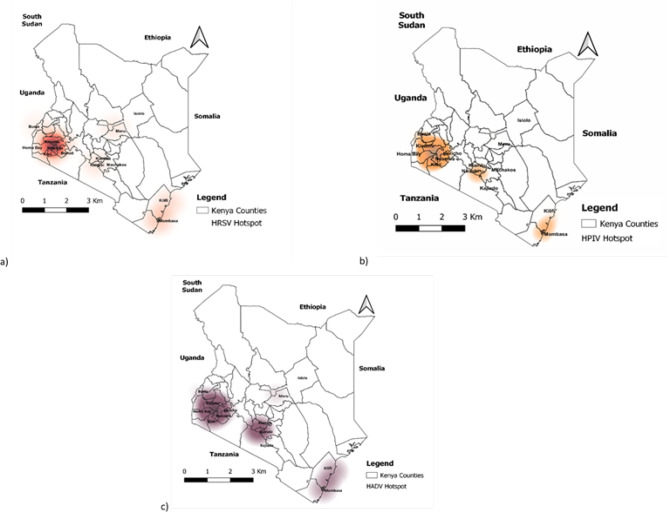
The findings showed that HRSV, HPIV, and HAdV cases had significant autocorrelation within the study areas. Furthermore, in the Western region of the country, the three respiratory viruses had local clusters with significant positive autocorrelation (p<0.05). Statistically, the Western region had significant spatial clusters of HRSV, HPIV, and HAdV occurrence. Furthermore, the space-time analysis revealed that the HPIV primary cluster persisted in the Western region from 2007 to 2013. However, primary clusters of HRSV and HAdV were observed in the Coastal region in 2009-11 and 2008-09, respectively.
Human respiratory syncytial virus (HRSV), human parainfluenza virus (HPIV), and human adenovirus (HAdV) hotspots (clusters) occurred in Kenya's Western and Coastal regions from 2007 to 2013. The Western region appeared to be more prone to the occurrence of allthree respiratory viruses throughout the study period. Strategic mitigation should focus on these locations to prevent future clusters of HRSV, HPIV, and HAdV infections that could lead to epidemics.
人呼吸道合胞病毒(HRSV)、人副流感病毒(HPIV)和人腺病毒(HAdV)的流行在地理位置、时间和病毒类型上存在差异。可以使用地理信息系统(GIS)和现有的检测空间和时间聚集性的方法来确定易感染区域。我们试图在肯尼亚不同地区寻找HRSV、HPIV和HAdV病例具有统计学意义的空间和时间聚集性。
为分析回顾性数据,我们使用了地理信息系统(GIS)和空间扫描统计法。这些信息是从监测点收集并在县级层面汇总,以识别单纯空间聚集性和时空聚集性。为检测空间自相关性,使用了局部莫兰指数检验。为检测HRSV、HPIV和HAdV病例的空间聚集性,我们进行了单纯空间扫描统计。此外,使用时空扫描统计法识别时空聚集性。空间分析和时空分析均基于离散泊松模型,预先设定的统计显著性水平为p<0.05。
研究结果表明,HRSV、HPIV和HAdV病例在研究区域内具有显著的自相关性。此外,在该国西部地区,这三种呼吸道病毒存在局部聚集性,具有显著的正自相关性(p<0.05)。从统计学角度看,西部地区存在HRSV、HPIV和HAdV发生的显著空间聚集性。此外,时空分析显示,HPIV主要聚集性在2007年至2013年期间持续存在于西部地区。然而,HRSV和HAdV的主要聚集性分别在2009 - 2011年和2008 - 2009年出现在沿海地区。
2007年至2013年期间,人呼吸道合胞病毒(HRSV)、人副流感病毒(HPIV)和人腺病毒(HAdV)的热点地区(聚集性区域)出现在肯尼亚的西部和沿海地区。在整个研究期间,西部地区似乎更容易出现这三种呼吸道病毒。应将战略缓解措施重点放在这些地区,以预防未来可能导致疫情的HRSV、HPIV和HAdV感染聚集性情况。