Chemical Insights Research Institute, Underwriters Laboratories Inc., Marietta, GA 30067, USA.
School of Earth and Atmospheric Sciences, Georgia Institute of Technology, Atlanta, GA 30332, USA.
Sci Total Environ. 2023 Feb 20;860:160512. doi: 10.1016/j.scitotenv.2022.160512. Epub 2022 Nov 25.
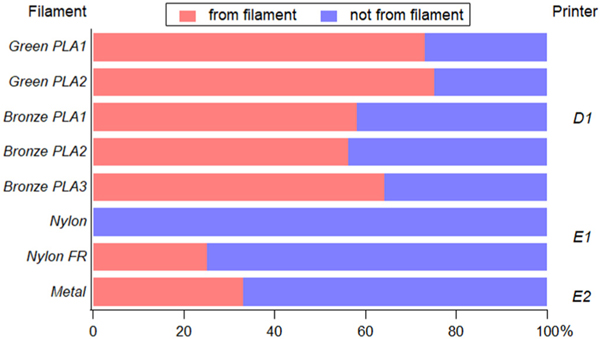
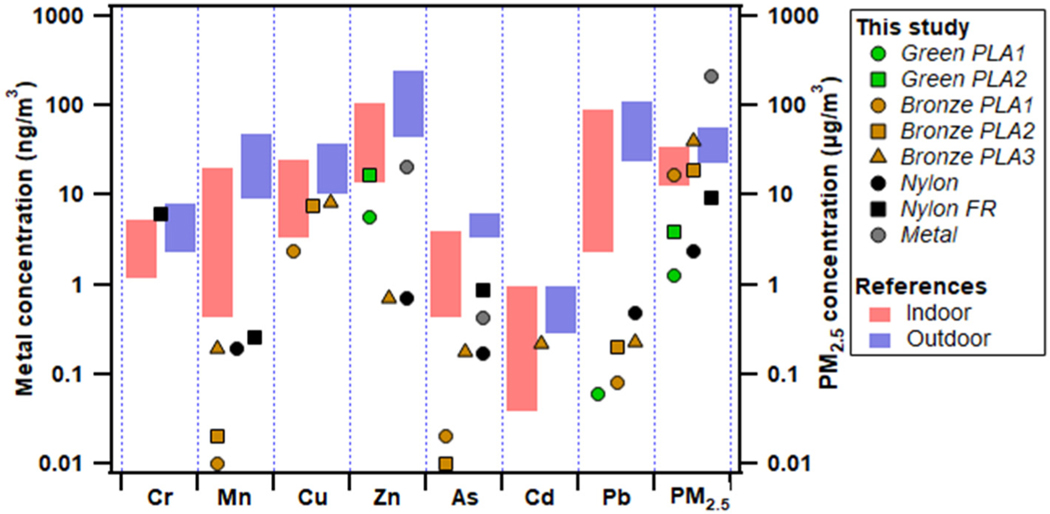
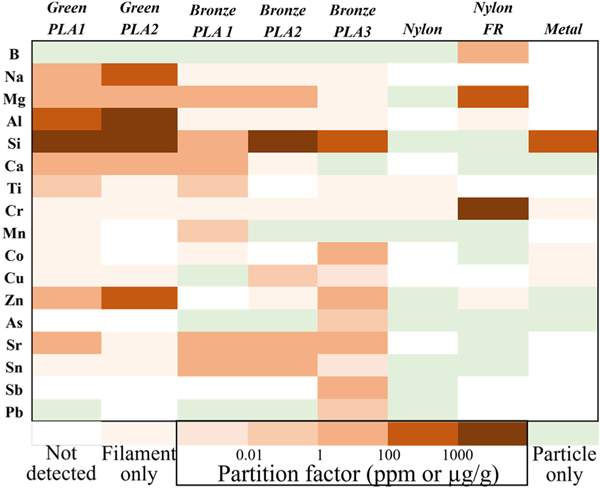
Material extrusion 3D printing has been widely used in industrial, educational and residential environments, while its exposure health impacts have not been well understood. High levels of ultrafine particles are found being emitted from 3D printing and could pose a hazard when inhaled. However, metals that potentially transfer from filament additives to emitted particles could also add to the exposure hazard, which have not been well characterized for their emissions. This study analyzed metal (and metalloid) compositions of raw filaments and in the emitted particles during printing; studied filaments included pure polymer filaments with metal additives and composite filaments with and without metal powder. Our chamber study found that crustal metals tended to have higher partitioning factors from filaments to emitted particles; silicon was the most abundant element in emitted particles and had the highest yield per filament mass. However, bronze and stainless-steel powder added in composite filaments were less likely to transfer from filament to particle. For some cases, boron, arsenic, manganese, and lead were only detected in particles, which indicated external sources, such as the printers themselves. Heavy metals with health concerns were also detected in emitted particles, while their estimated exposure concentrations in indoor air were below air quality standards and occupational regulations. However, total particle exposure concentrations estimated for indoor environments could exceed ambient air fine particulate standards.
材料挤出 3D 打印已广泛应用于工业、教育和住宅环境中,但其暴露健康影响尚未得到充分理解。研究发现,3D 打印过程中会释放出大量的超细颗粒,如果被吸入,可能会造成危害。然而,从灯丝添加剂转移到排放颗粒中的金属也可能会增加暴露的危险,但它们的排放特性尚未得到很好的描述。本研究分析了打印过程中原始灯丝和排放颗粒中的金属(和类金属)成分;研究的灯丝包括含有金属添加剂的纯聚合物灯丝和含有或不含有金属粉末的复合灯丝。我们的腔室研究发现,地壳金属从灯丝到排放颗粒的分配系数往往较高;硅是排放颗粒中最丰富的元素,每根灯丝的产率最高。然而,复合灯丝中添加的青铜和不锈钢粉末则不太可能从灯丝转移到颗粒中。在某些情况下,硼、砷、锰和铅只在颗粒中被检测到,这表明存在外部来源,如打印机本身。排放颗粒中也检测到了一些对健康有影响的重金属,而它们在室内空气中的估计暴露浓度低于空气质量标准和职业法规。然而,估计室内环境中的总颗粒暴露浓度可能会超过环境空气中细颗粒物的标准。