CIB, Centro de Investigaciones Biológicas Margarita Salas (CSIC), 28040, Madrid, Spain.
Grupo Interdisciplinar de Sistemas Complejos de Madrid (GISC), Madrid, Spain.
Nat Commun. 2022 Dec 1;13(1):7412. doi: 10.1038/s41467-022-35203-7.
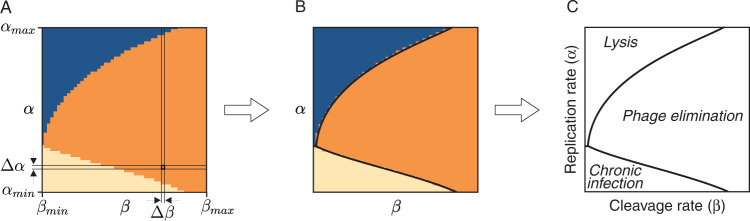
Bacterial cells are equipped with a variety of immune strategies to fight bacteriophage infections. Such strategies include unspecific mechanisms directed against any phage infecting the cell, ranging from the identification and cleavage of the viral DNA by restriction nucleases (restriction-modification systems) to the suicidal death of infected host cells (abortive infection, Abi). In addition, CRISPR-Cas systems generate an immune memory that targets specific phages in case of reinfection. However, the timing and coordination of different antiviral systems in bacterial cells are poorly understood. Here, we use simple mathematical models of immune responses in individual bacterial cells to propose that the intracellular dynamics of phage infections are key to addressing these questions. Our models suggest that the rates of viral DNA replication and cleavage inside host cells define functional categories of phages that differ in their susceptibility to bacterial anti-phage mechanisms, which could give raise to alternative phage strategies to escape bacterial immunity. From this viewpoint, the combined action of diverse bacterial defenses would be necessary to reduce the chances of phage immune evasion. The decision of individual infected cells to undergo suicidal cell death or to incorporate new phage sequences into their immune memory would be determined by dynamic interactions between the host's immune mechanisms and the phage DNA. Our work highlights the importance of within-cell dynamics to understand bacterial immunity, and formulates hypotheses that may inspire future research in this area.
细菌细胞配备了多种免疫策略来对抗噬菌体感染。这些策略包括针对感染细胞的任何噬菌体的非特异性机制,范围从识别和切割病毒 DNA 的限制核酸内切酶(限制修饰系统)到感染宿主细胞的自杀性死亡(流产感染,Abi)。此外,CRISPR-Cas 系统产生针对再次感染的特定噬菌体的免疫记忆。然而,细菌细胞中不同抗病毒系统的时间和协调仍知之甚少。在这里,我们使用单个细菌细胞中免疫反应的简单数学模型来提出噬菌体感染的细胞内动力学是解决这些问题的关键。我们的模型表明,宿主细胞内病毒 DNA 复制和切割的速度定义了噬菌体的功能类别,它们在对细菌抗噬菌体机制的敏感性方面存在差异,这可能导致噬菌体逃避细菌免疫的替代策略。从这个角度来看,多种细菌防御的联合作用将是减少噬菌体免疫逃避机会的必要条件。受感染细胞个体决定进行自杀性细胞死亡或将新的噬菌体序列整合到其免疫记忆中,将取决于宿主免疫机制和噬菌体 DNA 之间的动态相互作用。我们的工作强调了细胞内动力学对于理解细菌免疫的重要性,并提出了可能激发该领域未来研究的假设。