Endocrinology and Metabolism Research Center, Endocrinology and Metabolism Clinical Sciences Institute, Tehran University of Medical Sciences, Tehran, Iran.
Radiology department, Shariati hospital, Tehran University of Medical Sciences, Tehran, Iran.
BMC Endocr Disord. 2022 Dec 1;22(1):298. doi: 10.1186/s12902-022-01224-y.
Polycystic ovary syndrome (PCOS) is diagnosed based on chronic anovulation, androgen excess (clinical and/or biochemical), and polycystic ovaries in ultrasound. The aim of the present study was to evaluate which parameters in the transvaginal ultrasound (TVUS) of ovaries could be better associated with concurrent hormonal imbalance in the women with PCOS.
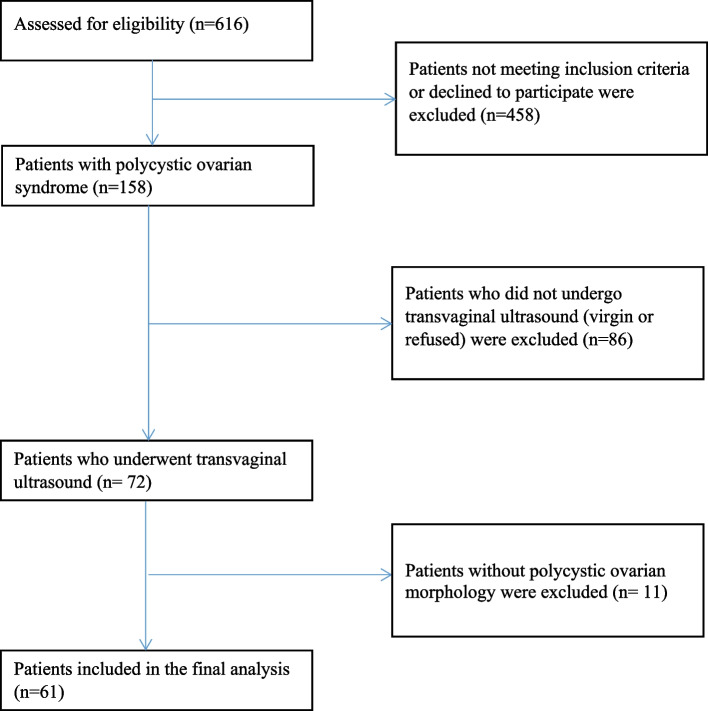
Using a cross-sectional design, this study focused on 61 subjects (18-40 years) with PCOS. Patients were recruited at three academic hospitals during the 2017-2019 period. PCOS was defined according to the Rotterdam criteria. The association of ovarian morphology with hormonal and metabolic feature was investigated using linear regression models, adjusted for a set of possible confounding variables including age, mensuration status and body mass index (BMI).
The mean volume of both ovaries was positively associated with the total testosterone level (β = 0.025, P value < 0.001), free androgen index (β = 0.041, P value < 0.001) and luteinizing hormone/follicle stimulating hormone (LH/FSH) ratio (β = 0.032, P value = 0.004), even after adjustments made for age, mensuration status and BMI (fully-adjusted model). In contrast, in the fully-adjusted model, antral follicle count (AFC), follicle number per ovary (FNPO), ovarian area, stromal area, and ratio of stromal area to ovarian area (S/A) were not associated with androgen levels and LH/FSH ratio. In addition, after full adjustments, ovarian volume, AFC, FNPO, ovarian area, stromal area and S/A were not associated with insulin resistance, which was estimated by the homeostasis model assessment of insulin resistance (HOMA-IR).
Increased ovarian volume is, thus, highly predictive of hyperandrogenemia and high LH/FSH ratio in PCOS patients.
多囊卵巢综合征(PCOS)的诊断基于慢性无排卵、雄激素过多(临床和/或生化)以及超声检查中的多囊卵巢。本研究旨在评估经阴道超声(TVUS)卵巢的哪些参数与 PCOS 患者同时存在的激素失衡有更好的相关性。
本研究采用横断面设计,共纳入 61 例(18-40 岁)PCOS 患者。患者于 2017 年至 2019 年期间在三家学术医院招募。PCOS 按照 Rotterdam 标准进行定义。使用线性回归模型,在考虑年龄、测量状态和体重指数(BMI)等一系列可能的混杂因素后,研究卵巢形态与激素和代谢特征的相关性。
双侧卵巢体积的平均值与总睾酮水平(β=0.025,P 值<0.001)、游离雄激素指数(β=0.041,P 值<0.001)和黄体生成素/卵泡刺激素(LH/FSH)比值(β=0.032,P 值=0.004)呈正相关,即使在调整年龄、测量状态和 BMI 后(全调整模型)。相反,在全调整模型中,窦卵泡计数(AFC)、每侧卵巢的卵泡数(FNPO)、卵巢面积、间质面积以及间质面积与卵巢面积之比(S/A)与雄激素水平和 LH/FSH 比值均无相关性。此外,在全调整后,卵巢体积、AFC、FNPO、卵巢面积、间质面积和 S/A 与胰岛素抵抗(通过稳态模型评估的胰岛素抵抗评估)无关。
因此,卵巢体积增加高度预测 PCOS 患者的高雄激素血症和高 LH/FSH 比值。