Institute of General Practice and Health Services Research, TUM School of Medicine, Technical University of Munich (TUM), Orleansstraße 47, 81667, Munich, Germany.
Institute for AI and Informatics in Medicine, TUM School of Medicine, Technical University of Munich (TUM), Munich, Germany.
BMC Pulm Med. 2022 Dec 1;22(1):457. doi: 10.1186/s12890-022-02217-2.
Asthma education programs (AEPs) have been shown to increase quality of life and reduce emergency treatments and hospital admissions. Despite the proven benefits, only a minority of asthma patients attend such programs. To increase the number of educated patients, an online education program (electronic AEP, eAEP) for asthma patients has been developed. The present study aims to investigate the effectiveness of the eAEP in terms of asthma knowledge, asthma control and emergency treatments in general practice settings.
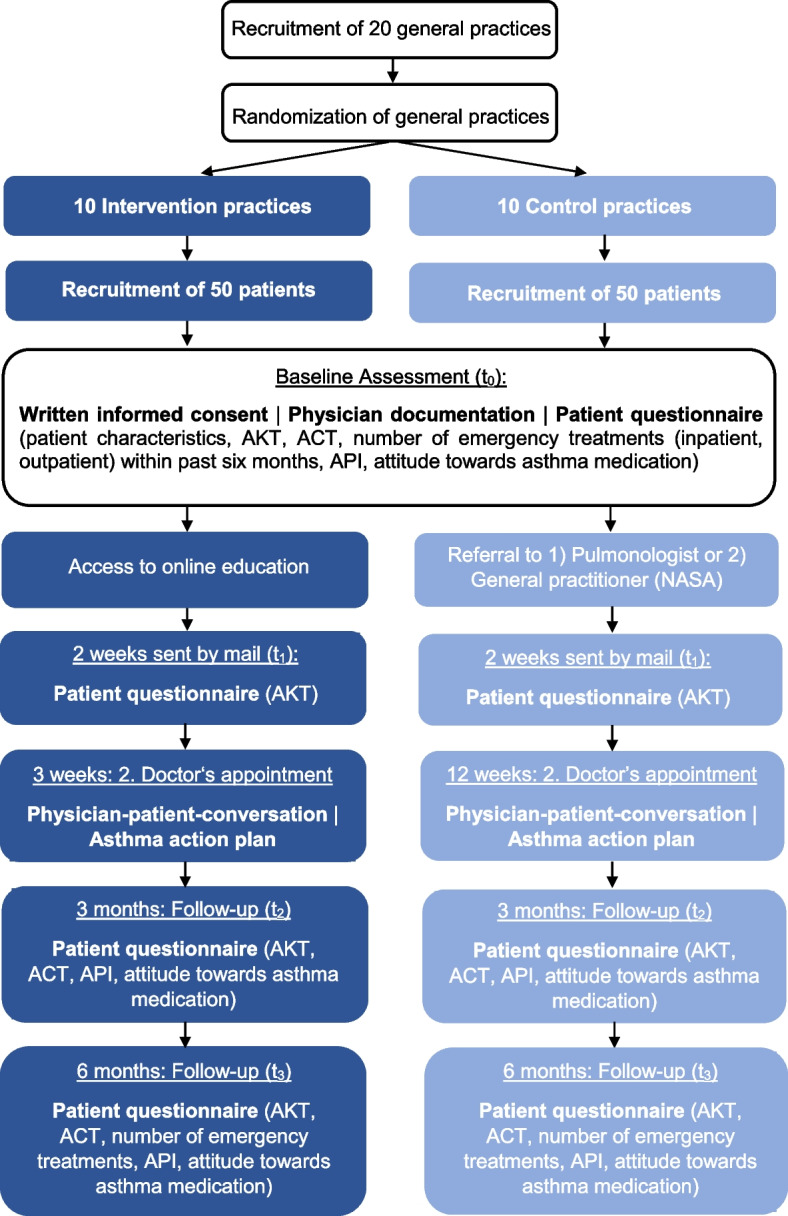
This is a cluster randomized controlled trial including 100 patients with bronchial asthma from 20 general practices in Bavaria, Germany. General practices will be randomly assigned to either the intervention or control group. Patients in the intervention group will receive access to the eAEP and instructions to complete this program within two weeks. Patients in the control group will receive usual care including a referral to face-to-face AEP (fAEP) by a certified primary care physician or a pulmonologist according to guideline recommendations. Furthermore, patients of both the intervention and control groups will be invited to a follow-up consultation in their general practice after completion of the eAEP and fAEP (three weeks and twelve weeks after study inclusion, respectively) to discuss any open issues. Outcomes for both groups will be assessed at baseline (t), after two weeks (t), three months (t) and six months (t). The primary outcome is the comparison of asthma knowledge gain between intervention and control groups after completion of the eAEP (two weeks after study inclusion) and fAEP (twelve weeks after study inclusion), respectively. Secondary outcomes include asthma control, frequency of emergency treatments, patient autonomy as well as attitudes towards asthma medication.
The results of the present trial will provide knowledge about the effectiveness of an online education program for asthma patients compared to usual care in primary care.
German Clinical Trials Register (DRKS), DRKS00028805 . Registered 22 April 2022.
哮喘教育计划(AEPs)已被证明可以提高生活质量,减少急诊治疗和住院治疗。尽管有明显的益处,但只有少数哮喘患者参加此类计划。为了增加受过教育的患者人数,已经为哮喘患者开发了在线教育计划(电子 AEP,eAEP)。本研究旨在调查 eAEP 在一般实践环境中对哮喘知识、哮喘控制和急诊治疗的有效性。
这是一项包括德国巴伐利亚州 20 家普通诊所的 100 名支气管哮喘患者的聚类随机对照试验。普通诊所将被随机分配到干预组或对照组。干预组的患者将获得访问 eAEP 的权限,并被指示在两周内完成该计划。对照组的患者将接受常规护理,包括根据指南建议由认证的初级保健医生或肺科医生进行面对面的 AEP(fAEP)转诊。此外,两组患者都将在完成 eAEP 和 fAEP 后(分别在研究纳入后三周和十二周)在其普通诊所进行随访咨询,以讨论任何未解决的问题。两组的结果将在基线(t)、两周后(t)、三个月后(t)和六个月后(t)进行评估。主要结果是比较干预组和对照组在完成 eAEP(研究纳入后两周)和 fAEP(研究纳入后十二周)后的哮喘知识增益。次要结果包括哮喘控制、急诊治疗频率、患者自主性以及对哮喘药物的态度。
本试验的结果将提供有关在线哮喘患者教育计划与初级保健常规护理相比的有效性的知识。
德国临床试验注册处(DRKS),DRKS00028805。注册于 2022 年 4 月 22 日。