Möller Steffen, Saul Nadine, Projahn Elias, Barrantes Israel, Gézsi András, Walter Michael, Antal Péter, Fuellen Georg
Rostock University Medical Center, Institute for Biostatistics and Informatics in Medicine and Ageing Research, Rostock, Germany.
Humboldt-University of Berlin, Institute of Biology, Berlin, Germany.
NAR Genom Bioinform. 2022 Nov 29;4(4):lqac083. doi: 10.1093/nargab/lqac083. eCollection 2022 Dec.
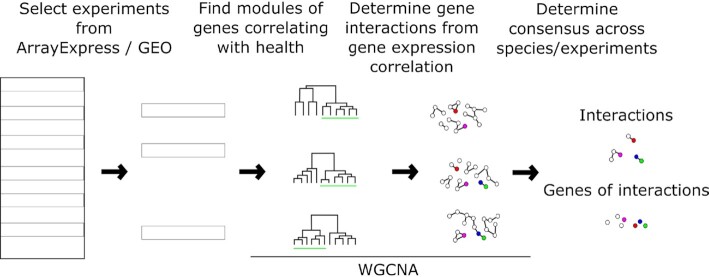
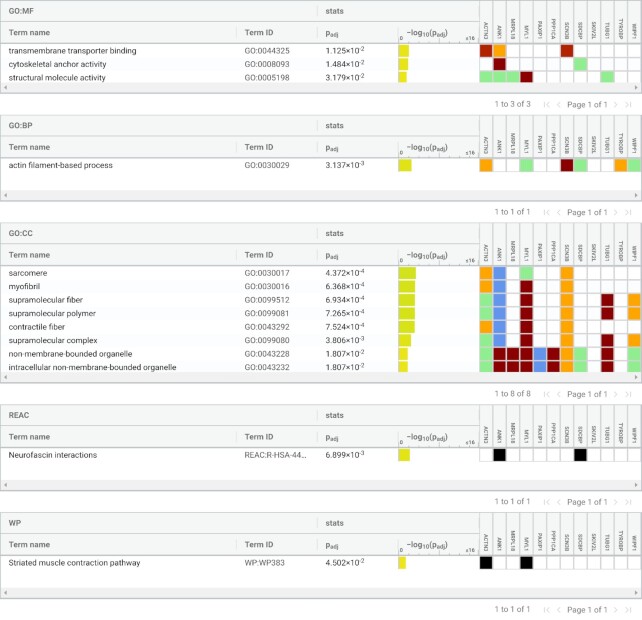
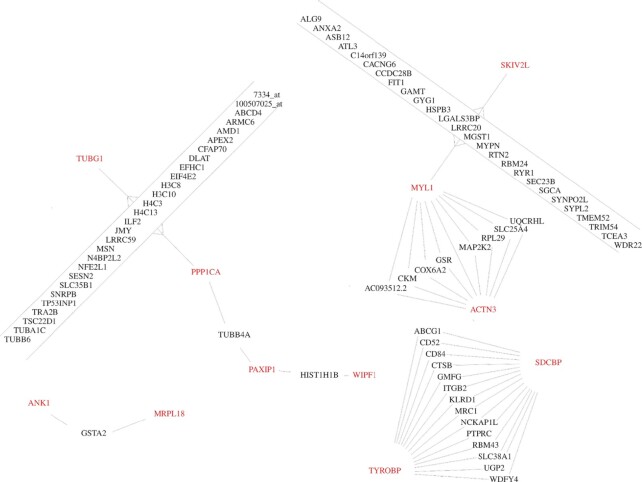
Health(span)-related gene clusters/modules were recently identified based on knowledge about the cross-species genetic basis of health, to interpret transcriptomic datasets describing health-related interventions. However, the cross-species comparison of health-related observations reveals a lot of heterogeneity, not least due to widely varying health(span) definitions and study designs, posing a challenge for the exploration of conserved healthspan modules and, specifically, their transfer across species. To improve the identification and exploration of conserved/transferable healthspan modules, here we apply an established workflow based on gene co-expression network analyses employing GEO/ArrayExpress data for human and animal models, and perform a comprehensive meta-study of the resulting modules related to health(span), yielding a small set of literature backed health(span) candidate genes. For each experiment, WGCNA (weighted gene correlation network analysis) was used to infer modules of genes which correlate in their expression with a 'health phenotype score' and to determine the most-connected (hub) genes (and their interactions) for each such module. After mapping these hub genes to their human orthologs, 12 health(span) genes were identified in at least two species (ACTN3, ANK1, MRPL18, MYL1, PAXIP1, PPP1CA, SCN3B, SDCBP, SKIV2L, TUBG1, TYROBP, WIPF1), for which enrichment analysis by g:profiler found an association with actin filament-based movement and associated organelles, as well as muscular structures. We conclude that a meta-study of hub genes from co-expression network analyses for the complex phenotype health(span), across multiple species, can yield molecular-mechanistic insights and can direct experimentalists to further investigate the contribution of individual genes and their interactions to health(span).
最近,基于有关健康的跨物种遗传基础的知识,鉴定出了与健康(寿命)相关的基因簇/模块,以解读描述与健康相关干预措施的转录组数据集。然而,与健康相关观察结果的跨物种比较显示出很大的异质性,这尤其是由于健康(寿命)定义和研究设计差异很大,这给保守的健康寿命模块的探索带来了挑战,特别是这些模块在物种间的转移。为了改进对保守/可转移健康寿命模块的鉴定和探索,我们在此应用一种基于基因共表达网络分析的既定工作流程,该流程采用来自人类和动物模型的GEO/ArrayExpress数据,并对与健康(寿命)相关的所得模块进行全面的元研究,从而产生一小部分有文献支持的健康(寿命)候选基因。对于每个实验,使用加权基因共表达网络分析(WGCNA)来推断其表达与“健康表型评分”相关的基因模块,并确定每个此类模块中连接性最强的(枢纽)基因(及其相互作用)。将这些枢纽基因映射到它们的人类直系同源基因后,在至少两个物种中鉴定出了12个与健康(寿命)相关的基因(ACTN3、ANK1、MRPL18、MYL1、PAXIP1、PPP1CA、SCN3B、SDCBP、SKIV2L、TUBG1、TYROBP、WIPF1),通过g:profiler进行的富集分析发现这些基因与基于肌动蛋白丝的运动及相关细胞器以及肌肉结构有关。我们得出结论,对跨多个物种的复杂表型健康(寿命)进行共表达网络分析中的枢纽基因进行元研究,可以产生分子机制方面的见解,并可以指导实验人员进一步研究单个基因及其相互作用对健康(寿命)的贡献。