
使用双任务深度学习从超低剂量PET/MRI合成高质量PET图像。
High-quality PET image synthesis from ultra-low-dose PET/MRI using bi-task deep learning.
作者信息
Sun Hanyu, Jiang Yongluo, Yuan Jianmin, Wang Haining, Liang Dong, Fan Wei, Hu Zhanli, Zhang Na
机构信息
Lauterbur Research Center for Biomedical Imaging, Shenzhen Institute of Advanced Technology, Chinese Academy of Sciences, Shenzhen, China.
Department of Nuclear Medicine, Sun Yat-sen University Cancer Center, Guangzhou, China.
出版信息
Quant Imaging Med Surg. 2022 Dec;12(12):5326-5342. doi: 10.21037/qims-22-116.
BACKGROUND
Lowering the dose for positron emission tomography (PET) imaging reduces patients' radiation burden but decreases the image quality by increasing noise and reducing imaging detail and quantifications. This paper introduces a method for acquiring high-quality PET images from an ultra-low-dose state to achieve both high-quality images and a low radiation burden.
METHODS
We developed a two-task-based end-to-end generative adversarial network, named bi-c-GAN, that incorporated the advantages of PET and magnetic resonance imaging (MRI) modalities to synthesize high-quality PET images from an ultra-low-dose input. Moreover, a combined loss, including the mean absolute error, structural loss, and bias loss, was created to improve the trained model's performance. Real integrated PET/MRI data from 67 patients' axial heads (each with 161 slices) were used for training and validation purposes. Synthesized images were quantified by the peak signal-to-noise ratio (PSNR), normalized mean square error (NMSE), structural similarity (SSIM), and contrast noise ratio (CNR). The improvement ratios of these four selected quantitative metrics were used to compare the images produced by bi-c-GAN with other methods.
RESULTS
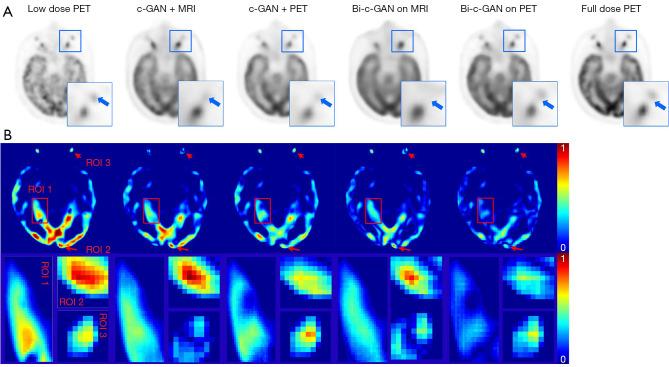
In the four-fold cross-validation, the proposed bi-c-GAN outperformed the other three selected methods (U-net, c-GAN, and multiple input c-GAN). With the bi-c-GAN, in a 5% low-dose PET, the image quality was higher than that of the other three methods by at least 6.7% in the PSNR, 0.6% in the SSIM, 1.3% in the NMSE, and 8% in the CNR. In the hold-out validation, bi-c-GAN improved the image quality compared to U-net and c-GAN in both 2.5% and 10% low-dose PET. For example, the PSNR using bi-C-GAN was at least 4.46% in the 2.5% low-dose PET and at most 14.88% in the 10% low-dose PET. Visual examples also showed a higher quality of images generated from the proposed method, demonstrating the denoising and improving ability of bi-c-GAN.
CONCLUSIONS
By taking advantage of integrated PET/MR images and multitask deep learning (MDL), the proposed bi-c-GAN can efficiently improve the image quality of ultra-low-dose PET and reduce radiation exposure.
背景
降低正电子发射断层扫描(PET)成像的剂量可减轻患者的辐射负担,但会因增加噪声、减少成像细节和定量分析而降低图像质量。本文介绍一种从超低剂量状态获取高质量PET图像的方法,以实现高质量图像和低辐射负担。
方法
我们开发了一种基于双任务的端到端生成对抗网络,名为bi-c-GAN,它融合了PET和磁共振成像(MRI)模态的优势,可从超低剂量输入合成高质量PET图像。此外,还创建了一种包括平均绝对误差、结构损失和偏差损失的组合损失,以提高训练模型的性能。来自67例患者轴向头部(各有161层)的真实PET/MRI整合数据用于训练和验证。合成图像通过峰值信噪比(PSNR)、归一化均方误差(NMSE)、结构相似性(SSIM)和对比噪声比(CNR)进行量化。这四个选定定量指标的改善率用于比较bi-c-GAN与其他方法生成的图像。
结果
在四折交叉验证中,所提出的bi-c-GAN优于其他三种选定方法(U-net、c-GAN和多输入c-GAN)。使用bi-c-GAN时,在5%低剂量PET中,图像质量在PSNR方面比其他三种方法至少高6.7%,在SSIM方面高0.6%,在NMSE方面高1.3%,在CNR方面高8%。在留一法验证中,与U-net和c-GAN相比,bi-c-GAN在2.5%和10%低剂量PET中均提高了图像质量。例如,在2.5%低剂量PET中使用bi-C-GAN时的PSNR至少为4.46%,在10%低剂量PET中最多为14.88%。可视化示例也显示了所提出方法生成的图像质量更高,证明了bi-c-GAN的去噪和改善能力。
结论
通过利用PET/MR整合图像和多任务深度学习(MDL),所提出的bi-c-GAN可有效提高超低剂量PET的图像质量并减少辐射暴露。




 Zotero 插件