Institute for Medical Engineering and Science (IMES), Massachusetts Institute of Technology, Cambridge, MA, USA.
Department of Chemistry, Massachusetts Institute of Technology, Cambridge, MA, USA.
Methods Mol Biol. 2023;2584:57-104. doi: 10.1007/978-1-0716-2756-3_3.
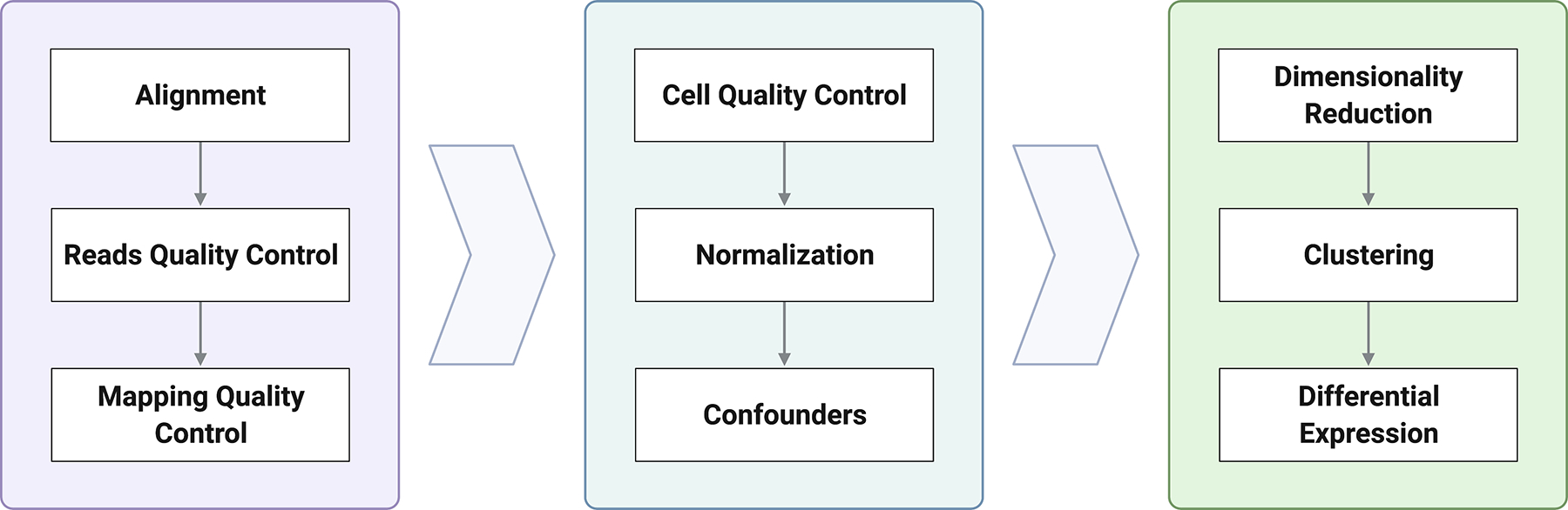
Seq-Well is a high-throughput, picowell-based single-cell RNA-seq technology that can be used to simultaneously profile the transcriptomes of thousands of cells (Gierahn et al. Nat Methods 14(4):395-398, 2017). Relative to its reverse-emulsion-droplet-based counterparts, Seq-Well addresses key cost, portability, and scalability limitations. Recently, we introduced an improved molecular biology for Seq-Well to enhance the information content that can be captured from individual cells using the platform. This update, which we call Seq-Well S (S: Second-Strand Synthesis), incorporates a second-strand-synthesis step after reverse transcription to boost the detection of cellular transcripts normally missed when running the original Seq-Well protocol (Hughes et al. Immunity 53(4):878-894.e7, 2020). This chapter provides details and tips on how to perform Seq-Well S, along with general pointers on how to subsequently analyze the resultant single-cell RNA-seq data.
Seq-Well 是一种高通量、基于 picowell 的单细胞 RNA-seq 技术,可用于同时分析数千个细胞的转录组(Gierahn 等人,Nat Methods 14(4):395-398, 2017)。与基于反转乳液液滴的同类技术相比,Seq-Well 解决了关键的成本、便携性和可扩展性限制。最近,我们引入了一种改进的分子生物学方法,用于 Seq-Well,以增强使用该平台从单个细胞中捕获的信息含量。这个更新,我们称之为 Seq-Well S(S:Second-Strand Synthesis),在反转录后增加了第二链合成步骤,以提高通常在运行原始 Seq-Well 方案时错过的细胞转录本的检测率(Hughes 等人,Immunity 53(4):878-894.e7, 2020)。本章提供了有关如何执行 Seq-Well S 的详细信息和技巧,以及如何随后分析所得单细胞 RNA-seq 数据的一般提示。