Center for Immuno-Oncology, Center for Cancer Research, National Cancer Institute, National Institutes of Health, Bethesda, MD 20892, USA.
Cells. 2022 Nov 29;11(23):3826. doi: 10.3390/cells11233826.
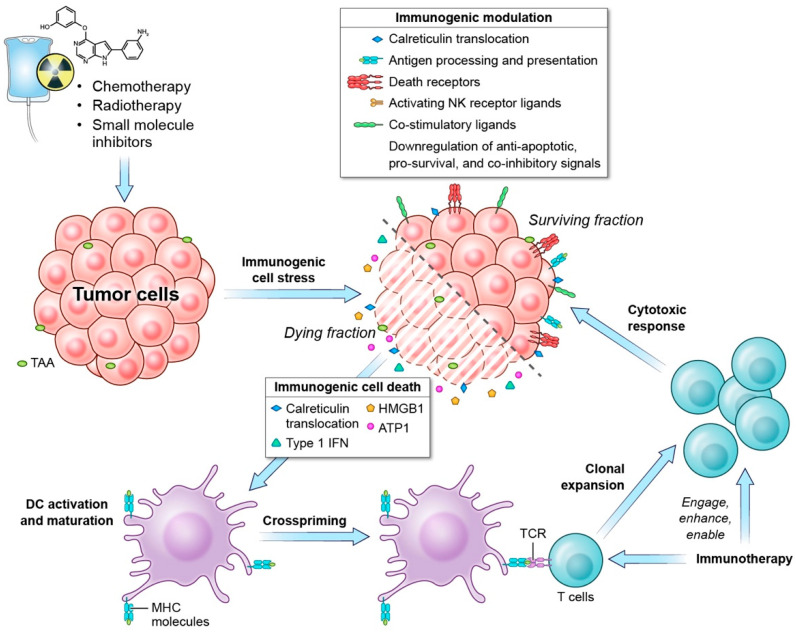
Innovative strategies to re-establish the immune-mediated destruction of malignant cells is paramount to the success of anti-cancer therapy. Accumulating evidence suggests that radiotherapy and select chemotherapeutic drugs and small molecule inhibitors induce immunogenic cell stress on tumors that results in improved immune recognition and targeting of the malignant cells. Through immunogenic cell death, which entails the release of antigens and danger signals, and immunogenic modulation, wherein the phenotype of stressed cells is altered to become more susceptible to immune attack, radiotherapies, chemotherapies, and small-molecule inhibitors exert immune-mediated anti-tumor responses. In this review, we discuss the mechanisms of immunogenic cell death and immunogenic modulation and their relevance in the anti-tumor activity of radiotherapies, chemotherapies, and small-molecule inhibitors. Our aim is to feature the immunological aspects of conventional and targeted cancer therapies and highlight how these therapies may be compatible with emerging immunotherapy approaches.
创新策略,重新建立免疫介导的恶性细胞破坏,是癌症治疗成功的关键。越来越多的证据表明,放射治疗和选择化疗药物和小分子抑制剂诱导肿瘤的免疫原性细胞应激,从而改善对恶性细胞的免疫识别和靶向。通过免疫原性细胞死亡,即释放抗原和危险信号,以及免疫原性调节,其中应激细胞的表型发生改变,变得更容易受到免疫攻击,放射治疗、化疗和小分子抑制剂发挥免疫介导的抗肿瘤反应。在这篇综述中,我们讨论了免疫原性细胞死亡和免疫原性调节的机制及其在放射治疗、化疗和小分子抑制剂的抗肿瘤活性中的相关性。我们的目的是突出传统和靶向癌症治疗的免疫学方面,并强调这些治疗方法如何与新兴的免疫治疗方法兼容。