Matthaios Stefanos, Tsolakis Apostolos I, Haidich Anna-Bettina, Galanis Ioannis, Tsolakis Ioannis A
Department of Orthodontics, School of Dental Medicine, Case Western Reserve University, Cleveland, OH 44106, USA.
Department of Orthodontics, School of Dentistry, National and Kapodistrian University of Athens, 11527 Athens, Greece.
J Clin Med. 2022 Nov 26;11(23):6995. doi: 10.3390/jcm11236995.
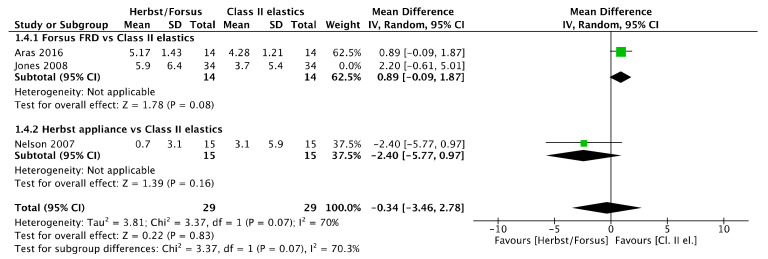
Background: Our study aimed to systematically summarize the dentoskeletal effects of Herbst appliance; Forsus fatigue resistance device; and Class II elastics in adolescent Class II malocclusion. Methods: Five databases; unpublished literature; and reference lists were last searched in August 2022. Randomized clinical trials and observational studies of at least 10 Class II growing patients that assessed dentoskeletal effects through cephalometric/CBCT superimpositions were eligible. The included studies quality was assessed with the RoB 2 and ROBINS-I tools. A random-effects model meta-analysis was performed. Heterogeneity was explored with subgroup and sensitivity analyses. Results: Among nine studies (298 patients); two-to-three studies were included in each meta-analysis. Less post-treatment upper incisor retroclination (<2) and no overbite; overjet; SNA; SNB; and lower incisor inclination differences were found between Herbst/Forsus and Class II elastics. No differences in maxilla; condyle; glenoid fossa; and most mandibular changes were found between Herbst and Class II elastics; except for a greater 1.5 mm increase in mandibular length and right mandibular ramus height (1.6 mm) with Herbst. Conclusions: Herbst and Class II elastics corrected the molar relationship; but Herbst moved the lower molars more mesially. Apart from an additional mandibular length increase; no other dental and anteroposterior skeletal difference was found. Forsus was more effective in molar correction; overjet reduction; and upper incisor control than Class II elastics. Trial registration number OSF: 10.17605/OSF.IO/8TK3R.
我们的研究旨在系统总结Herbst矫治器、Forsus抗疲劳装置和II类弹力牵引对青少年II类错牙合畸形的牙颌影响。方法:2022年8月最后一次检索了五个数据库、未发表的文献和参考文献列表。纳入至少10例生长发育期II类患者,通过头影测量/CBCT叠加评估牙颌影响的随机临床试验和观察性研究。采用RoB 2和ROBINS-I工具评估纳入研究的质量。进行随机效应模型的荟萃分析。通过亚组分析和敏感性分析探讨异质性。结果:在9项研究(298例患者)中,每项荟萃分析纳入2至3项研究。Herbst/Forsus矫治器与II类弹力牵引相比,治疗后上切牙舌倾减少(<2),覆牙合、覆盖、SNA、SNB及下切牙倾斜度差异均无统计学意义。Herbst矫治器与II类弹力牵引相比,上颌、髁突、关节窝及下颌多数部位变化差异无统计学意义,但Herbst矫治器使下颌长度增加1.5 mm,右侧下颌升支高度增加1.6 mm。结论:Herbst矫治器和II类弹力牵引均能矫正磨牙关系,但Herbst矫治器使下磨牙更向近中移动。除下颌长度额外增加外,未发现其他牙及前后向骨骼差异。Forsus矫治器在磨牙矫正、覆盖减少及上切牙控制方面比II类弹力牵引更有效。试验注册号OSF:10.17605/OSF.IO/8TK3R。