School of Medical Biology, South Ural State University, 454080 Chelyabinsk, Russia.
Department of Basic Medicine, Chelyabinsk State University, 454001 Chelyabinsk, Russia.
Int J Mol Sci. 2022 Nov 23;23(23):14575. doi: 10.3390/ijms232314575.
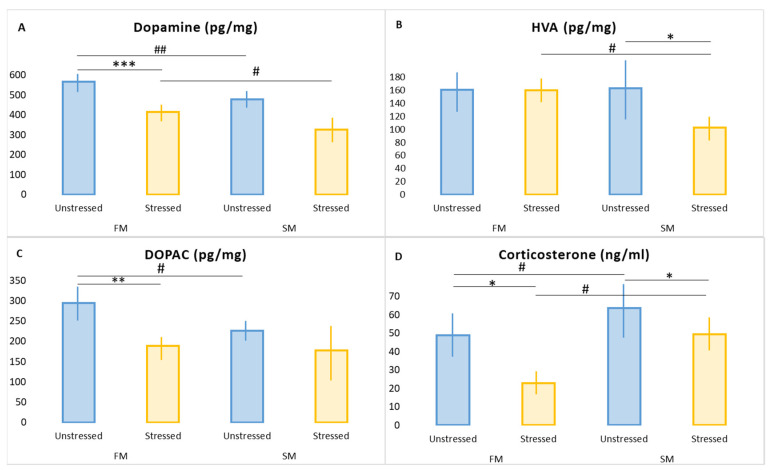
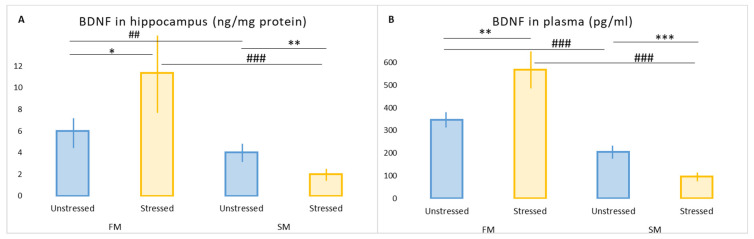
Susceptibility and resilience to post-traumatic stress disorder (PTSD) are recognized, but their mechanisms are not understood. Here, the hexobarbital sleep test (HST) was used to elucidate mechanisms of PTSD resilience or susceptibility. A HST was performed in rats 30 days prior to further experimentation. Based on the HST, the rats were divided into groups: (1) fast metabolizers (FM; sleep duration < 15 min); (2) slow metabolizers (SM; sleep duration ≥ 15 min). Then the SM and FM groups were subdivided into stressed (10 days predator scent, 15 days rest) and unstressed subgroups. Among stressed animals, only SMs developed experimental PTSD, and had higher plasma corticosterone (CORT) than stressed FMs. Thus, resilience or susceptibility to PTSD was consistent with changes in glucocorticoid metabolism. Stressed SMs had a pronounced decrease in hippocampal dopamine associated with increased expressions of catecholamine-O-methyl-transferase and DA transporter. In stressed SMs, a decrease in monoaminoxidase (MAO) A was associated with increased expressions of hippocampal MAO-A and MAO-B. BDNF gene expression was increased in stressed FMs and decreased in stressed SMs. These results demonstrate relationships between the microsomal oxidation phenotype, CORT concentration, and anxiety, and they help further the understanding of the role of the liver−brain axis during PTSD.
创伤后应激障碍(PTSD)的易感性和弹性已得到公认,但它们的机制尚不清楚。在这里,使用戊巴比妥睡眠试验(HST)来阐明 PTSD 弹性或易感性的机制。在进一步实验之前,对大鼠进行 HST 30 天。根据 HST,将大鼠分为两组:(1)快速代谢者(FM;睡眠持续时间<15 分钟);(2)慢速代谢者(SM;睡眠持续时间≥15 分钟)。然后将 SM 和 FM 组进一步分为应激(10 天捕食者气味,15 天休息)和非应激亚组。在应激动物中,只有 SM 发展为实验性 PTSD,且其血浆皮质酮(CORT)水平高于应激 FM。因此,对 PTSD 的易感性或弹性与糖皮质激素代谢的变化一致。应激 SM 与海马多巴胺相关的单胺氧化酶(MAO)A 表达减少,与儿茶酚-O-甲基转移酶和 DA 转运体表达增加有关。在应激 SM 中,MAO-A 的减少与海马 MAO-A 和 MAO-B 的表达增加有关。应激 FM 中的脑源性神经营养因子(BDNF)基因表达增加,而应激 SM 中的 BDNF 基因表达减少。这些结果表明微体氧化表型、CORT 浓度与焦虑之间存在关系,并有助于进一步了解在 PTSD 期间肝脑轴的作用。