Tong Wenjie, Li Junying, Cong Wenfeng, Zhang Cuiping, Xu Zhaoli, Chen Xiaolong, Yang Min, Liu Jiani, Yu Lei, Deng Xiaopeng
Yunnan Academy of Tobacco Agricultural Sciences, Kunming 650021, Yunnan, China.
National Academy of Agriculture Green Development, China Agricultural University, Beijing 100193, China.
Plant Pathol J. 2022 Dec;38(6):583-592. doi: 10.5423/PPJ.OA.08.2022.0105. Epub 2022 Dec 1.
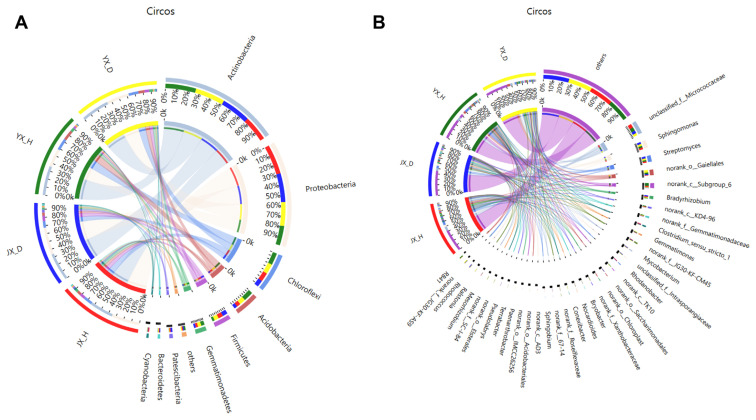
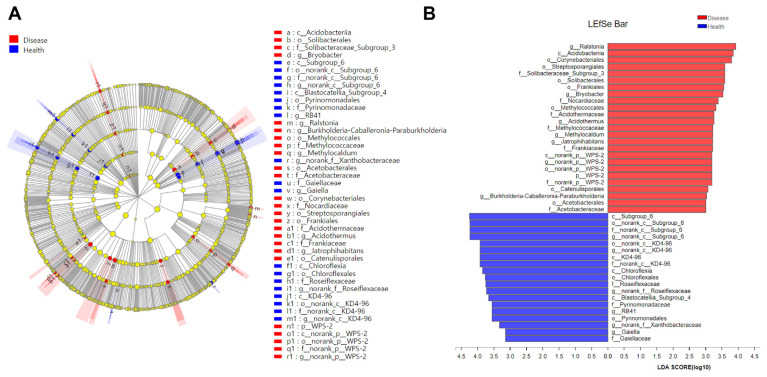
Root-knot nematode disease is a widespread and catastrophic disease of tobacco. However, little is known about the relationship between rhizosphere bacterial community and root-knot nematode disease. This study used 16S rRNA gene sequencing and PICRUSt to assess bacterial community structure and function changes in rhizosphere soil from Meloidogyne incognita-infected tobacco plants. We studied the rhizosphere bacterial community structure of M. incognita-infected and uninfected tobacco plants through a paired comparison design in two regions of tobacco planting area, Yuxi and Jiuxiang of Yunnan Province, southwest China. According to the findings, M. incognita infection can alter the bacterial population in the soil. Uninfested soil has more operational taxonomic unit numbers and richness than infested soil. Principal Coordinate Analysis revealed clear separations between bacterial communities from infested and uninfested soil, indicating that different infection conditions resulted in significantly different bacterial community structures in soils. Firmicutes was prevalent in infested soil, but Chloroflexi and Acidobacteria were prevalent in uninfested soil. Sphingomonas, Streptomyces, and Bradyrhizobium were the dominant bacteria genera, and their abundance were higher in infested soil. By PICRUSt analysis, some metabolism-related functions and signal transduction functions of the rhizosphere bacterial community in the M. incognita infection-tobacco plants had a higher relative abundance than those uninfected. As a result, rhizosphere soils from tobacco plants infected with M. incognita showed considerable bacterial community structure and function alterations.
根结线虫病是烟草一种广泛存在且具有灾难性的病害。然而,关于根际细菌群落与根结线虫病之间的关系却知之甚少。本研究采用16S rRNA基因测序和PICRUSt来评估南方根结线虫感染的烟草植株根际土壤中细菌群落结构和功能的变化。我们通过配对比较设计,在中国西南部云南省玉溪和九乡两个烟草种植区,研究了南方根结线虫感染和未感染的烟草植株的根际细菌群落结构。研究结果表明,南方根结线虫感染会改变土壤中的细菌种群。未受侵染的土壤比受侵染的土壤具有更多的可操作分类单元数量和丰富度。主坐标分析显示,受侵染和未受侵染土壤的细菌群落之间存在明显分离,这表明不同的感染条件导致土壤中细菌群落结构存在显著差异。厚壁菌门在受侵染土壤中占优势,但绿弯菌门和酸杆菌门在未受侵染土壤中占优势。鞘氨醇单胞菌属、链霉菌属和慢生根瘤菌属是优势细菌属,它们在受侵染土壤中的丰度更高。通过PICRUSt分析,南方根结线虫感染的烟草植株根际细菌群落的一些与代谢相关的功能和信号转导功能的相对丰度高于未感染的植株。因此,南方根结线虫感染的烟草植株的根际土壤显示出相当大的细菌群落结构和功能变化。