Department of Psychiatry, University of California, La Jolla, San Diego, CA, 92093, USA.
Child and Adolescent Services Research Center, San Diego, CA, USA.
Implement Sci. 2022 Dec 12;17(1):80. doi: 10.1186/s13012-022-01256-x.
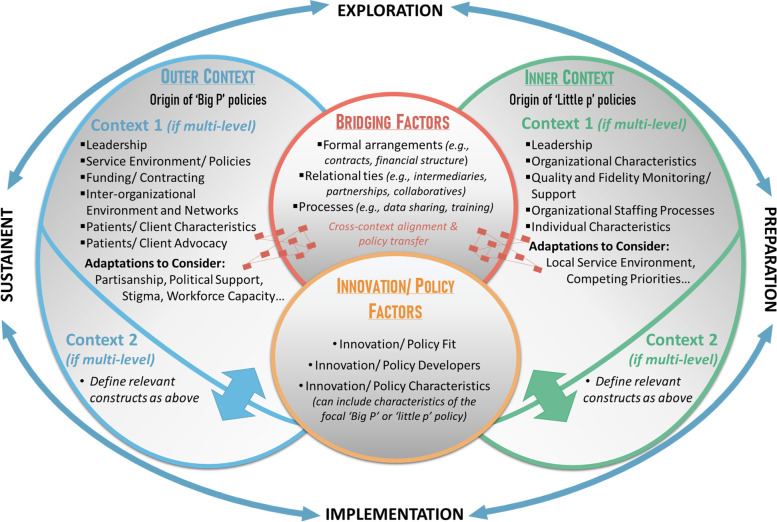
Implementation science aims to accelerate the public health impact of evidence-based interventions. However, implementation science has had too little focus on the role of health policy - and its inseparable politics, polity structures, and policymakers - in the implementation and sustainment of evidence-based healthcare. Policies can serve as determinants, implementation strategies, the evidence-based "thing" to be implemented, or another variable in the causal pathway to healthcare access, quality, and patient outcomes. Research describing the roles of policy in dissemination and implementation (D&I) efforts is needed to resolve persistent knowledge gaps about policymakers' evidence use, how evidence-based policies are implemented and sustained, and methods to de-implement policies that are ineffective or cause harm. Few D&I theories, models, or frameworks (TMF) explicitly guide researchers in conceptualizing where, how, and when policy should be empirically investigated. We conducted and reflected on the results of a scoping review to identify gaps of existing Exploration, Preparation, Implementation, and Sustainment (EPIS) framework-guided policy D&I studies. We argue that rather than creating new TMF, researchers should optimize existing TMF to examine policy's role in D&I. We describe six recommendations to help researchers optimize existing D&I TMF. Recommendations are applied to EPIS, as one example for advancing TMF for policy D&I.
(1) Specify dimensions of a policy's function (policy goals, type, contexts, capital exchanged). (2) Specify dimensions of a policy's form (origin, structure, dynamism, outcomes). (3) Identify and define the nonlinear phases of policy D&I across outer and inner contexts. (4) Describe the temporal roles that stakeholders play in policy D&I over time. (5) Consider policy-relevant outer and inner context adaptations. (6) Identify and describe bridging factors necessary for policy D&I success.
Researchers should use TMF to meaningfully conceptualize policy's role in D&I efforts to accelerate the public health impact of evidence-based policies or practices and de-implement ineffective and harmful policies. Applying these six recommendations to existing D&I TMF advances existing theoretical knowledge, especially EPIS application, rather than introducing new models. Using these recommendations will sensitize researchers to help them investigate the multifaceted roles policy can play within a causal pathway leading to D&I success.
实施科学旨在加速基于证据的干预措施对公共卫生的影响。然而,实施科学对卫生政策的作用关注太少——以及卫生政策不可分割的政治、政治结构和决策者——在实施和维持基于证据的医疗保健方面。政策可以作为决定因素、实施策略、要实施的基于证据的“事物”或通向获得医疗保健、质量和患者结果的因果途径中的另一个变量。需要研究描述政策在传播和实施(D&I)工作中的作用,以解决关于决策者证据使用、如何实施和维持基于证据的政策以及取消无效或造成伤害的政策的持续知识差距。很少有传播和实施(D&I)理论、模型或框架(TMF)明确指导研究人员从概念上理解政策应在何处、如何以及何时进行实证研究。我们进行了一次范围审查,并对结果进行了反思,以确定现有探索、准备、实施和维持(EPIS)框架指导的政策 D&I 研究中的差距。我们认为,研究人员不应创建新的 TMF,而应优化现有 TMF 以检查政策在 D&I 中的作用。我们提出了六项建议,以帮助研究人员优化现有的 D&I TMF。建议适用于 EPIS,作为推进政策 D&I 的 TMF 的一个例子。
(1)指定政策功能的维度(政策目标、类型、背景、交换资本)。(2)指定政策形式的维度(起源、结构、动态、结果)。(3)确定和定义政策 D&I 在内外背景下的非线性阶段。(4)描述利益相关者随时间在政策 D&I 中扮演的角色。(5)考虑与政策相关的外部和内部背景适应。(6)确定并描述政策 D&I 成功所需的桥梁因素。
研究人员应使用 TMF 从概念上合理地理解政策在 D&I 工作中的作用,以加速基于证据的政策或实践对公共卫生的影响,并取消无效和有害的政策。将这六项建议应用于现有的 D&I TMF 可以推进现有理论知识,特别是 EPIS 的应用,而不是引入新的模型。使用这些建议将使研究人员更加敏感,帮助他们调查政策在通向 D&I 成功的因果途径中可以发挥的多方面作用。