Department of Anesthesiology, The Affiliated Hospital of Guizhou Medical University, Guiyang, People's Republic of China.
College of Anesthesiology, Guizhou Medical University, Guiyang, People's Republic of China.
Drug Des Devel Ther. 2022 Dec 5;16:4151-4159. doi: 10.2147/DDDT.S391147. eCollection 2022.
Remimazolam tosilate (RT) is a new type of γ-aminobutyric acid subtype A (GABA) receptor agonist, having the possibility to be an ideal sedative drug for procedural sedation. At present, there are few studies on the effect of RT on respiratory depression in elderly patients. We aimed to evaluate the effect of RT on respiratory depression in elderly patients undergoing gastroscopy.
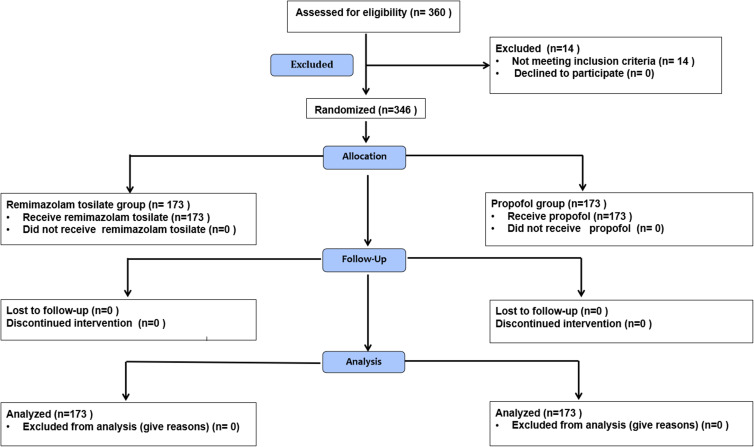
This prospective, randomized, single-blinded trial recruited patients from eight centers in China between May 2022 and July 2022. A total of 346 elderly patients undergoing gastroscopy were randomly divided into RT group (0.2 mg/kg) or propofol group (1.5 mg/kg), respectively. The primary outcome was the incidence of respiratory depression. Secondary outcomes include the incidence of sedative-related adverse events, the success rate of sedation, time to fully alert, time to loss of consciousness (LOC), time to ready for discharge, as well as the the patients, endoscopists and anethetists' satisfaction.
The incidence of respiratory depression was significantly reduced in the RT group compared with the propofol group (9.8% vs 17.9%, P=0.042). The time of LOC and fully alert in the RT group were longer than that in the propofol group (P < 0.05). The incidences of hypotention (50.9% vs 32.4%, P=0.001) and hypotension requiring treatment (5.8% vs 1.7%, P=0.031) were significantly higher in the propofol group than that in the RT group. The incidence and severity of injection pain were more frequently recorded in the propofol group than that in the RT group (40.5% vs 12.1%, P<0.05). There were no statistically significant differences between the two groups in terms of sedation success rates, time to ready for discharge, endoscopists and anethetists' satisfaction and other sedative-related adverse events.
RT may be a suitable alternative sedative agent for elderly patients undergoing gastroscopy due to its safety profile.
甲苯磺酸雷米唑仑(RT)是一种新型的γ-氨基丁酸 A 型(GABA)受体激动剂,有可能成为一种理想的镇静药物,用于程序镇静。目前,关于 RT 对老年患者呼吸抑制影响的研究较少。我们旨在评估 RT 对接受胃镜检查的老年患者呼吸抑制的影响。
本前瞻性、随机、单盲试验于 2022 年 5 月至 2022 年 7 月在我国 8 个中心招募患者。共纳入 346 例接受胃镜检查的老年患者,随机分为 RT 组(0.2mg/kg)或丙泊酚组(1.5mg/kg)。主要结局是呼吸抑制的发生率。次要结局包括镇静相关不良事件的发生率、镇静成功率、完全清醒时间、意识丧失时间(LOC)、准备出院时间以及患者、内镜医师和麻醉医师的满意度。
与丙泊酚组相比,RT 组呼吸抑制的发生率显著降低(9.8% vs. 17.9%,P=0.042)。RT 组的 LOC 和完全清醒时间长于丙泊酚组(P<0.05)。丙泊酚组低血压的发生率(50.9% vs. 32.4%,P=0.001)和需要治疗的低血压发生率(5.8% vs. 1.7%,P=0.031)明显高于 RT 组。丙泊酚组注射疼痛的发生率和严重程度明显高于 RT 组(40.5% vs. 12.1%,P<0.05)。两组镇静成功率、准备出院时间、内镜医师和麻醉医师的满意度以及其他镇静相关不良事件的发生率无统计学差异。
由于 RT 具有良好的安全性,它可能是一种适合用于接受胃镜检查的老年患者的替代镇静药物。