Institute for Health Research and Policy, University of Illinois Chicago, Chicago, Illinois, USA
Health Policy and Administration, School of Public Health, University of Illinois Chicago, Chicago, IL, USA.
Tob Control. 2024 Mar 19;33(e1):e91-e96. doi: 10.1136/tc-2022-057486.
This study examines the association between the Tobacconomics cigarette tax scores and cigarette consumption in 97 countries during the period of 2014-2020.
Data on countries' retail cigarette sales and overall cigarette tax scores from 2014 to 2020 are drawn from the proprietary Euromonitor International database and the Tobacconomics Cigarette Tax Scorecard (second edition). Information on countries' tobacco control environments and demographic characteristics is from the relevant years' WHO Report on the Global Tobacco Epidemic, and the World Bank's World Development Indicators database. Ordinary least squares regressions are employed to examine the link between countries' overall cigarette tax scores and cigarette consumption. All regressions control for countries' tobacco control environments, countries' demographic characteristics, year indicators and country fixed effects.
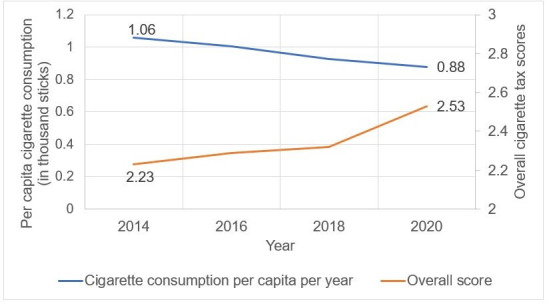
Each unit increase in the overall cigarette tax scores is significantly associated with a reduction of 9% in countries' per-capita cigarette consumption during 2014-2020. The reduction is more pronounced in low and middle-income countries (9%) than in high-income countries (6%). The modest improvement in scores from 2014 to 2020 is associated with a reduction of 3.27% in consumption, while consumption could have been reduced by 20.74% had countries implemented optimal tax policies that would earn the highest score of 5.
Our results provide evidence on the association between higher cigarette tax scores and lower cigarette consumption. To reduce tobacco consumption, governments must strive to implement all four components in the Cigarette Tax Scorecard at the highest level.
本研究考察了 2014 年至 2020 年间 97 个国家的 Tobacconomics 卷烟税评分与卷烟消费之间的关联。
从专有的 Euromonitor International 数据库和 Tobacconomics 卷烟税评分卡(第二版)中提取了 2014 年至 2020 年各国零售卷烟销售额和总体卷烟税评分的数据。有关国家烟草控制环境和人口特征的信息来自当年的世界卫生组织全球烟草流行报告和世界银行的世界发展指标数据库。采用普通最小二乘法检验各国总体卷烟税评分与卷烟消费之间的关系。所有回归均控制了各国的烟草控制环境、各国的人口特征、年份指标和国家固定效应。
总体卷烟税评分每增加一个单位,与 2014 年至 2020 年间各国人均卷烟消费量减少 9%显著相关。在中低收入国家(9%)比在高收入国家(6%)更为明显。2014 年至 2020 年评分略有提高,与消费减少 3.27%相关,而如果各国实施可获得最高 5 分的最优税收政策,消费本可以减少 20.74%。
我们的研究结果提供了更高卷烟税评分与更低卷烟消费之间关联的证据。为了减少烟草消费,各国政府必须努力在最高水平上实施卷烟税评分卡中的所有四个组成部分。