• 文献检索
  • 文档翻译
  • 深度研究
  • 学术资讯
  • Suppr Zotero 插件Zotero 插件
  • 邀请有礼
  • 套餐&价格
  • 历史记录
应用&插件
Suppr Zotero 插件Zotero 插件浏览器插件Mac 客户端Windows 客户端微信小程序
定价
高级版会员购买积分包购买API积分包
服务
文献检索文档翻译深度研究API 文档MCP 服务
关于我们
关于 Suppr公司介绍联系我们用户协议隐私条款
关注我们

Suppr 超能文献

核心技术专利:CN118964589B侵权必究
粤ICP备2023148730 号-1Suppr @ 2026

文献检索

告别复杂PubMed语法,用中文像聊天一样搜索,搜遍4000万医学文献。AI智能推荐,让科研检索更轻松。

立即免费搜索

文件翻译

保留排版,准确专业,支持PDF/Word/PPT等文件格式,支持 12+语言互译。

免费翻译文档

深度研究

AI帮你快速写综述,25分钟生成高质量综述,智能提取关键信息,辅助科研写作。

立即免费体验

LiSA:一个利用深度学习检测严重药物不良事件的辅助文献检索管道。

LiSA: an assisted literature search pipeline for detecting serious adverse drug events with deep learning.

机构信息

Quinten, 8 rue Vernier, 75017, Paris, France.

Swiss Agency for Therapeutic Products, Swissmedic, Hallerstrasse 7, 3012, Bern, Switzerland.

出版信息

BMC Med Inform Decis Mak. 2022 Dec 22;22(1):338. doi: 10.1186/s12911-022-02085-0.

DOI:10.1186/s12911-022-02085-0
PMID:36550485
原文链接:https://pmc.ncbi.nlm.nih.gov/articles/PMC9773506/
Abstract

INTRODUCTION

Detecting safety signals attributed to a drug in scientific literature is a fundamental issue in pharmacovigilance. The constant increase in the volume of publications requires the automation of this tedious task, in order to find and extract relevant articles from the pack. This task is critical, as serious Adverse Drug Reactions (ADRs) still account for a large number of hospital admissions each year.

OBJECTIVES

The aim of this study is to develop an augmented intelligence methodology for automatically identifying relevant publications mentioning an established link between a Drug and a Serious Adverse Event, according to the European Medicines Agency (EMA) definition of seriousness.

METHODS

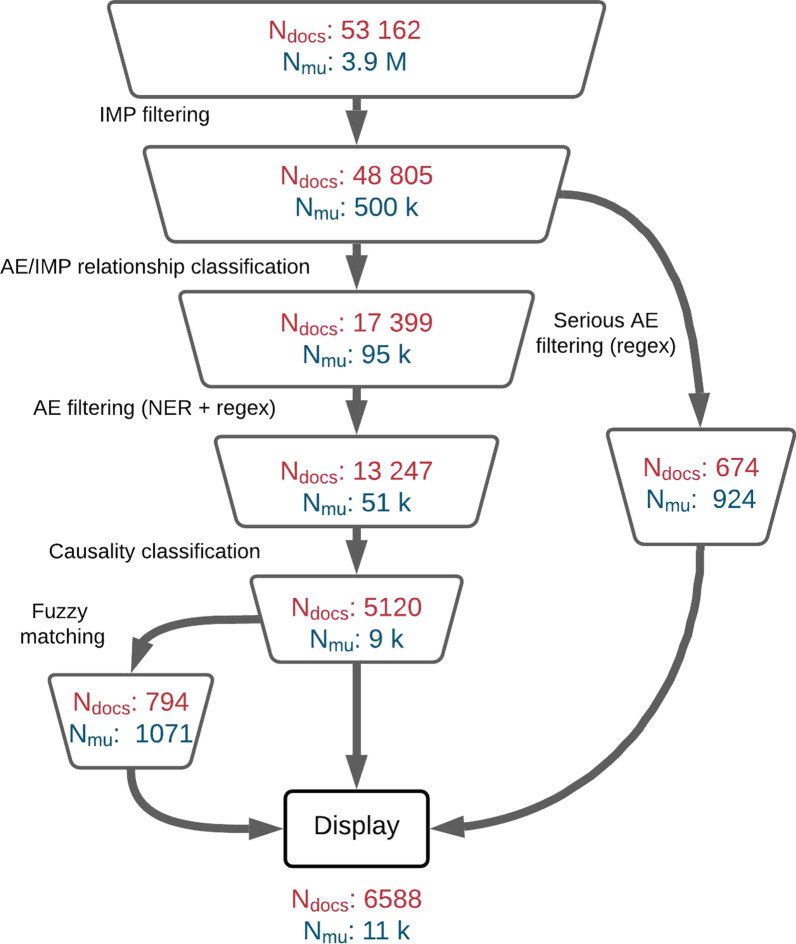
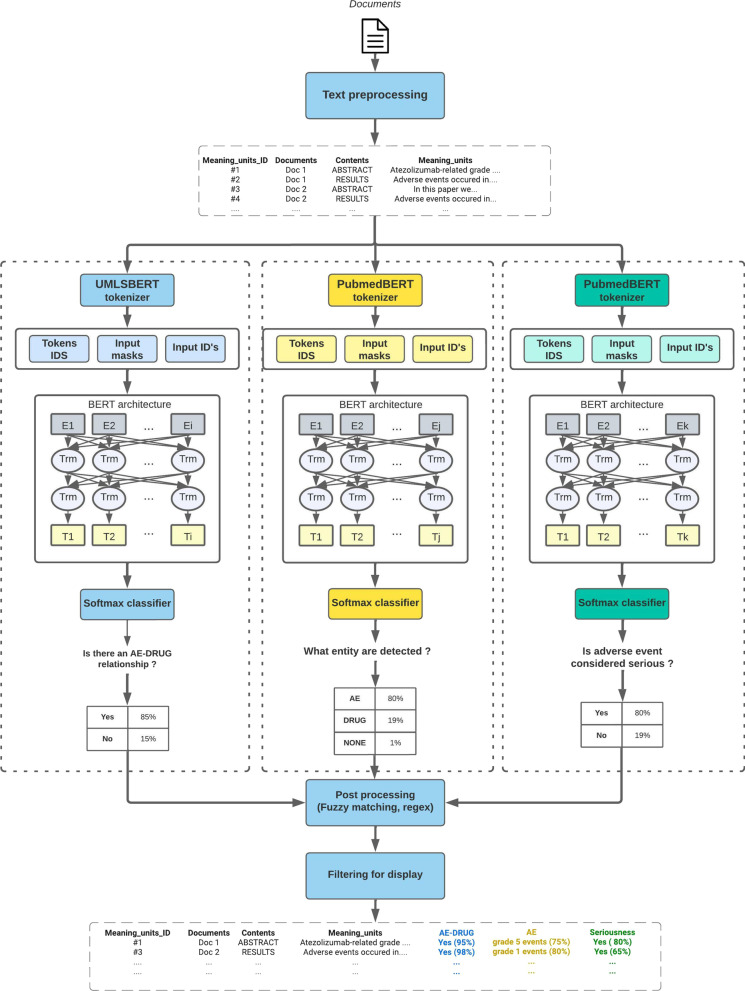
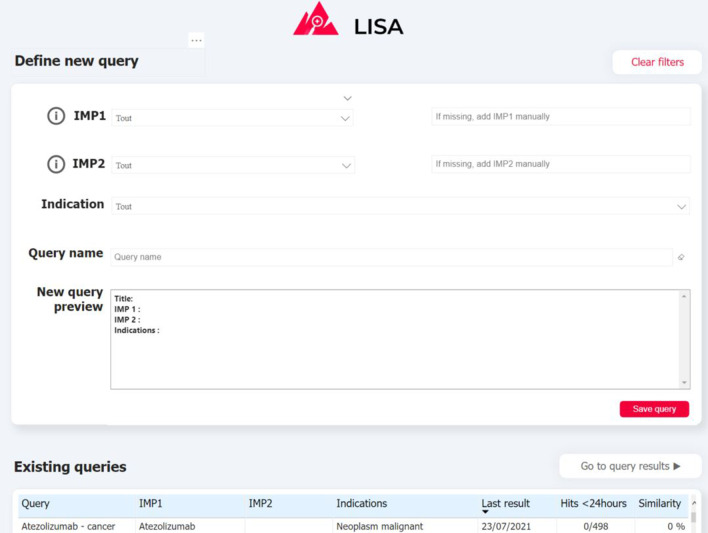
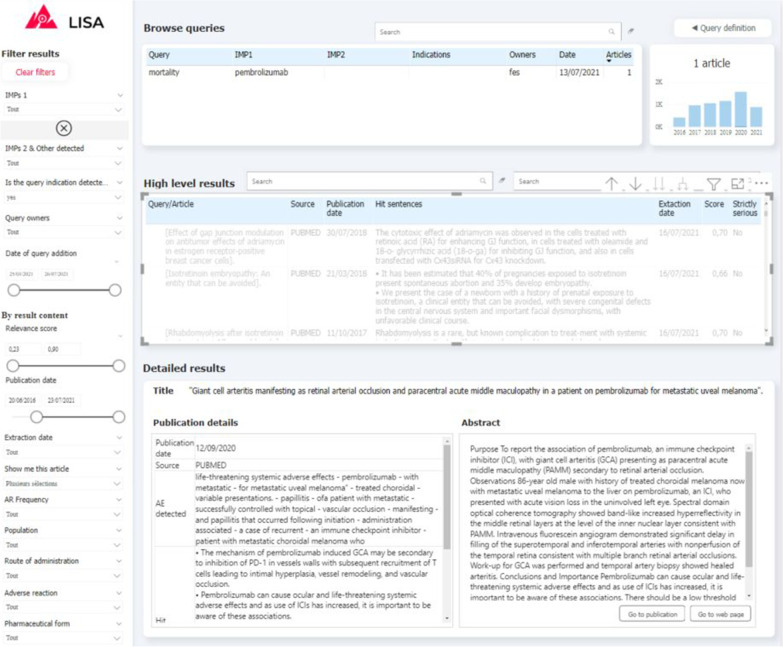
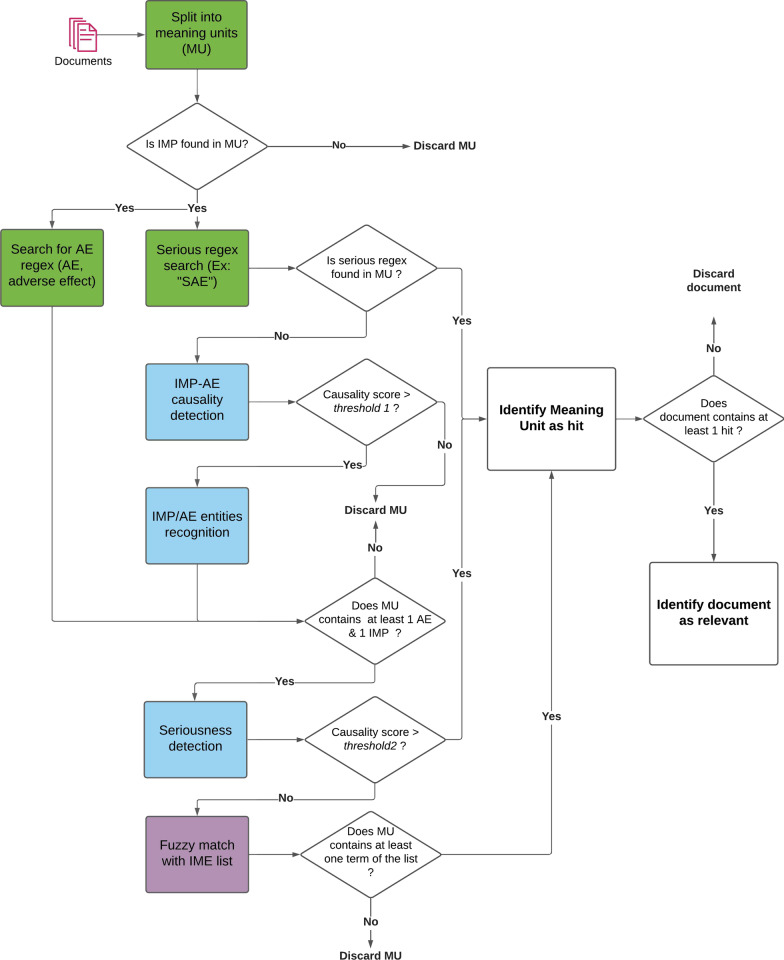
The proposed pipeline, called LiSA (for Literature Search Application), is based on three independent deep learning models supporting a precise detection of safety signals in the biomedical literature. By combining a Bidirectional Encoder Representations from Transformers (BERT) algorithms and a modular architecture, the pipeline achieves a precision of 0.81 and a recall of 0.89 at sentences level in articles extracted from PubMed (either abstract or full-text). We also measured that by using LiSA, a medical reviewer increases by a factor of 2.5 the number of relevant documents it can collect and evaluate compared to a simple keyword search. In the interest of re-usability, emphasis was placed on building a modular pipeline allowing the insertion of other NLP modules to enrich the results provided by the system, and extend it to other use cases. In addition, a lightweight visualization tool was developed to analyze and monitor safety signal results.

CONCLUSIONS

Overall, the generic pipeline and the visualization tool proposed in this article allows for efficient and accurate monitoring of serious adverse drug reactions from the literature and can easily be adapted to similar pharmacovigilance use cases. To facilitate reproducibility and benefit other research studies, we also shared a first benchmark dataset for Serious Adverse Drug Events detection.

摘要

简介

在药物警戒学中,检测科学文献中归因于药物的安全信号是一个基本问题。出版物数量的不断增加需要自动化完成这项繁琐的任务,以便从文献中找到并提取相关文章。这项任务至关重要,因为每年仍有大量严重的药物不良反应(ADR)导致患者住院。

目的

本研究旨在开发一种增强型人工智能方法,根据欧洲药品管理局(EMA)对严重性的定义,自动识别提及药物与严重不良事件之间既定关联的相关出版物。

方法

该方法称为 LiSA(文献搜索应用程序),基于三个独立的深度学习模型,为生物医学文献中的安全信号检测提供支持。通过结合双向编码器表示的转换器(BERT)算法和模块化架构,该管道在从 PubMed 提取的文章中(无论是摘要还是全文)实现了句子级别的 0.81 的精度和 0.89 的召回率。我们还测量到,与简单的关键字搜索相比,使用 LiSA 可以使医学审查员收集和评估的相关文档数量增加 2.5 倍。为了提高可重用性,重点在于构建一个模块化管道,允许插入其他自然语言处理模块来丰富系统提供的结果,并将其扩展到其他用例。此外,还开发了一个轻量级可视化工具来分析和监测安全信号结果。

结论

总的来说,本文提出的通用管道和可视化工具允许从文献中高效准确地监测严重药物不良反应,并可以轻松适应类似的药物警戒用例。为了促进可重复性并使其他研究受益,我们还共享了用于检测严重药物不良反应的第一个基准数据集。
https://cdn.ncbi.nlm.nih.gov/pmc/blobs/f31e/9773506/7dd7d1628b25/12911_2022_2085_Fig5_HTML.jpg
https://cdn.ncbi.nlm.nih.gov/pmc/blobs/f31e/9773506/5f28f9a2eca3/12911_2022_2085_Fig1_HTML.jpg
https://cdn.ncbi.nlm.nih.gov/pmc/blobs/f31e/9773506/392c75be6b23/12911_2022_2085_Fig2_HTML.jpg
https://cdn.ncbi.nlm.nih.gov/pmc/blobs/f31e/9773506/7c9d0d79c29b/12911_2022_2085_Fig3_HTML.jpg
https://cdn.ncbi.nlm.nih.gov/pmc/blobs/f31e/9773506/3f90c96e6f5d/12911_2022_2085_Fig4_HTML.jpg
https://cdn.ncbi.nlm.nih.gov/pmc/blobs/f31e/9773506/7dd7d1628b25/12911_2022_2085_Fig5_HTML.jpg
https://cdn.ncbi.nlm.nih.gov/pmc/blobs/f31e/9773506/5f28f9a2eca3/12911_2022_2085_Fig1_HTML.jpg
https://cdn.ncbi.nlm.nih.gov/pmc/blobs/f31e/9773506/392c75be6b23/12911_2022_2085_Fig2_HTML.jpg
https://cdn.ncbi.nlm.nih.gov/pmc/blobs/f31e/9773506/7c9d0d79c29b/12911_2022_2085_Fig3_HTML.jpg
https://cdn.ncbi.nlm.nih.gov/pmc/blobs/f31e/9773506/3f90c96e6f5d/12911_2022_2085_Fig4_HTML.jpg
https://cdn.ncbi.nlm.nih.gov/pmc/blobs/f31e/9773506/7dd7d1628b25/12911_2022_2085_Fig5_HTML.jpg

相似文献

1
LiSA: an assisted literature search pipeline for detecting serious adverse drug events with deep learning.LiSA:一个利用深度学习检测严重药物不良事件的辅助文献检索管道。
BMC Med Inform Decis Mak. 2022 Dec 22;22(1):338. doi: 10.1186/s12911-022-02085-0.
2
Artificial intelligence-powered pharmacovigilance: A review of machine and deep learning in clinical text-based adverse drug event detection for benchmark datasets.人工智能驱动的药物警戒:基于机器学习和深度学习的临床文本药物不良事件检测基准数据集综述。
J Biomed Inform. 2024 Apr;152:104621. doi: 10.1016/j.jbi.2024.104621. Epub 2024 Mar 5.
3
Application of Augmented Intelligence for Pharmacovigilance Case Seriousness Determination.增强智能在药物警戒案例严重程度判定中的应用。
Drug Saf. 2020 Jan;43(1):57-66. doi: 10.1007/s40264-019-00869-4.
4
Deep learning approaches for extracting adverse events and indications of dietary supplements from clinical text.深度学习方法从临床文本中提取膳食补充剂的不良事件和适应证。
J Am Med Inform Assoc. 2021 Mar 1;28(3):569-577. doi: 10.1093/jamia/ocaa218.
5
Evaluation of patient reporting of adverse drug reactions to the UK 'Yellow Card Scheme': literature review, descriptive and qualitative analyses, and questionnaire surveys.评估患者向英国“黄卡计划”报告药物不良反应的情况:文献回顾、描述性和定性分析以及问卷调查。
Health Technol Assess. 2011 May;15(20):1-234, iii-iv. doi: 10.3310/hta15200.
6
Inferring ADR causality by predicting the Naranjo Score from Clinical Notes.通过从临床记录预测纳伦霍评分来推断药物不良反应因果关系。
AMIA Annu Symp Proc. 2021 Jan 25;2020:1041-1049. eCollection 2020.
7
Identification of hand-foot syndrome from cancer patients' blog posts: BERT-based deep-learning approach to detect potential adverse drug reaction symptoms.基于 BERT 的深度学习方法从癌症患者的博客文章中识别手足综合征:检测潜在药物不良反应症状。
PLoS One. 2022 May 4;17(5):e0267901. doi: 10.1371/journal.pone.0267901. eCollection 2022.
8
From narrative descriptions to MedDRA: automagically encoding adverse drug reactions.从叙述性描述到 MedDRA:自动编码药物不良反应。
J Biomed Inform. 2018 Aug;84:184-199. doi: 10.1016/j.jbi.2018.07.001. Epub 2018 Jul 4.
9
The Use of Artificial Intelligence in Pharmacovigilance: A Systematic Review of the Literature.人工智能在药物警戒中的应用:文献系统评价。
Pharmaceut Med. 2022 Oct;36(5):295-306. doi: 10.1007/s40290-022-00441-z. Epub 2022 Jul 29.
10
Identifying the serious clinical outcomes of adverse reactions to drugs by a multi-task deep learning framework.利用多任务深度学习框架识别药物不良反应的严重临床结局。
Commun Biol. 2023 Aug 24;6(1):870. doi: 10.1038/s42003-023-05243-w.

引用本文的文献

1
The emergence of large language models as tools in literature reviews: a large language model-assisted systematic review.大语言模型作为文献综述工具的出现:一项大语言模型辅助的系统综述
J Am Med Inform Assoc. 2025 Jun 1;32(6):1071-1086. doi: 10.1093/jamia/ocaf063.
2
The applications and advances of artificial intelligence in drug regulation: A global perspective.人工智能在药品监管中的应用与进展:全球视角
Acta Pharm Sin B. 2025 Jan;15(1):1-14. doi: 10.1016/j.apsb.2024.11.006. Epub 2024 Nov 13.
3
AI-Based Computational Methods in Early Drug Discovery and Post Market Drug Assessment: A Survey.

本文引用的文献

1
CODER: Knowledge-infused cross-lingual medical term embedding for term normalization.知识注入的跨语言医学术语嵌入用于术语归一化。
J Biomed Inform. 2022 Feb;126:103983. doi: 10.1016/j.jbi.2021.103983. Epub 2022 Jan 4.
2
Application of Augmented Intelligence for Pharmacovigilance Case Seriousness Determination.增强智能在药物警戒案例严重程度判定中的应用。
Drug Saf. 2020 Jan;43(1):57-66. doi: 10.1007/s40264-019-00869-4.
3
BioBERT: a pre-trained biomedical language representation model for biomedical text mining.BioBERT:一种用于生物医学文本挖掘的预训练生物医学语言表示模型。
早期药物发现与上市后药物评估中基于人工智能的计算方法:一项综述。
IEEE Trans Comput Biol Bioinform. 2025 Jan-Feb;22(1):97-115. doi: 10.1109/TCBB.2024.3492708.
4
Improving Neurology Clinical Care With Natural Language Processing Tools.利用自然语言处理工具改善神经病学临床护理。
Neurology. 2023 Nov 27;101(22):1010-1018. doi: 10.1212/WNL.0000000000207853.
Bioinformatics. 2020 Feb 15;36(4):1234-1240. doi: 10.1093/bioinformatics/btz682.
4
RobotReviewer: evaluation of a system for automatically assessing bias in clinical trials.机器人评审员:用于自动评估临床试验偏倚的系统评估
J Am Med Inform Assoc. 2016 Jan;23(1):193-201. doi: 10.1093/jamia/ocv044. Epub 2015 Jun 22.
5
Mining adverse drug reactions from online healthcare forums using hidden Markov model.使用隐马尔可夫模型从在线医疗论坛中挖掘药物不良反应
BMC Med Inform Decis Mak. 2014 Oct 23;14:91. doi: 10.1186/1472-6947-14-91.
6
A pipeline to extract drug-adverse event pairs from multiple data sources.从多个数据源中提取药物不良事件对的管道。
BMC Med Inform Decis Mak. 2014 Feb 24;14:13. doi: 10.1186/1472-6947-14-13.
7
Extraction of potential adverse drug events from medical case reports.从医疗病例报告中提取潜在的药物不良事件。
J Biomed Semantics. 2012 Dec 20;3(1):15. doi: 10.1186/2041-1480-3-15.
8
Combing signals from spontaneous reports and electronic health records for detection of adverse drug reactions.从自发报告和电子健康记录中组合信号以检测药物不良反应。
J Am Med Inform Assoc. 2013 May 1;20(3):413-9. doi: 10.1136/amiajnl-2012-000930. Epub 2012 Oct 31.
9
Development of a benchmark corpus to support the automatic extraction of drug-related adverse effects from medical case reports.开发一个基准语料库,以支持从医疗病例报告中自动提取与药物相关的不良反应。
J Biomed Inform. 2012 Oct;45(5):885-92. doi: 10.1016/j.jbi.2012.04.008. Epub 2012 Apr 25.