Department of Chemistry and Earth Sciences, College of Arts and Sciences, Qatar University, Doha P.O. Box 2713, Qatar.
Center of Advanced Materials, Qatar University, Doha P.O. Box 2713, Qatar.
Biosensors (Basel). 2022 Dec 1;12(12):1107. doi: 10.3390/bios12121107.
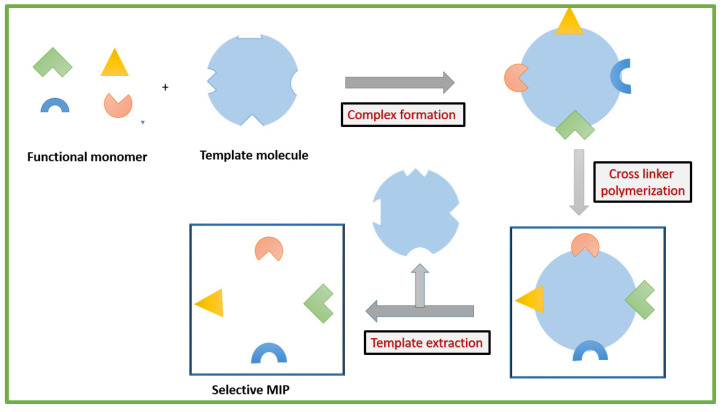
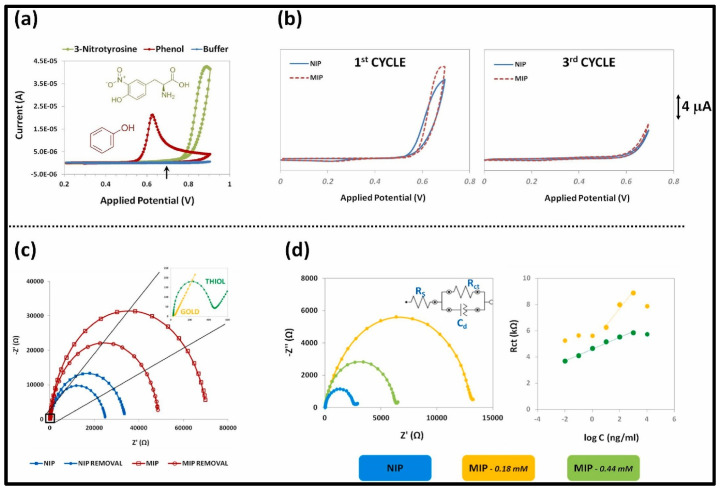
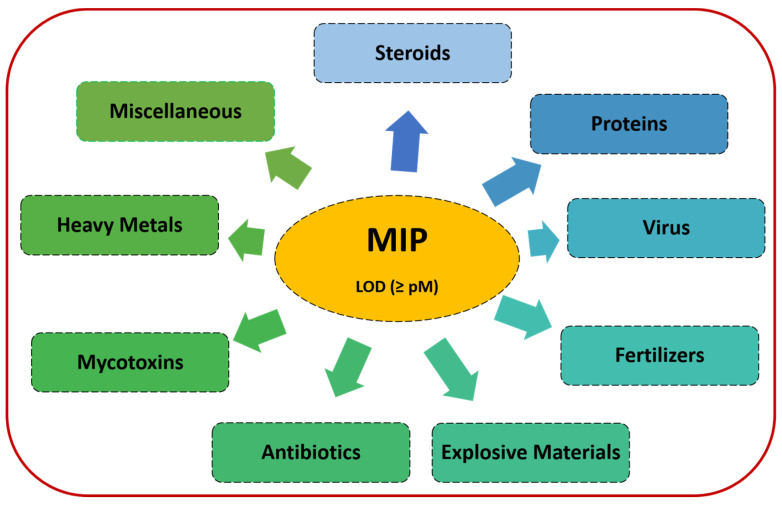
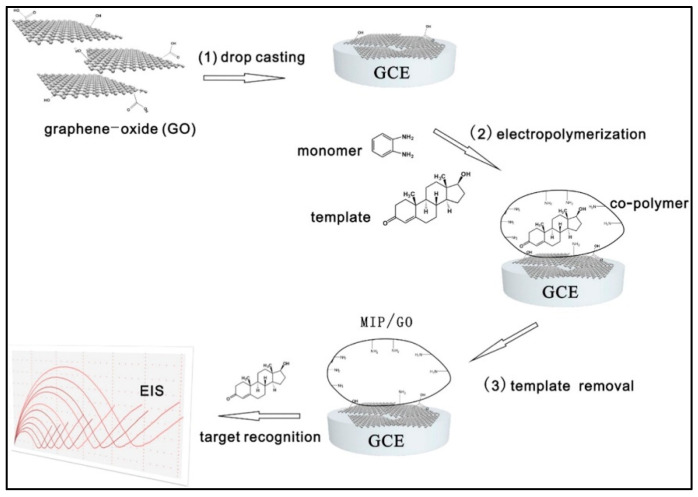
Over the last decades, molecularly imprinted polymers (MIPs) have emerged as selective synthetic receptors that have a selective binding site for specific analytes/target molecules. MIPs are synthetic analogues to the natural biological antigen-antibody system. Owing to the advantages they exhibit, such as high stability, simple synthetic procedure, and cost-effectiveness, MIPs have been widely used as receptors/sensors for the detection and monitoring of a variety of analytes. Moreover, integrating electrochemical sensors with MIPs offers a promising approach and demonstrates greater potential over traditional MIPs. In this review, we have compiled the methods and techniques for the production of MIP-based electrochemical sensors along with the applications of reported MIP sensors for a variety of analytes. A comprehensive in-depth analysis of recent trends reported on picomolar (pM/10 M)) and beyond picomolar concentration LOD (≥pM) achieved using MIPs sensors is reported. Finally, we discuss the challenges faced and put forward future perspectives along with our conclusion.
在过去的几十年中,分子印迹聚合物(MIP)作为选择性合成受体已经出现,它们具有针对特定分析物/靶分子的选择性结合位点。MIP 是天然生物抗原-抗体系统的合成类似物。由于它们具有高稳定性、简单的合成程序和成本效益等优点,MIP 已被广泛用作各种分析物的检测和监测的受体/传感器。此外,将电化学传感器与 MIP 集成提供了一种很有前途的方法,并展示了比传统 MIP 更大的潜力。在这篇综述中,我们总结了基于 MIP 的电化学传感器的生产方法和技术,以及报道的 MIP 传感器在各种分析物中的应用。我们对使用 MIP 传感器实现的纳摩尔(pM/10 M)及更高纳摩尔浓度检测限(≥pM)的最新趋势进行了全面深入的分析。最后,我们讨论了面临的挑战,并提出了未来的展望和结论。