Otterbring Tobias, Bhatnagar Roopali
University of Agder, School of Business and Law, Department of Management, Universitetsveien 17, 4630 Kristiansand, Norway.
Institute of Retail Economics, Regeringsgatan 60, 103 29 Stockholm, Sweden.
Food Qual Prefer. 2022 Apr;97:104461. doi: 10.1016/j.foodqual.2021.104461. Epub 2021 Nov 11.
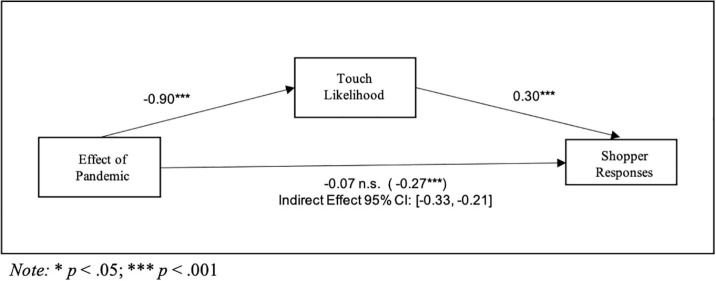
The COVID-19 pandemic has influenced consumer behavior in numerous ways. Most of the public health measures have centered around minimizing social contact and physical touch. In the present study, we investigate the impact of such touch restrictions, introduced during the pandemic, on consumers' shopping responses and payment preferences in the context of a perishable food category amenable to tactile evaluation (fresh fruits and vegetables). The study used a single-factor between-subjects design (during vs. before the COVID-19 pandemic), with the data collected in a scenario-based online experiment from a sample of 729 participants. The results revealed significantly less favorable shopping responses during (vs. before) the pandemic in terms of purchase likelihood, satisfaction levels, and purchase confidence. Touch likelihood mediated the link between pandemic condition and shopping responses, such that participants in the pandemic condition reported a significantly lower touch likelihood of fresh fruits and vegetables than their counterparts in the pre-pandemic condition, which ultimately resulted in less favorable shopping responses. Participants in the pandemic condition also reported a decreased preference for tangible payment options (cash), with a corresponding increase in preferences for contactless payment methods (credit card or mobile payment). These findings contribute to our understanding of whether and how tactile aspects may influence consumers' shopping responses, offering important implications for retailers and people working in the food industry.
新冠疫情在诸多方面影响了消费者行为。大多数公共卫生措施都围绕着尽量减少社交接触和身体触碰展开。在本研究中,我们调查了疫情期间实施的此类触碰限制,在易腐食品类别(新鲜水果和蔬菜)适合触觉评估的背景下,对消费者购物反应和支付偏好的影响。该研究采用单因素被试间设计(新冠疫情期间与疫情之前),数据通过基于情景的在线实验收集,样本为729名参与者。结果显示,在购买可能性、满意度和购买信心方面,疫情期间(与疫情之前相比)的购物反应明显更不理想。触碰可能性介导了疫情状况与购物反应之间的联系,即疫情期间的参与者报告称,与疫情前的参与者相比,他们触碰新鲜水果和蔬菜的可能性显著降低,这最终导致了不太理想的购物反应。疫情期间的参与者还报告说,他们对有形支付方式(现金)的偏好降低,对非接触式支付方式(信用卡或移动支付)的偏好相应增加。这些发现有助于我们理解触觉因素是否以及如何影响消费者的购物反应,为零售商和食品行业从业者提供了重要启示。