Dr Rajendra Prasad Centre for Ophthalmic Sciences, All India Institute of Medical Sciences, New Delhi, India.
Indian J Ophthalmol. 2023 Jan;71(1):222-228. doi: 10.4103/ijo.IJO_1685_22.
To observe the photoreceptor anomalies in cases of ametropic amblyopia.
A prospective study with 25 isoametropic amblyopic children in the age group of 5-14 years and 25 age-matched controls was done. Examination included refraction, best-corrected visual acuity (BCVA), and color vision. Adaptive optics (AO) and multifocal electroretinogram (mf-ERG) were done to assess the anatomy and function of photoreceptors. The subgroup analysis of the improved and non-improved groups was done.
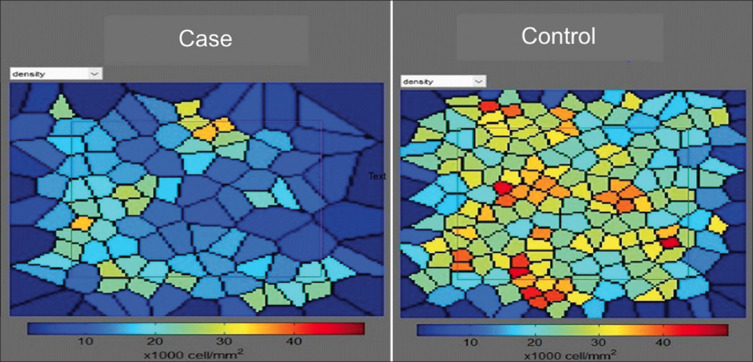
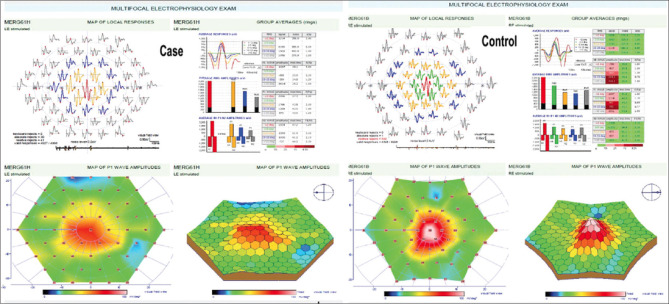
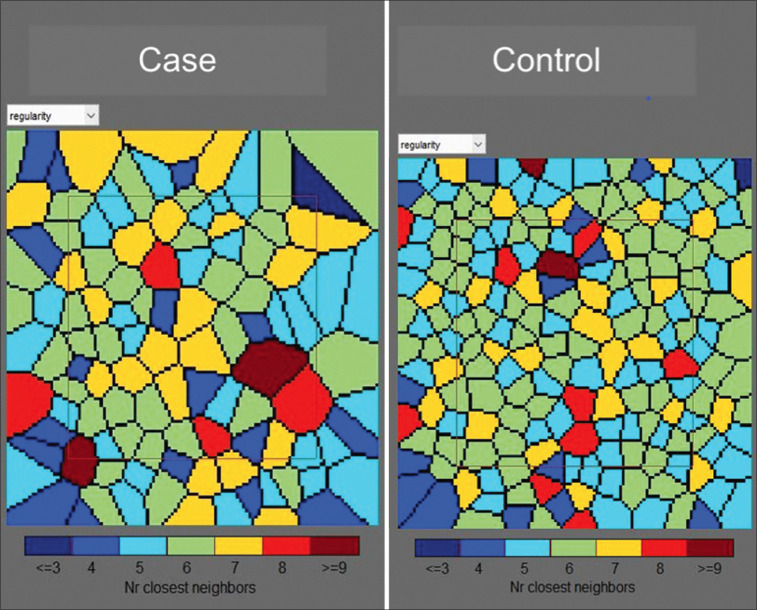
The mean cone density in cases and control in the superior, temporal, and nasal quadrants was respectively as follows (21640 ± 5713, 24040 ± 3386, P = 0.01) (19755 ± 6282, 21832 ± 2911, P = 0.03) (19897 ± 5418, 22171 ± 3660, P = 0.01) (20768 ± 4799, 22819 ± 3241, P = 0.01). The amplitude of N1 wave and P1 wave in cases was significantly low compared to the controls. Cases with subnormal color vision had reduced BCVA (0.55 ± 0.018) in comparison to the children with normal response (0.350 ± 0.014). Cone density was also significantly reduced in children with subnormal color vision. Sixteen out of 25 cases showed BCVA improvement with spectacles. Baseline cone density was found to be significantly higher in the improved group. There was no correlation between BCVA and AO parameters.
Patients with ametropic amblyopia show subnormal photoreceptor properties than controls. Low cone density may be associated with defective color vision and poor prognosis in these cases.
观察屈光不正性弱视患者的光感受器异常。
对 25 名年龄在 5-14 岁的屈光不正性弱视儿童和 25 名年龄匹配的对照者进行前瞻性研究。检查包括屈光、最佳矫正视力(BCVA)和色觉。采用自适应光学(AO)和多焦视网膜电图(mf-ERG)评估光感受器的解剖和功能。对改善组和未改善组进行亚组分析。
病例组和对照组上方、颞侧和鼻侧视锥细胞密度分别为(21640±5713)个/mm²、(24040±3386)个/mm²(P=0.01)、(19755±6282)个/mm²、(21832±2911)个/mm²(P=0.03)、(19897±5418)个/mm²、(22171±3660)个/mm²(P=0.01)、(20768±4799)个/mm²、(22819±3241)个/mm²(P=0.01)。与对照组相比,病例组 N1 波和 P1 波振幅明显降低。与正常反应的儿童相比,色觉异常的儿童 BCVA(0.55±0.018)降低(0.350±0.014)。色觉异常的儿童视锥细胞密度也明显降低。25 例中有 16 例经眼镜矫正后视力提高。改善组的基线视锥细胞密度明显较高。BCVA 与 AO 参数之间无相关性。
屈光不正性弱视患者的光感受器特性低于对照组。低视锥细胞密度可能与这些病例的色觉缺陷和预后不良有关。