Chow Po-Ming, Chuang Yao-Chi, Hsu Karina Chin Po, Shen Yuan-Chi, Liu Shih-Ping
Department of Urology, National Taiwan University Hospital and College of Medicine, Taipei, Taiwan.
Department of Urology, Kaohsiung Chang Gung Memorial Hospital, Chang Gung University College of Medicine, Kaohsiung, Taiwan.
Int J Womens Health. 2022 Dec 28;14:1871-1880. doi: 10.2147/IJWH.S383651. eCollection 2022.
Stress urinary incontinence (SUI) is common among adult women with negative effects on psychosocial well-being, mental health, and health-related quality of life. The purpose of the research is to determine if SUI in women is a factor implicated in changes in health-related quality of life (HRQoL) in both physical and mental health domains and in work difficulties.
Data of women 40 years or older from a cross-sectional, population-based, internet survey were examined post-hoc. The effect of SUI frequency on HRQoL (SF12 score), in physical and mental health domains, was assessed. In addition, multivariate and univariate analyses were used to show the influence of SUI on HADS (Hospital Anxiety and Depression Scale) depression score and HADS anxiety score. The effects of demographic factors and physical ailments and SUI on work difficulties were similarly analyzed using multivariate logistic regression.
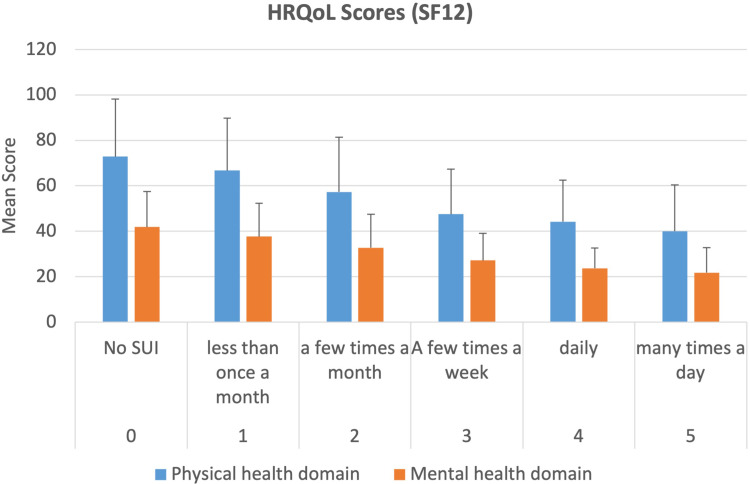
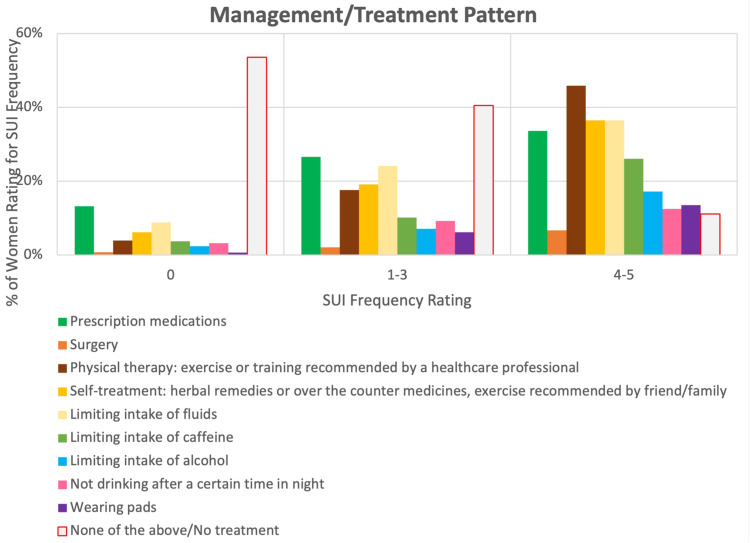
A total of 4208 women with mean age of 60 were included in the analysis. The more frequent SUI episodes were associated with a greater reduction of HRQoL in both physical and mental health domains. In addition, both multivariate and univariate analyses showed that SUI could be correlated with a negative effect on HADS anxiety score (OR 1.617, CI 1.335-1.958, =0.000) and HADS depression score (OR 1.263, CI 1.044-1.527, =0.016). Univariate analyses suggested that work difficulties were correlated with SUI. Available data revealed that many sufferers, including up to 40% of individuals with SUI frequency rating 1 (less than once a month) to 3 (a few times a week), failed to seek treatment.
SUI, common in women ≥40 years of age, impairs quality of life in both physical and mental health domains. SUI is an independent risk factor for anxiety and depression and has been linked to significant work dysfunctions.
This study is registered at ClinicalTrials.gov: NCT02618421 (Date of registration: December 1, 2015).
压力性尿失禁(SUI)在成年女性中很常见,会对心理社会幸福感、心理健康及健康相关生活质量产生负面影响。本研究的目的是确定女性的SUI是否是影响身心健康领域的健康相关生活质量(HRQoL)变化及工作困难的一个因素。
对一项基于人群的横断面互联网调查中40岁及以上女性的数据进行事后分析。评估SUI频率对身心健康领域HRQoL(SF12评分)的影响。此外,使用多变量和单变量分析来显示SUI对医院焦虑抑郁量表(HADS)抑郁评分和HADS焦虑评分的影响。使用多变量逻辑回归类似地分析人口统计学因素、身体疾病和SUI对工作困难的影响。
共有4208名平均年龄为60岁的女性纳入分析。SUI发作越频繁,身心健康领域的HRQoL下降幅度越大。此外,多变量和单变量分析均显示,SUI可能与HADS焦虑评分(OR 1.617,CI 1.335 - 1.958,P = 0.000)和HADS抑郁评分(OR 1.263,CI 1.044 - 1.527,P = 0.016)的负面影响相关。单变量分析表明工作困难与SUI相关。现有数据显示,许多患者,包括高达40%的SUI频率评分为1(每月少于一次)至3(每周几次)的个体,未寻求治疗。
SUI在40岁及以上女性中很常见,会损害身心健康领域的生活质量。SUI是焦虑和抑郁的独立危险因素,并与严重的工作功能障碍有关。
本研究已在ClinicalTrials.gov注册:NCT02618421(注册日期:2015年12月1日)。