Institute of Environmental Medicine, Karolinska Institutet, Stockholm, Sweden.
Center for Occupational and Environmental Medicine, Region Stockholm, Stockholm, Sweden.
Environ Health Perspect. 2023 Jan;131(1):17003. doi: 10.1289/EHP10745. Epub 2023 Jan 6.
Transportation noise may induce cardiovascular disease, but the public health implications are unclear.
The study aimed to assess exposure-response relationships for different transportation noise sources and ischemic heart disease (IHD), including subtypes.
Pooled analyses were performed of nine cohorts from Denmark and Sweden, together including 132,801 subjects. Time-weighted long-term exposure to road, railway, and aircraft noise, as well as air pollution, was estimated based on residential histories. Hazard ratios (HRs) were calculated using Cox proportional hazards models following adjustment for lifestyle and socioeconomic risk factors.
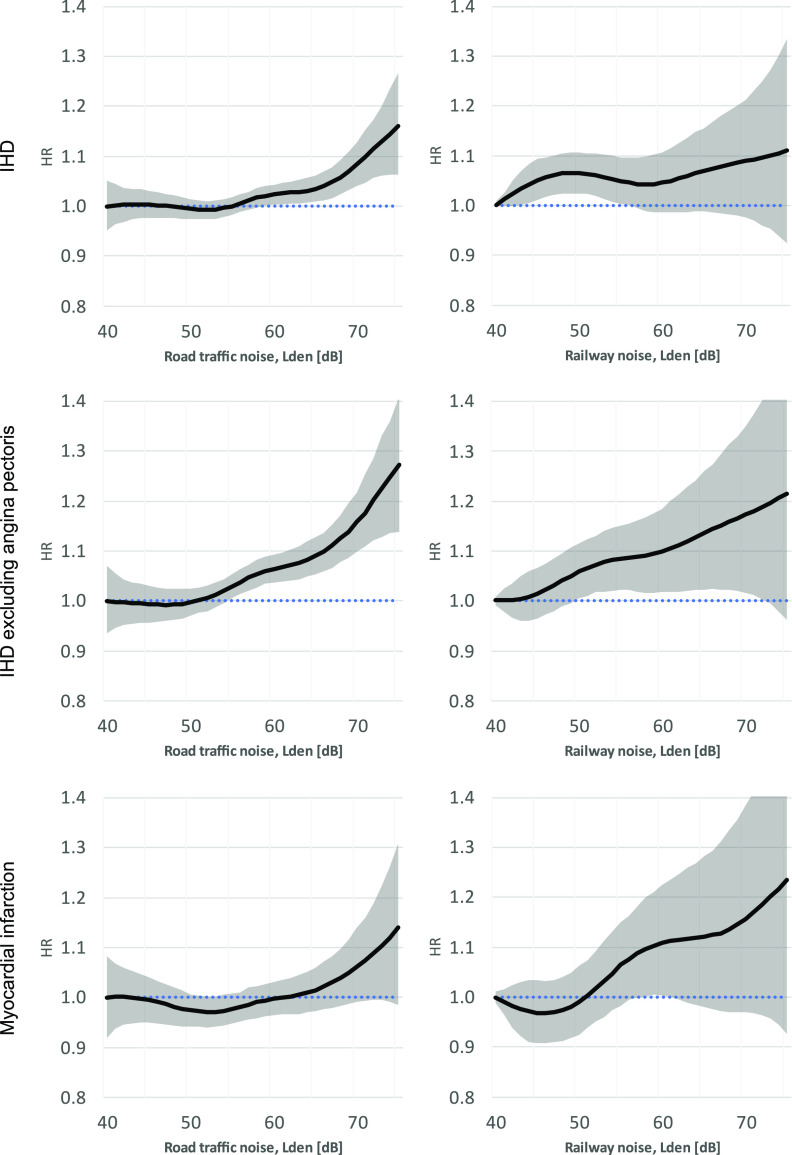
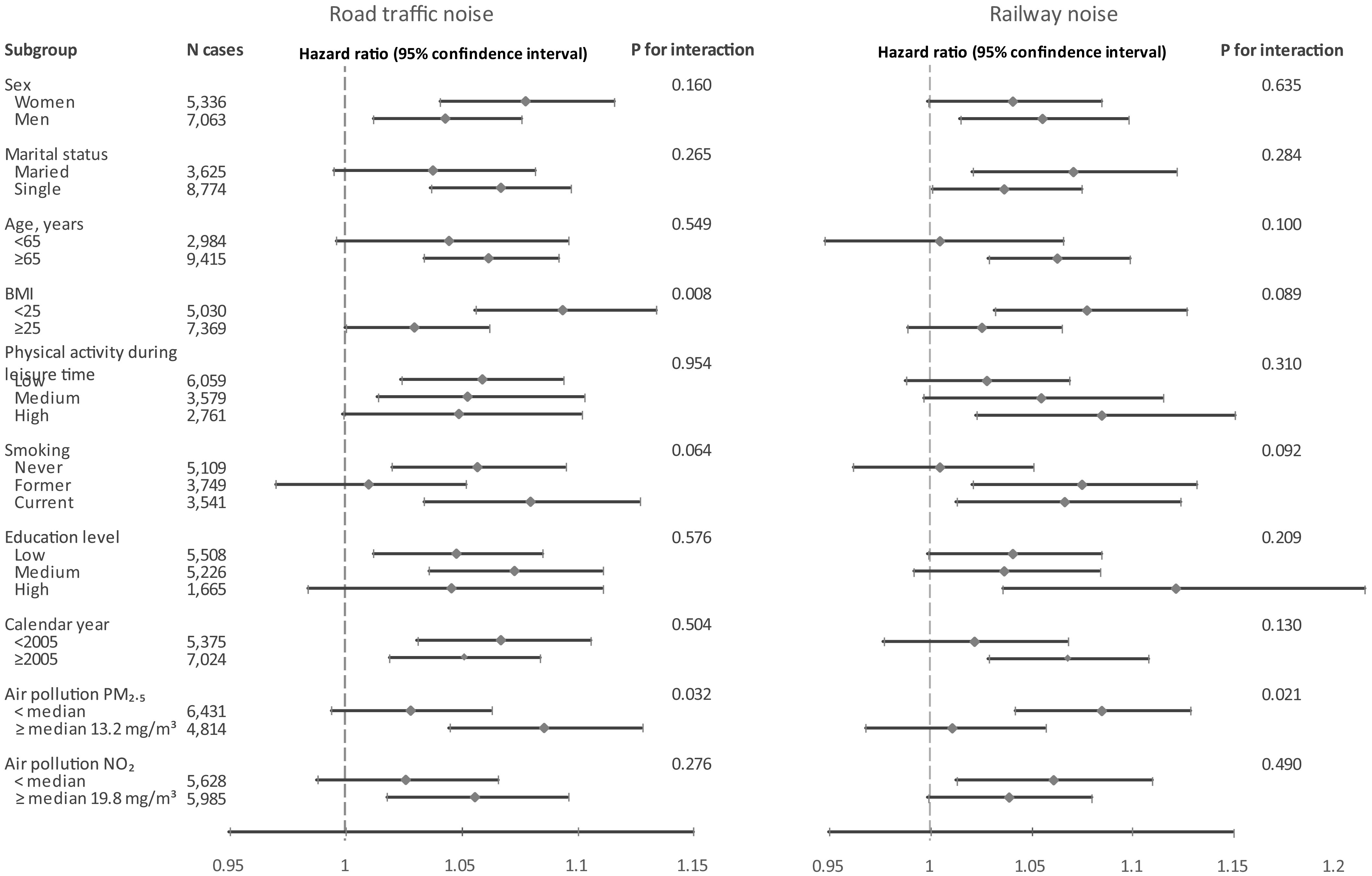
A total of 22,459 incident cases of IHD were identified during follow-up from national patient and mortality registers, including 7,682 cases of myocardial infarction. The adjusted HR for IHD was 1.03 [95% confidence interval (CI) 1.00, 1.05] per 10 dB for both road and railway noise exposure during 5 y prior to the event. Higher risks were indicated for IHD excluding angina pectoris cases, with HRs of 1.06 (95% CI: 1.03, 1.08) and 1.05 (95% CI: 1.01, 1.08) per 10 dB for road and railway noise, respectively. Corresponding HRs for myocardial infarction were 1.02 (95% CI: 0.99, 1.05) and 1.04 (95% CI: 0.99, 1.08). Increased risks were observed for aircraft noise but without clear exposure-response relations. A threshold at around 55 dB was suggested in the exposure-response relation for road traffic noise and IHD.
Exposure to road, railway, and aircraft noise in the prior 5 y was associated with an increased risk of IHD, particularly after exclusion of angina pectoris cases, which are less well identified in the registries. https://doi.org/10.1289/EHP10745.
交通噪声可能会引发心血管疾病,但公众健康的影响尚不清楚。
本研究旨在评估不同交通噪声源与缺血性心脏病(IHD),包括其亚型之间的暴露-反应关系。
对来自丹麦和瑞典的 9 个队列进行了汇总分析,共纳入 132801 名受试者。根据居住史,估算了道路、铁路和飞机噪声以及空气污染的长期时间加权暴露量。使用 Cox 比例风险模型计算风险比(HR),并在调整生活方式和社会经济风险因素后进行分析。
从国家患者和死亡率登记处随访期间共确定了 22459 例 IHD 事件,包括 7682 例心肌梗死。在事件发生前 5 年内,道路和铁路噪声每增加 10dB,IHD 的调整后 HR 分别为 1.03(95%CI:1.00,1.05)和 1.03(95%CI:1.00,1.05)。排除心绞痛病例后,IHD 风险更高,道路和铁路噪声的 HR 分别为 1.06(95%CI:1.03,1.08)和 1.05(95%CI:1.01,1.08)。心肌梗死的相应 HR 分别为 1.02(95%CI:0.99,1.05)和 1.04(95%CI:0.99,1.08)。飞机噪声的风险也有所增加,但没有明确的暴露-反应关系。在道路交通噪声与 IHD 的暴露-反应关系中,大约 55dB 的阈值被认为是一个转折点。
在过去 5 年中,接触道路、铁路和飞机噪声与 IHD 风险增加有关,尤其是在排除了在登记处中不太明确的心绞痛病例后。https://doi.org/10.1289/EHP10745.