Institute of Earth Resources, Faculty of Mining, Ecology, Process Control and Geotechnologies, Technical University of Košice, Košice, Slovakia.
Center for Applied Economic Research, Faculty of Management and Economics, Tomas Bata University in Zlín, Zlín, Czechia.
Front Public Health. 2022 Dec 21;10:1036058. doi: 10.3389/fpubh.2022.1036058. eCollection 2022.
Population health is one of the highest priorities for countries, which can translate into increased economic prosperity. This encourages research on health in an economic context.
The objective was to assess the relationships between health spending, treatable respiratory mortality, and gross domestic product (GDP) in countries of the Organization for Economic Co-operation and Development (OECD). The research was conducted with respect to health systems (tax-based, insurance-based) and gender differentiation of the productive population (aged 25-64 years). Descriptive analysis, regression analysis, and cluster analysis were used to achieve the main objective. The data covered the period from 1994 to 2016.
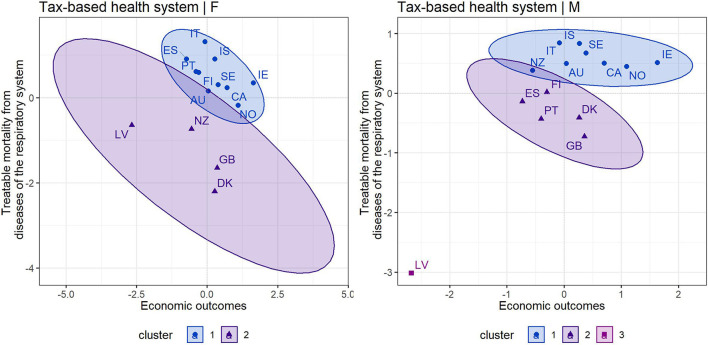
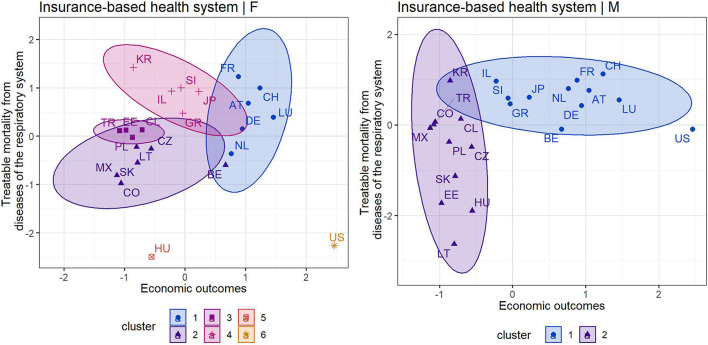
The results of the regression analysis revealed negative relationships between health spending and treatable respiratory mortality in countries with a tax-based health system for male and female working-age populations, as well as in countries with an insurance-based health system for male population. This means that higher health spending was associated with lower treatable respiratory mortality. Also, lower treatable mortality was associated with higher GDP, especially in the male productive population from countries with an insurance-based health system. In this study, countries with a tax-based health system were characterized by higher health spending, lower rates of treatable mortality from respiratory system diseases, and higher GDP compared to countries with an insurance-based health system. Males reported a higher mortality rate than females. Among the countries with a tax-based health system, the United Kingdom and Latvia showed less positive outcomes, while Italy and Iceland were the countries with the most positive outcomes. Among the countries with an insurance-based health system, Hungary and Slovakia reported poor outcomes, while France, Switzerland and Luxembourg were characterized by very positive outcomes. The United States showed a high mortality rate despite its high economic outcomes, i.e., health spending and GDP.
Health care financing in particular is one of the instruments of health policy. It seems that the leaders of countries should ensure a sufficient level of health financing, as higher health spending can contribute to lower mortality rates in a country. This may translate into higher productivity. Especially countries with underfunded health systems should increase their health spending.
人口健康是各国的首要任务之一,这可以转化为经济繁荣的提高。这鼓励了经济背景下的健康研究。
本研究旨在评估经合组织(OECD)国家的卫生支出、可治疗呼吸死亡率和国内生产总值(GDP)之间的关系。该研究考虑了卫生系统(基于税收、基于保险)和劳动年龄人口(25-64 岁)的性别差异。使用描述性分析、回归分析和聚类分析来实现主要目标。数据涵盖了 1994 年至 2016 年期间。
回归分析的结果表明,在男性和女性劳动年龄人口实行基于税收的卫生系统的国家,以及在男性人口实行基于保险的卫生系统的国家,卫生支出与可治疗呼吸死亡率之间存在负相关关系。这意味着较高的卫生支出与较低的可治疗呼吸死亡率相关。此外,可治疗死亡率越低,与 GDP 越高相关,尤其是在实行基于保险的卫生系统的男性劳动年龄人口国家。在这项研究中,实行基于税收的卫生系统的国家的特点是卫生支出较高、呼吸系统疾病可治疗死亡率较低以及 GDP 较高,与实行基于保险的卫生系统的国家相比。男性的死亡率高于女性。在实行基于税收的卫生系统的国家中,英国和拉脱维亚的结果不太积极,而意大利和冰岛的结果则最积极。在实行基于保险的卫生系统的国家中,匈牙利和斯洛伐克的结果较差,而法国、瑞士和卢森堡的结果则非常积极。尽管美国的经济产出(即卫生支出和 GDP)较高,但仍存在高死亡率。
特别是医疗保健融资是卫生政策的工具之一。看来,各国领导人应确保有足够的卫生融资水平,因为较高的卫生支出可以有助于降低一个国家的死亡率。这可能转化为更高的生产力。特别是资金不足的卫生系统国家应增加其卫生支出。