National Center for Chronic and Noncommunicable Disease Control and Prevention, Chinese Center for Disease Control and Prevention, Beijing 100050, China.
National Clinical Research Center for Cardiovascular Diseases, Heart Failure Ward, Fuwai Hospital Chinese Academy of Medical Sciences, Shenzhen, Guangdong Province, China.
BMJ. 2023 Jan 11;380:e071952. doi: 10.1136/bmj-2022-071952.
To assess the recent trends in prevalence and management of hypertension in China, nationally and by population subgroups.
Six rounds of a national survey, China.
China Chronic Disease and Risk Factors Surveillance, 2004-18.
642 523 community dwelling adults aged 18-69 years (30 501 in 2004, 47 353 in 2007, 90 491 in 2010, 156 836 in 2013, 162 293 in 2015, and 155 049 in 2018).
Hypertension was defined as a blood pressure of ≥140/90 mm Hg or taking antihypertensive drugs. The main outcome measures were hypertension prevalence and proportion of people with hypertension who were aware of their hypertension, who were treated for hypertension, and whose blood pressure was controlled below 140/90 mm Hg.
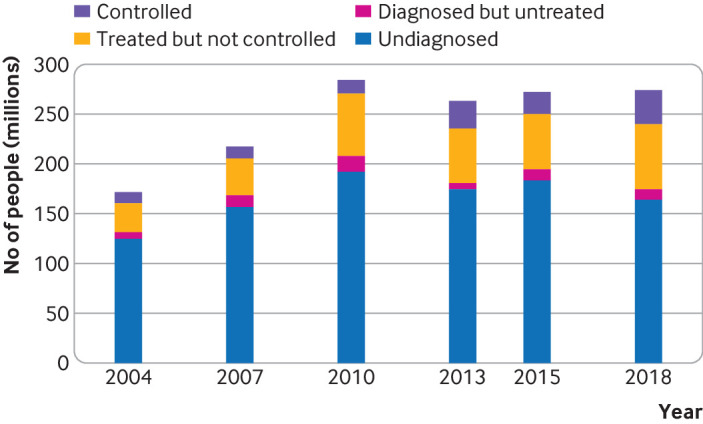
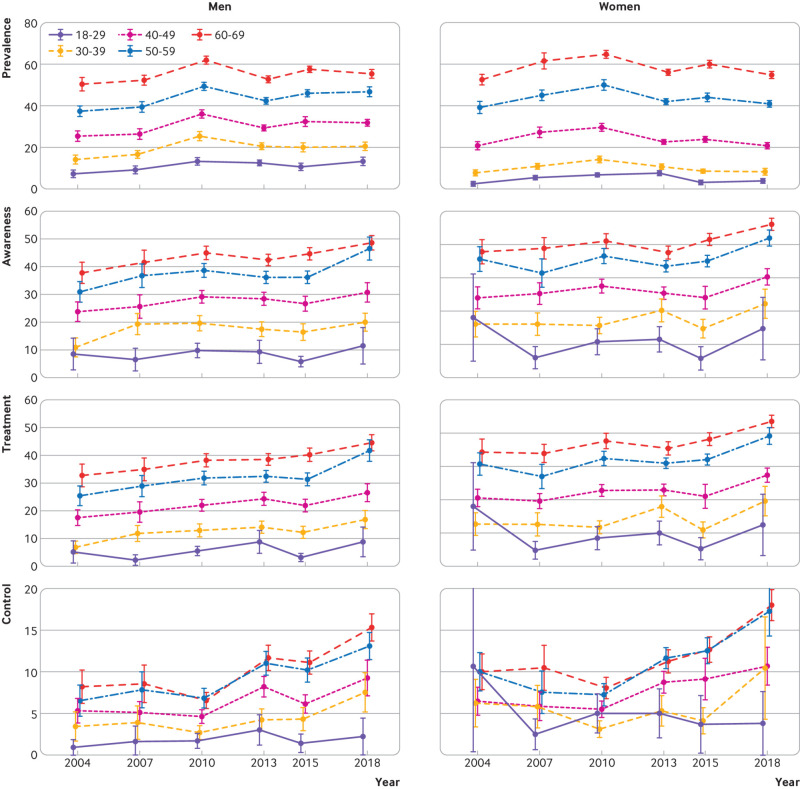
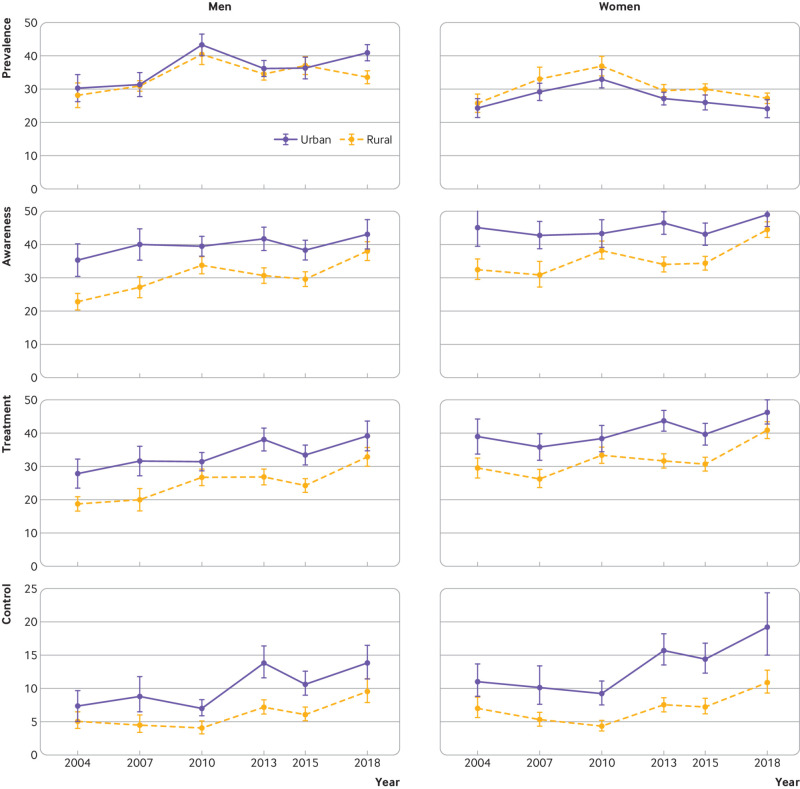
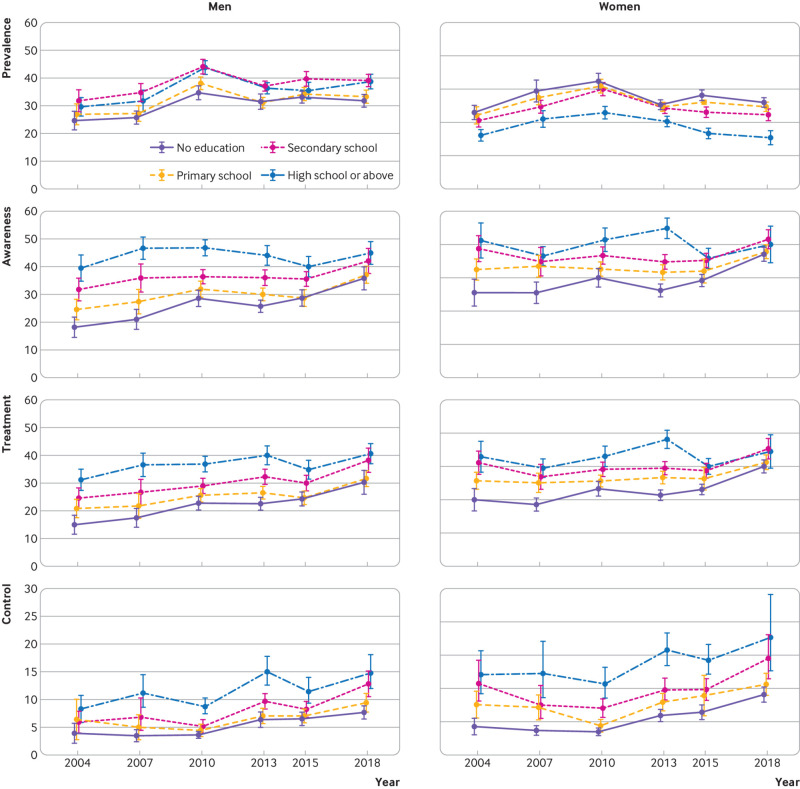
The standardised prevalence of hypertension in adults aged 18-69 years in China increased from 20.8% (95% confidence interval 19.0% to 22.5%) in 2004 to 29.6% (27.8% to 31.3%) in 2010, then decreased to 24.7% (23.2% to 26.1%) in 2018. During 2010-18, the absolute annual decline in prevalence of hypertension among women was more than twice that among men (-0.83 percentage points (95% confidence interval -1.13 to -0.52) -0.40 percentage points (-0.73 to -0.07)). Despite modest improvements in the awareness, treatment, and control of hypertension since 2004, rates remained low in 2018, at 38.3% (36.3% to 40.4%), 34.6% (32.6% to 36.7%), and 12.0% (10.6% to 13.4%). Of 274 million (95% confidence interval 238 to 311 million) adults aged 18-69 years with hypertension in 2018, control was inadequate in an estimated 240 million (215 to 264 million). Across all surveys, women with low educational attainment had higher prevalence of hypertension than those with higher education, but the finding was mixed for men. The gap in hypertension control between urban and rural areas persisted, despite larger improvements in diagnosis and control in rural than in urban areas.
The prevalence of hypertension in China has slightly declined since 2010, but treatment and control remain low. The findings highlight the need for improving detection and treatment of hypertension through the strengthening of primary care in China, especially in rural areas.
评估中国全国范围内及按人群亚组划分的高血压流行趋势和管理情况。
全国性的六轮调查,中国。
中国慢性病及其危险因素监测,2004-2018 年。
642523 名年龄在 18-69 岁的社区居民(2004 年 30501 人,2007 年 47353 人,2010 年 90491 人,2013 年 156836 人,2015 年 162293 人,2018 年 155049 人)。
高血压定义为血压≥140/90mmHg 或正在服用降压药物。主要结局指标为高血压的流行率,以及知晓自己患有高血压、接受高血压治疗以及血压控制在 140/90mmHg 以下的高血压患者的比例。
2004 年至 2010 年期间,18-69 岁成年人的高血压标准化流行率从 20.8%(95%置信区间 19.0%至 22.5%)上升至 29.6%(27.8%至 31.3%),然后在 2018 年下降至 24.7%(23.2%至 26.1%)。2010-2018 年期间,女性高血压患病率的绝对年下降幅度是男性的两倍多(-0.83 个百分点(95%置信区间-1.13 至-0.52)-0.40 个百分点(-0.73 至-0.07))。尽管自 2004 年以来,高血压的知晓率、治疗率和控制率有所提高,但 2018 年的这些比率仍然较低,分别为 38.3%(36.3%至 40.4%)、34.6%(32.6%至 36.7%)和 12.0%(10.6%至 13.4%)。在 2018 年,估计有 2.74 亿(95%置信区间 2.38 亿至 3.11 亿)年龄在 18-69 岁的高血压成年人中,有 2.4 亿(2.15 亿至 2.64 亿)人的血压控制不充分。在所有调查中,受教育程度较低的女性高血压患病率高于受教育程度较高的女性,但男性的情况则较为复杂。城乡之间高血压控制的差距仍然存在,尽管农村地区在诊断和控制方面取得了更大的改善。
自 2010 年以来,中国的高血压流行率略有下降,但治疗和控制情况仍然较低。这些发现强调了需要通过加强中国的基层医疗来提高高血压的检出和治疗水平,尤其是在农村地区。