Jean Mayer USDA Human Nutrition Research Center on Aging at Tufts University, Boston, MA, USA.
Department of Psychiatry and Behavioral Sciences, Emory University, Atlanta, GA, USA.
Neuropsychopharmacology. 2023 May;48(6):929-935. doi: 10.1038/s41386-022-01527-7. Epub 2023 Jan 12.
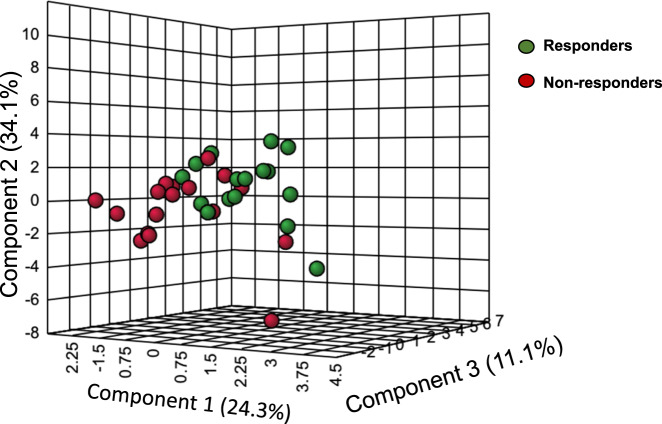
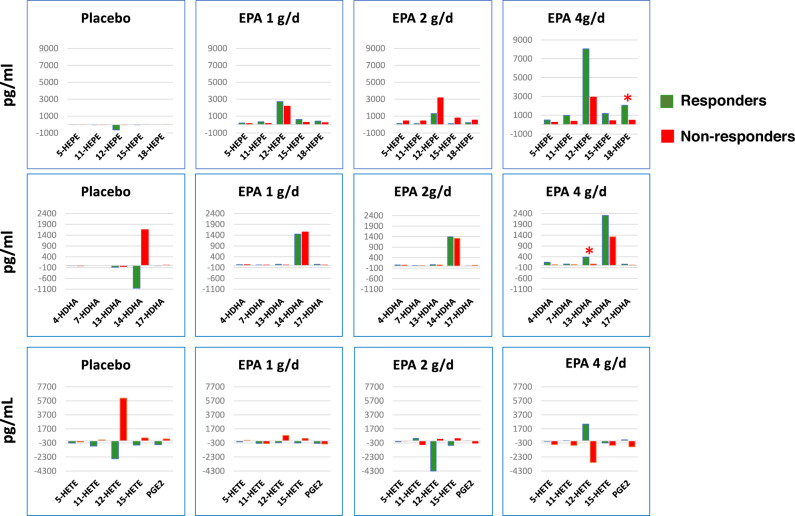
Chronic inflammation has been implicated in the pathophysiology of major depressive disorder (MDD). Activating the resolution of inflammation through ω-3 fatty acid supplementation may prove to be a successful therapeutic strategy for the treatment of MDD. Patients with MDD, body mass index >25 kg/m, and plasma high-sensitivity C-reactive protein ≥3 μg/mL (n = 61) were enrolled in a 12-week randomized trial consisting of 4 parallel arms: EPA 1, 2, and 4 g/d, and placebo. The supplement contained EPA and DHA in a 3.9:1 ratio. Depression symptoms were assessed using the IDS-C30 scale. Plasma fatty acids and pro-resolving lipid mediators (SPMs) were measured in 42 study completers at baseline and at the end of treatment by liquid chromatography/mass spectrometry. The response rate (≥50% reduction in IDS-30 score) was higher in the 4 g/d EPA arm than placebo (Cohen d = 0.53). In the 4 g/d EPA arm, responders had significantly greater increases in 18-hydroxyeicosapentaenoic acid (18-HEPE) and 13-hydroxydocosahexaenoic acid (13-HDHA) than non-responders (p < 0.05). Within the 4 g/d EPA arm, the increase in 18-HEPE was significantly associated with reductions in plasma hs-CRP concentrations (p < 0.05) and IDS-C30 scores (p < 0.01). In summary, response rates were greater among patients with MDD randomized to EPA 4 g/d supplementation and in those who showed a greater ability to activate the synthesis of 18-HEPE. The inverse association of 18-HEPE with both systemic inflammation and symptoms of depression highlights the activation of the resolution of inflammation as a likely mechanism in the treatment of MDD with ω-3 fatty acid supplementation.
慢性炎症与重度抑郁症(MDD)的病理生理学有关。通过ω-3 脂肪酸补充来激活炎症的解决可能被证明是治疗 MDD 的一种成功的治疗策略。在一项为期 12 周的随机试验中,共纳入 61 名 MDD 患者,体重指数(BMI)>25kg/m2 且血浆高敏 C 反应蛋白(hs-CRP)≥3μg/mL,随机分为 4 个平行组:EPA1、2、4g/d 和安慰剂。该补充剂含有 EPA 和 DHA,比例为 3.9:1。使用 IDS-C30 量表评估抑郁症状。在 42 名完成研究的患者中,通过液相色谱/质谱法在基线和治疗结束时测量血浆脂肪酸和促解决脂质介质(SPM)。4g/d EPA 组的应答率(IDS-30 评分降低≥50%)高于安慰剂组(Cohen d=0.53)。在 4g/d EPA 组中,应答者的 18-羟基二十碳五烯酸(18-HEPE)和 13-羟基二十二碳六烯酸(13-HDHA)的增加明显大于无应答者(p<0.05)。在 4g/d EPA 组中,18-HEPE 的增加与血浆 hs-CRP 浓度的降低(p<0.05)和 IDS-C30 评分的降低(p<0.01)显著相关。总之,在随机接受 EPA 4g/d 补充的 MDD 患者和那些表现出更大激活 18-HEPE 合成能力的患者中,应答率更高。18-HEPE 与全身炎症和抑郁症状的负相关突出了激活炎症解决作为ω-3 脂肪酸补充治疗 MDD 的可能机制。