Del Re Dominic P
Cell Biology and Molecular Medicine, Cardiovascular Research Institute, Rutgers New Jersey Medical School, Newark, NJ 07103.
Curr Opin Physiol. 2022 Apr;26. doi: 10.1016/j.cophys.2022.100492. Epub 2022 Apr 29.
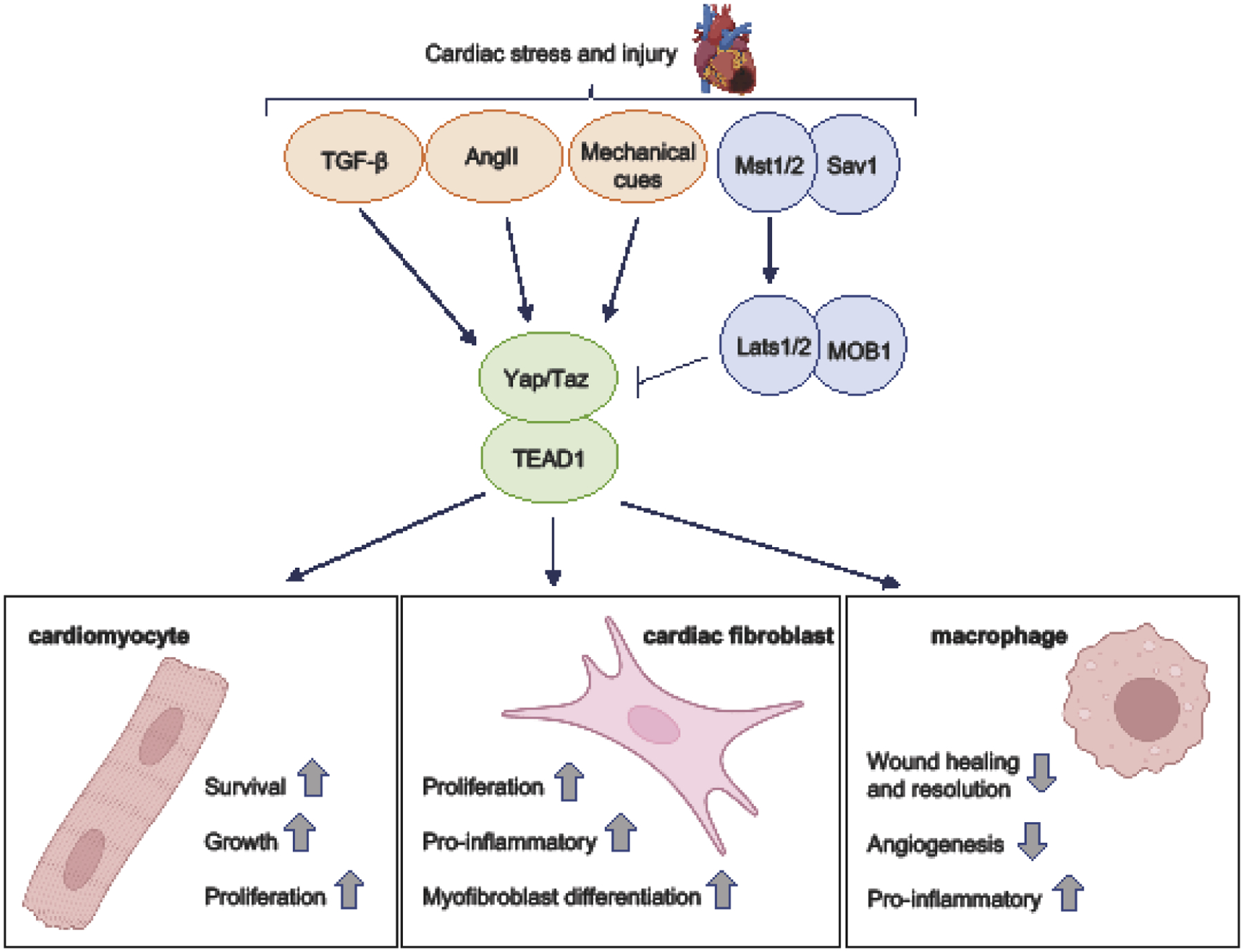
Cardiac injury initiates a tissue remodeling process in which aberrant fibrosis plays a significant part, contributing to impaired contractility of the myocardium and the progression to heart failure. Fibrotic remodeling is characterized by the activation, proliferation, and differentiation of quiescent fibroblasts to myofibroblasts, and the resulting effects on the extracellular matrix and inflammatory milieu. Molecular mechanisms underlying fibroblast fate decisions and subsequent cardiac fibrosis are complex and remain incompletely understood. Emerging evidence has implicated the Hippo-Yap signaling pathway, originally discovered as a fundamental regulator of organ size, as an important mechanism that modulates fibroblast activity and adverse remodeling in the heart, while also exerting distinct cell type-specific functions that dictate opposing outcomes on heart failure. This brief review will focus on Hippo-Yap signaling in cardiomyocytes, cardiac fibroblasts, and other non-myocytes, and present mechanisms by which it may influence the course of cardiac fibrosis and dysfunction.
心脏损伤会引发组织重塑过程,其中异常纤维化起重要作用,导致心肌收缩力受损并进展为心力衰竭。纤维化重塑的特征是静止的成纤维细胞激活、增殖并分化为肌成纤维细胞,以及由此对细胞外基质和炎症环境产生的影响。成纤维细胞命运决定及随后心脏纤维化的分子机制复杂,仍未完全明确。新出现的证据表明,最初作为器官大小基本调节因子被发现的Hippo-Yap信号通路,是调节心脏成纤维细胞活性和不良重塑的重要机制,同时还发挥着独特的细胞类型特异性功能,对心力衰竭产生相反的影响。本简要综述将聚焦于心肌细胞、心脏成纤维细胞和其他非心肌细胞中的Hippo-Yap信号通路,并介绍其可能影响心脏纤维化和功能障碍进程的机制。