Department of Molecular Biology, Cell Biology & Biochemistry, Division of Biology and Medicine, Brown University, Providence, RI, 02912, USA.
Center for Computational Biology of Human Disease and Center for Computation and Visualization, Brown University, Providence, RI, 02912, USA.
Nat Commun. 2023 Jan 17;14(1):273. doi: 10.1038/s41467-023-35985-4.
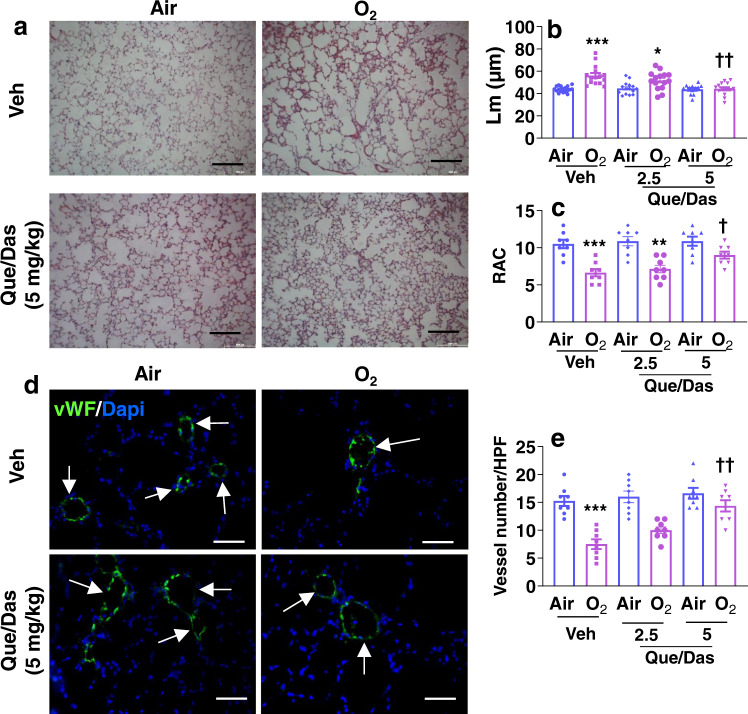
Senescence causes age-related diseases and stress-related injury. Paradoxically, it is also essential for organismal development. Whether senescence contributes to lung development or injury in early life remains unclear. Here, we show that lung senescence occurred at birth and decreased throughout the saccular stage in mice. Reducing senescent cells at this stage disrupted lung development. In mice (<12 h old) exposed to hyperoxia during the saccular stage followed by air recovery until adulthood, lung senescence increased particularly in type II cells and secondary crest myofibroblasts. This peaked during the alveolar stage and was mediated by the p53/p21 pathway. Decreasing senescent cells during the alveolar stage attenuated hyperoxia-induced alveolar and vascular simplification. Conclusively, early programmed senescence orchestrates postnatal lung development whereas later hyperoxia-induced senescence causes lung injury through different mechanisms. This defines the ontogeny of lung senescence and provides an optimal therapeutic window for mitigating neonatal hyperoxic lung injury by inhibiting senescence.
衰老会导致与年龄相关的疾病和与压力相关的损伤。但具有矛盾性的是,衰老是机体发育所必需的。衰老是否会促进肺在生命早期的发育或损伤仍不清楚。在这里,我们发现,衰老细胞在小鼠出生时就出现,并在囊泡期逐渐减少。在这个阶段减少衰老细胞会破坏肺的发育。在囊泡期接受高氧暴露并在成年后恢复空气的小鼠(<12 小时龄)中,肺衰老细胞在 II 型细胞和次级嵴肌成纤维细胞中特别增加。这一现象在肺泡期达到高峰,并由 p53/p21 通路介导。在肺泡期减少衰老细胞可减轻高氧诱导的肺泡和血管简化。总之,早期程序性衰老协调出生后肺的发育,而后期高氧诱导的衰老通过不同的机制导致肺损伤。这定义了肺衰老的个体发生,并为通过抑制衰老来减轻新生儿高氧肺损伤提供了一个最佳的治疗窗。