Environmental Epidemiology and Toxicology Division, National Environment Agency, 11 Biopolis Way #06-05/08, Helios Block, Singapore, 138667, Singapore.
Environmental Monitoring and Modelling Division, National Environment Agency, 40 Scotts Road, #13-00, Singapore, 228231, Singapore.
Sci Rep. 2023 Jan 18;13(1):1001. doi: 10.1038/s41598-022-26184-0.
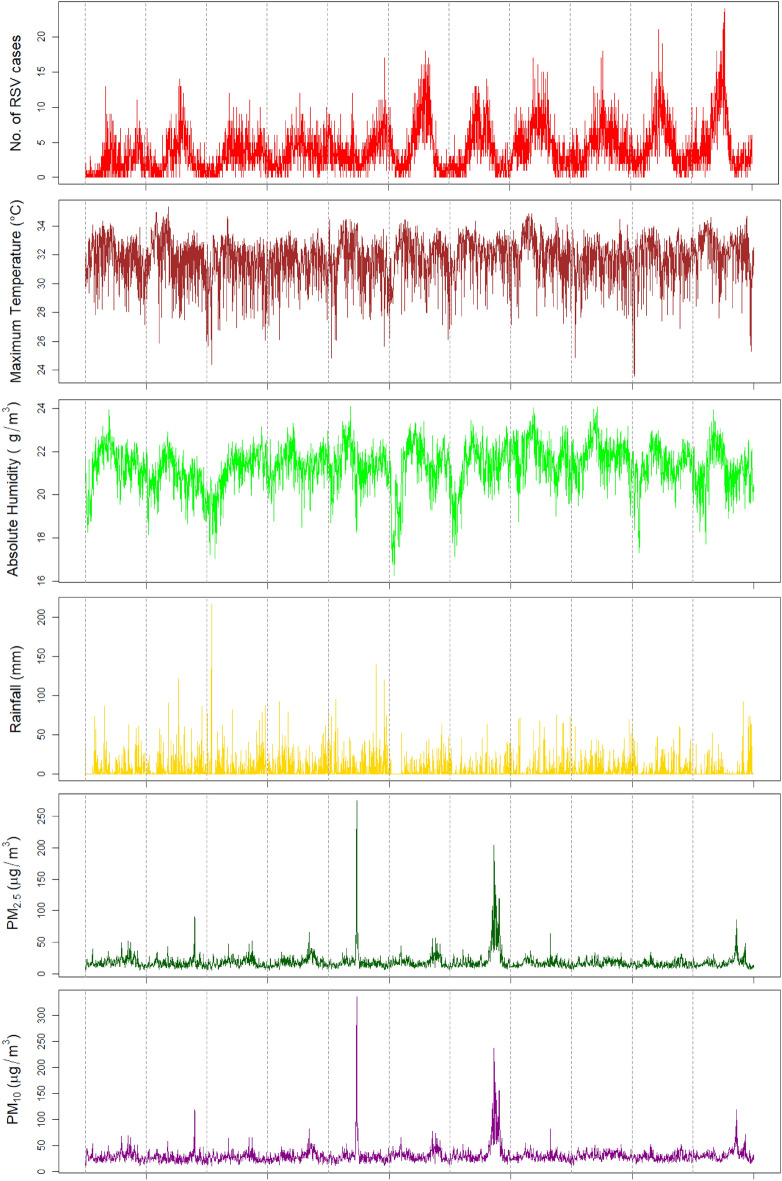
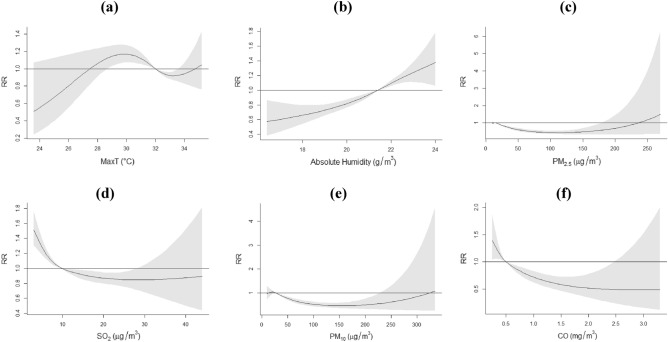
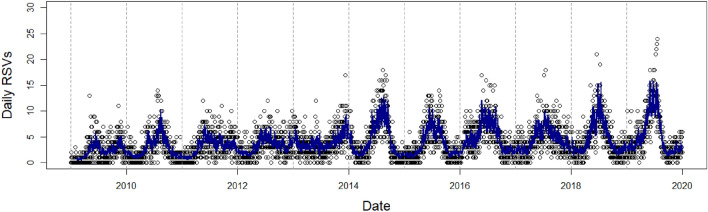
Respiratory syncytial virus (RSV) is an important cause of respiratory illness among children. While studies have focused on the air-quality and climate dependence of RSV infections, few have been undertaken in South-East Asia where the burden of respiratory illness is among the highest across the globe. This study aimed to determine the relationships between climatic factors and air quality with RSV infections among children in Singapore. We obtained all laboratory-confirmed reports of RSV infections in children below 5 years old from the largest public hospital specializing in pediatric healthcare in Singapore. We assessed the independent cumulative effects of air quality and meteorological factors on RSV infection risk using the Distributed Lag Non-Linear Model (DLNM) framework in negative binomial models adjusted for long-term trend, seasonality and changes in the diagnostic systems. We included 15,715 laboratory-confirmed RSV reports from 2009 to 2019. Daily maximum temperature exhibited a complex, non-linear association with RSV infections. Absolute humidity (Relative Risk, 90th percentile [RR]: 1.170, 95% CI: [1.102, 1.242]) was positively associated with RSV risk. Higher levels of particulate matter of aerodynamic diameter of less than (i) 2.5 µm (PM), (ii) 10 µm (PM), carbon monoxide (CO) and sulfur dioxide (SO) were associated with lower RSV infection risk. RSV infections exhibited both annual and within-year seasonality. Our findings suggest that falls in ambient temperature and rises in absolute humidity exacerbated pediatric RSV infection risk while increases in air pollutant concentrations were associated with lowered infection risk. These meteorological factors, together with the predictable seasonality of RSV infections, can inform the timing of mitigation measures aimed at reducing transmission.
呼吸道合胞病毒(RSV)是儿童呼吸道疾病的重要病因。虽然已有研究关注 RSV 感染与空气质量和气候的关系,但在全球呼吸道疾病负担最高的东南亚地区,这方面的研究却很少。本研究旨在确定新加坡儿童呼吸道合胞病毒感染与气候因素和空气质量之间的关系。我们从新加坡最大的专门从事儿科医疗保健的公立医院获取了所有 5 岁以下儿童实验室确诊的 RSV 感染报告。我们使用负二项式模型中的分布滞后非线性模型(DLNM)框架,在调整长期趋势、季节性和诊断系统变化的情况下,评估了空气质量和气象因素对 RSV 感染风险的独立累积效应。我们纳入了 2009 年至 2019 年期间 15715 例实验室确诊的 RSV 报告。每日最高温度与 RSV 感染呈复杂的非线性关系。绝对湿度(相对风险,90 分位数 [RR]:1.170,95%CI:[1.102,1.242])与 RSV 风险呈正相关。较小的空气动力学直径的颗粒物(i)小于 2.5 µm(PM)、(ii)10 µm(PM)、一氧化碳(CO)和二氧化硫(SO)的水平较高与 RSV 感染风险较低相关。RSV 感染具有年度和年内季节性。我们的研究结果表明,环境温度下降和绝对湿度上升加剧了儿科 RSV 感染风险,而空气污染物浓度的增加与感染风险降低有关。这些气象因素以及 RSV 感染可预测的季节性,可以为旨在减少传播的缓解措施的时机提供信息。